
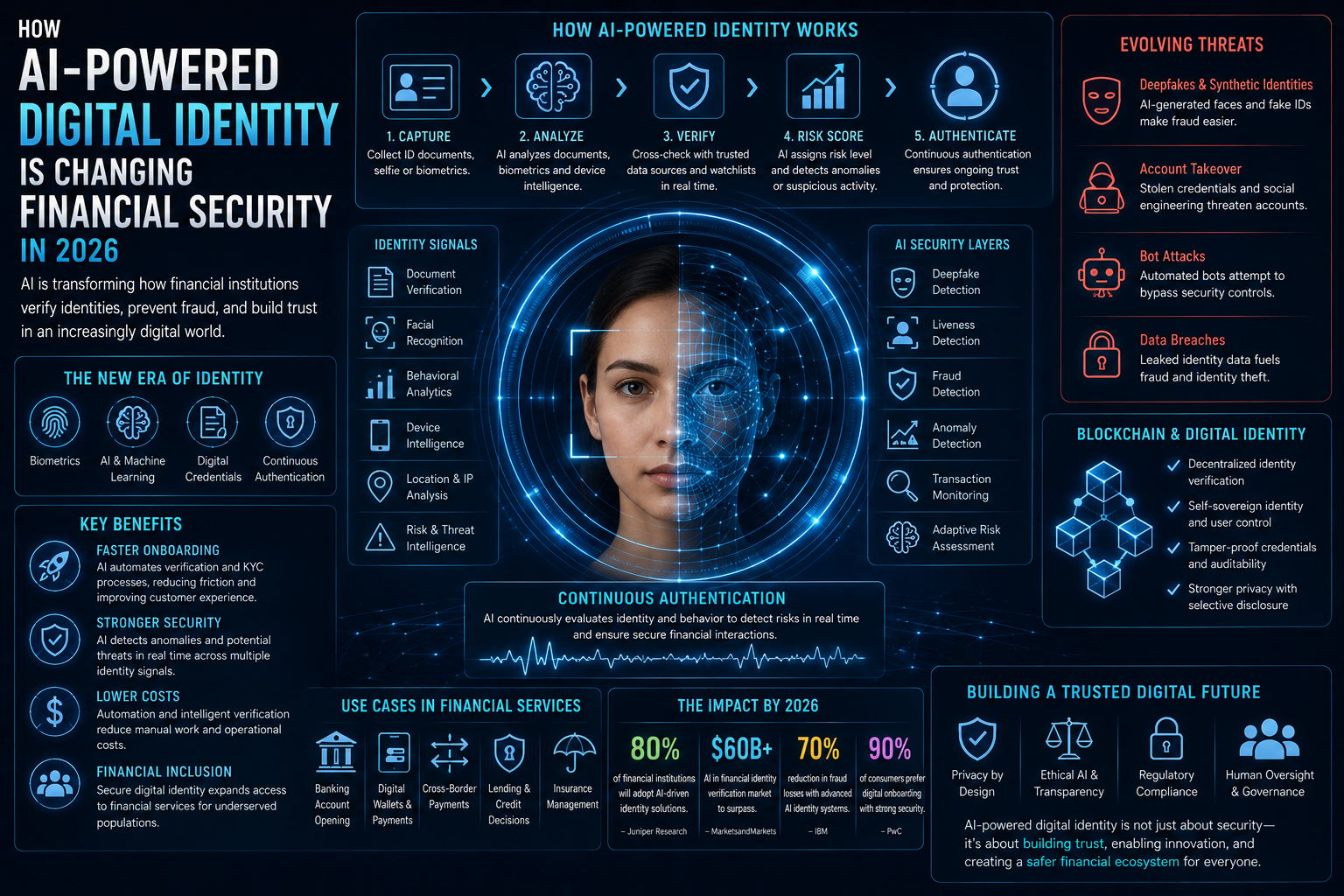
Digital identity is becoming a critical part of modern financial infrastructure. Banks, fintech companies, payment platforms, cryptocurrency businesses, insurers, and online marketplaces increasingly need to establish that customers are genuine while keeping onboarding fast and convenient.
At the same time, fraudsters are using increasingly sophisticated technologies, including synthetic identities, deepfakes, automated social engineering, and stolen credentials.
Artificial intelligence is therefore changing the way organizations verify identity.
Instead of relying only on passwords, scanned documents, or a single biometric check, modern identity systems can combine document verification, biometrics, behavioral analytics, device intelligence, risk scoring, and AI-powered anomaly detection.
A 2026 review of financial identity verification research highlights the growing use of AI in KYC, biometric verification, fraud detection, and risk assessment, while also emphasizing concerns around explainability, bias, privacy, and governance.
The result is a new model of financial security in which identity becomes a continuous process rather than a one-time check.
What Is AI-Powered Digital Identity?
Digital identity is the collection of digital attributes used to establish and authenticate who a person or organization is.
These attributes can include:
Name and personal information
Government-issued identification
Biometric information
Digital credentials
Device information
Authentication history
Behavioral patterns
Account activity
AI can analyze these signals to determine whether an identity appears legitimate and whether current activity is consistent with expected behavior.
This creates a more dynamic approach to identity verification.
Instead of asking only “Who is this person?”, financial institutions can increasingly ask:
“Is this person really who they claim to be, and does their current behavior make sense?”
Why Digital Identity Matters for Finance
Financial institutions need to establish customer identities for security and regulatory reasons.
Know Your Customer (KYC) and customer due-diligence processes are particularly important when opening accounts and providing financial services.
The Financial Action Task Force has recognized that reliable digital ID can make identification easier, cheaper, and more secure while supporting customer due diligence and financial inclusion.
Digital identity can therefore serve two purposes simultaneously:
security and accessibility.
Customers can potentially open accounts remotely while financial institutions gain better tools for managing identity-related risks.
AI-Powered KYC
KYC processes have traditionally required employees or automated systems to review identification documents and customer information.
AI can automate many parts of this workflow.
A digital onboarding system can potentially:
Capture an identity document.
Extract relevant information.
Check document characteristics.
Compare the document with a selfie or biometric signal.
Analyze device and behavioral information.
Screen the customer against relevant risk databases.
Assign a risk level.
Route unusual cases for human review.
This can make onboarding faster while allowing financial institutions to focus human resources on higher-risk cases.
The Rise of Biometric Authentication
Biometrics can provide another layer of digital identity.
Financial applications may use:
Facial recognition
Fingerprints
Voice recognition
Behavioral biometrics
Device-based authentication
AI can analyze biometric signals and compare them with previously verified identity information.
However, biometrics should not be treated as an infallible security mechanism.
Generative AI has created new challenges for facial and voice verification, particularly through synthetic media and deepfakes. Recent research specifically identifies deepfake-enabled impersonation as a growing concern for financial identity systems.
Deepfakes Are Changing the Threat Landscape
Deepfakes can create realistic synthetic images, voices, and videos.
This creates a serious challenge for remote identity verification.
If a financial institution relies heavily on a selfie or video check, an attacker may attempt to manipulate the verification process using synthetic media.
Security systems therefore need more than simple facial matching.
They can combine:
Liveness detection
Device intelligence
Behavioral signals
Document verification
Transaction history
Risk analysis
Multi-factor authentication
The objective is to make identity attacks harder by requiring attackers to defeat multiple independent security layers.
Behavioral Identity
One of the most important developments is the use of behavioral signals.
Every legitimate customer tends to develop patterns.
They may normally:
Log in from certain devices
Access accounts at particular times
Transfer predictable amounts
Use familiar locations
Interact with applications in consistent ways
AI can learn these patterns.
If an account suddenly behaves very differently, the system can assign a higher risk score.
This does not automatically mean fraud has occurred.
Instead, it creates a reason for additional verification or investigation.
Continuous Authentication
Traditional identity verification often happens at account creation.
Once the account is approved, the customer may remain authenticated through a password, device, or session.
AI enables a more continuous approach.
A financial system can continuously evaluate risk as activity occurs.
For example, a customer might successfully log in from a recognized device.
Later, the account suddenly attempts a high-value transfer from an unusual location.
The system can reassess the risk and request additional authentication.
This creates a security model where identity confidence changes according to behavior.
AI and Fraud Prevention
Digital identity and fraud detection are increasingly connected.
A fraudulent transaction may not involve a completely fake identity.
It could involve a legitimate customer's stolen credentials.
AI can therefore analyze both identity and transaction behavior.
A system might recognize that a valid account is being used in a highly unusual way.
This can help financial institutions detect account takeover attempts.
The broader objective is to move from static authentication toward identity-aware risk management.
AI-Powered Customer Onboarding
Financial companies compete on customer experience.
Long onboarding processes can cause customers to abandon applications.
AI can help automate document processing and identity verification.
A customer can potentially complete onboarding through a smartphone rather than visiting a branch.
The system can process information quickly and send only unusual cases to human reviewers.
This can reduce friction while maintaining risk controls.
Digital Identity and Financial Inclusion
Digital identity can also support financial inclusion.
People without traditional documentation may face difficulties accessing regulated financial services.
FATF has noted that reliable digital identity systems can potentially help expand access to financial services while supporting appropriate customer due diligence.
Digital systems can provide alternative ways to establish identity, provided they meet appropriate assurance and regulatory requirements.
This could be particularly important as financial services increasingly move online.
Digital Identity for Digital Wallets
Digital wallets are becoming increasingly important within financial ecosystems.
A wallet can contain payment credentials, digital assets, identity information, or other financial capabilities.
AI can help protect wallets by monitoring access and transaction behavior.
If an account suddenly behaves differently, additional verification can be requested.
For digital-asset platforms, identity systems can also support compliance with customer identification and transaction-monitoring requirements.
Blockchain-Based Identity
Blockchain can provide another component of digital identity infrastructure.
A blockchain-based identity system can potentially allow credentials or attestations to be represented digitally while reducing the need to repeatedly provide the same information.
The concept is sometimes associated with self-sovereign identity, where individuals have greater control over their credentials.
However, blockchain does not automatically solve identity problems.
Identity systems still need reliable credential issuers, privacy protections, recovery mechanisms, governance, and legal recognition.
Privacy-Preserving Identity
Financial institutions need identity information, but collecting excessive personal information creates privacy risks.
Modern identity systems increasingly need to balance verification with data minimization.
Instead of revealing an individual's entire identity record, a system could potentially confirm only the attribute required for a transaction.
For example, a service may need to confirm that a customer is over a certain age without requiring access to unrelated personal information.
Privacy-preserving approaches can reduce unnecessary data exposure.
AI and AML Monitoring
Identity verification is closely connected with Anti-Money Laundering (AML) controls.
Financial institutions need to understand who their customers are and monitor transactions for suspicious activity.
AI can help analyze identity information alongside transaction behavior.
This can allow institutions to identify unusual patterns more quickly.
FATF's digital-ID guidance emphasizes that reliable digital identity can support customer due diligence and transaction monitoring when its assurance levels and risks are appropriately understood.
Risk-Based Identity Verification
Not every customer presents the same level of risk.
A low-value transaction may require a different level of verification from a high-value international transfer.
AI can help institutions apply risk-based controls.
A low-risk customer could experience a relatively simple authentication process.
A higher-risk event could trigger:
Additional document verification
Biometric checks
Multi-factor authentication
Human review
Additional transaction monitoring
This can improve security without forcing every customer through the most restrictive process.
AI Agents and Digital Identity
The emergence of AI agents could further change identity management.
An AI agent may interact with financial systems on behalf of a customer or business.
This creates a new question:
How do financial institutions verify that an AI agent is authorized to act?
Future identity infrastructure may need to distinguish between:
Human identities
Business identities
Devices
Software agents
Digital wallets
Authentication could increasingly involve both the identity of the human and the authority granted to an AI system.
Digital Identity for Businesses
Digital identity is not limited to individuals.
Businesses also need verifiable identities.
A corporate identity system can potentially establish:
Company registration
Ownership information
Authorized representatives
Licensing
Financial relationships
Account permissions
AI can analyze corporate information and identify inconsistencies.
This could improve business onboarding for banks, payment providers, marketplaces, and financial platforms.
The Role of Digital Identity in Payments
As payments become faster, identity becomes increasingly important.
Real-time payments give organizations less time to investigate suspicious transactions before funds move.
Strong digital identity can therefore provide an important security layer.
A payment system can evaluate identity, device, transaction behavior, and risk before allowing a transaction to proceed.
This becomes particularly relevant as businesses increasingly explore instant payments and blockchain-based settlement.
Challenges and Risks
AI-powered digital identity also creates significant challenges.
Privacy
Identity systems can process highly sensitive information.
Bias
AI models may perform differently across demographic groups if they are poorly designed or trained.
Explainability
Financial institutions may need to understand why an AI system rejected or flagged an identity.
Deepfakes
Synthetic media can challenge biometric verification.
Data Security
A compromised identity database could have serious consequences.
Regulatory Fragmentation
Different jurisdictions can have different rules for identity, privacy, biometrics, and financial compliance.
Research published in 2026 highlights these concerns, particularly around explainability, demographic bias, and cross-jurisdictional data governance.
Stronger Multi-Layer Security
The most effective identity systems are unlikely to depend on one technology.
Instead, businesses can combine multiple signals.
For example:
Identity document + biometric + device + behavior + transaction context + AI risk analysis
This creates a layered defense.
If one verification method is compromised, additional controls can still detect suspicious activity.
How Businesses Can Prepare
Businesses considering AI-powered identity should begin with a specific objective.
Possible use cases include:
Digital customer onboarding
KYC automation
Fraud detection
Account takeover prevention
Payment authentication
Digital wallet security
Employee identity
Business verification
Organizations should then evaluate data quality, regulatory requirements, privacy risks, model performance, and human-review procedures.
AI should support a broader identity strategy rather than operate as an isolated security product.
The Future of Financial Identity
Financial identity is likely to become increasingly dynamic.
Instead of proving identity once, users may continuously demonstrate trustworthiness through a combination of credentials, biometrics, device information, and behavior.
AI can analyze these signals in real time.
Digital wallets may contain verified credentials.
Businesses may have machine-readable corporate identities.
AI agents may operate under delegated permissions.
Blockchain networks may provide additional infrastructure for verifiable credentials.
Together, these developments could create a financial system where identity becomes an intelligent security layer across accounts, payments, and digital assets.
Conclusion
AI-powered digital identity is becoming an important part of financial security in 2026.
The combination of AI, biometrics, behavioral analytics, digital credentials, device intelligence, and automated risk assessment can help financial institutions verify customers more efficiently while detecting suspicious activity earlier.
However, stronger technology does not eliminate risk.
Deepfakes, synthetic identities, privacy concerns, bias, cyberattacks, and regulatory complexity require organizations to build identity systems carefully.
The strongest approach is likely to combine multiple independent signals rather than relying on a single biometric or document check.
As financial services become increasingly digital, identity will become more than a login mechanism.
It will become a continuous trust layer connecting people, businesses, devices, AI agents, wallets, and financial transactions.
In 2026, AI is helping build that layer—making financial identity faster and more intelligent while creating a new responsibility for institutions to balance security, privacy, transparency, and user experience.