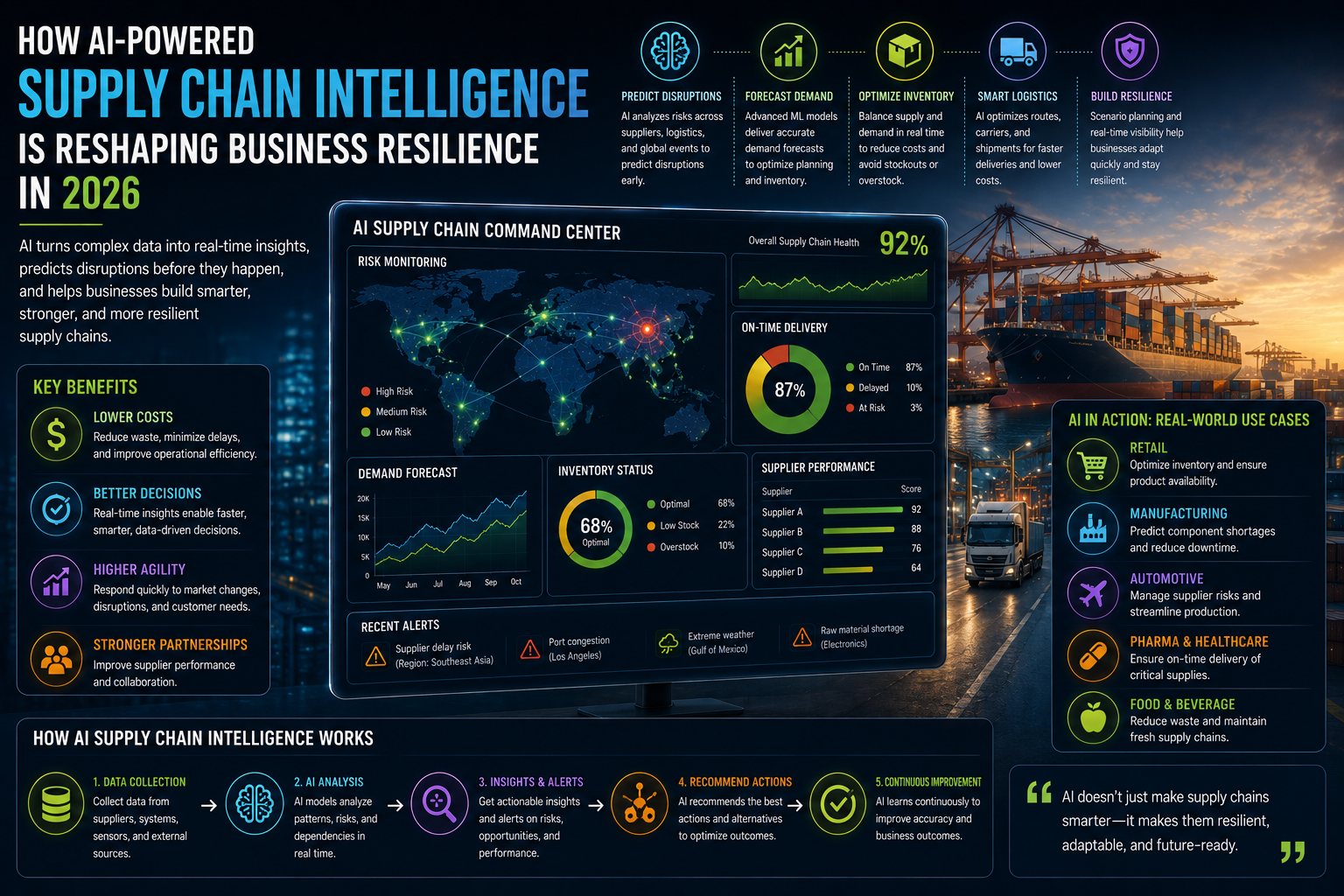
Global supply chains have become more complex, interconnected, and vulnerable to disruption. Businesses today depend on networks of suppliers, manufacturers, warehouses, logistics providers, transportation systems, and customers spread across multiple markets.
A disruption in one part of this network can quickly affect the entire business.
Extreme weather, geopolitical uncertainty, transportation delays, raw-material shortages, changing consumer demand, and unexpected supplier problems can create significant operational challenges. As companies look for better ways to prepare for these risks, artificial intelligence is becoming an increasingly important tool.
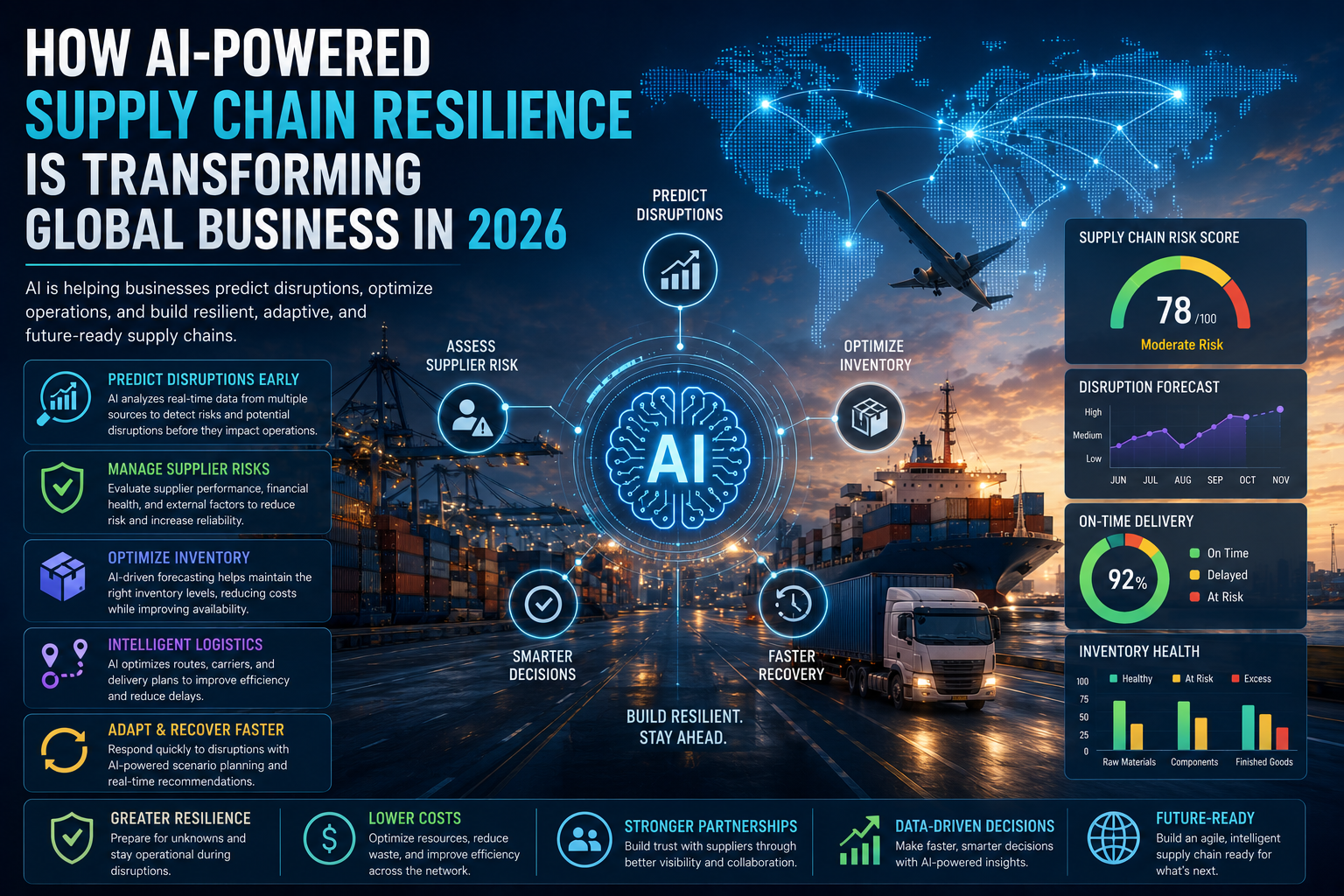
AI-powered supply chain resilience combines artificial intelligence, predictive analytics, real-time data, automation, and intelligent decision-making to help businesses anticipate disruptions and respond more effectively.
BullNext is already covering AI-powered supply-chain intelligence, so this article takes a more specific angle: how AI can help businesses build resilient and adaptable supply networks, rather than focusing only on supply-chain visibility.
What Is Supply Chain Resilience?
Supply chain resilience refers to a company's ability to prepare for disruptions, respond when they occur, and recover operations quickly.
A resilient supply chain does not assume that disruptions can be eliminated.
Instead, it is designed to continue functioning when unexpected problems occur.
For example, a manufacturer may depend on a particular supplier for an important component. If that supplier suddenly experiences a production problem, the manufacturer needs alternative options.
AI can help businesses identify these dependencies and evaluate potential responses before a disruption becomes a major crisis.
Why Traditional Supply Chains Are Under Pressure
Traditional supply-chain planning often relies heavily on historical information and fixed assumptions.
Businesses may establish supplier relationships, inventory levels, transportation routes, and production schedules based on expected conditions.
But modern markets can change rapidly.
Customer demand can shift unexpectedly. Transportation costs can change. Suppliers can experience delays. New regulations can affect sourcing. Weather events can interrupt production or transportation.
This means supply-chain strategies need to become more dynamic.
AI can help organizations continuously evaluate changing conditions and adjust their plans.
AI Can Predict Potential Disruptions
One of the most important applications of AI is predictive analysis.
AI systems can analyze large quantities of information to identify patterns associated with potential disruptions.
Depending on the business, this could include:
Supplier performance
Inventory levels
Transportation conditions
Demand changes
Weather information
Market conditions
Production data
Delivery performance
The goal is to identify warning signals before a disruption becomes severe.
For example, if a supplier's delivery performance has gradually deteriorated, an AI system could identify the trend and alert supply-chain managers.
This gives the organization more time to investigate alternatives.
Smarter Supplier Risk Management
Supplier dependency is one of the biggest challenges facing businesses.
A company may rely heavily on a small number of suppliers for critical materials or components.
AI can help organizations evaluate supplier risk by analyzing performance history and relevant operational signals.
A supply-chain platform could identify suppliers with increasing delivery delays, declining quality, or capacity problems.
Businesses can then determine whether they need alternative suppliers or additional inventory protection.
This does not mean replacing suppliers automatically.
Instead, AI can provide better information for supplier-management decisions.
Building Alternative Supply Networks
Resilient businesses need alternatives.
If a company relies on one transportation route, supplier, or manufacturing facility, a disruption can have a significant impact.
AI can help businesses model alternative supply networks.
For example, a manufacturer could evaluate what would happen if a particular supplier became unavailable.
The system could compare alternative suppliers, transportation routes, costs, delivery times, and available capacity.
This type of scenario planning allows businesses to prepare before a real disruption occurs.
AI-Powered Demand Forecasting
Supply-chain resilience is not only about disruptions.
Demand uncertainty can create equally serious problems.
If a business significantly underestimates demand, it may experience stockouts and lost sales.
If it overestimates demand, it may hold excessive inventory and increase storage costs.
AI-powered forecasting can analyze historical sales, customer behavior, seasonal trends, promotions, market conditions, and other relevant information.
Forecasts can then be updated as new information becomes available.
This allows businesses to adjust inventory and production plans more dynamically.
Real-Time Inventory Optimization
Inventory is an important part of resilience.
Businesses need enough stock to protect against unexpected disruptions, but excessive inventory can tie up capital.
AI can help organizations balance these competing requirements.
An intelligent system can evaluate demand forecasts, supplier reliability, lead times, warehouse capacity, and product importance.
It can then help managers determine where additional inventory may provide the greatest protection.
Instead of maintaining the same safety-stock levels for every product, companies can prioritize critical items.
AI and Transportation Planning
Transportation disruptions can quickly affect supply chains.
Shipments can face delays because of congestion, weather, infrastructure problems, or changing logistics conditions.
AI can help businesses evaluate transportation options and identify potential problems.
If a particular route becomes unreliable, an intelligent system can compare alternatives.
It may evaluate different routes based on expected delivery time, cost, capacity, and risk.
This can help logistics teams respond more quickly when conditions change.
Digital Twins and Supply Chain Simulation
Digital twins can provide another layer of resilience planning.
A digital twin can represent a supply network in a virtual environment.
Businesses can use the model to simulate potential disruptions.
For example, they could model the impact of:
A supplier shutdown
A transportation delay
A sudden demand increase
A warehouse disruption
A raw-material shortage
AI can analyze these scenarios and help identify possible responses.
This allows companies to test strategies digitally before applying them in the real world.
AI Agents and Supply Chain Operations
AI agents could eventually make supply-chain management even more proactive.
An AI agent could continuously monitor approved data sources and identify significant changes.
If a supplier begins experiencing delays, the agent could investigate the issue, compare approved alternatives, and prepare recommendations for a supply-chain manager.
In certain low-risk situations, businesses may eventually allow agents to execute predefined actions automatically.
For example, an agent could reorder approved inventory when stock reaches a defined threshold.
Higher-risk decisions should remain subject to human approval.
Improving Collaboration Between Departments
Supply chains involve many departments.
Procurement manages suppliers.
Operations manages production.
Finance manages budgets.
Sales provides demand information.
Logistics manages transportation.
When these teams operate with disconnected information, responding to disruptions can become slower.
AI can help connect information across departments.
For example, a change in sales demand could automatically influence inventory forecasts and production planning.
This creates a more connected decision-making process.
Supply Chain Resilience and Cost Management
Resilience does not mean maintaining huge amounts of inventory or using the most expensive supplier.
Businesses still need to manage costs.
AI can help evaluate the trade-off between resilience and efficiency.
For example, a company could compare the cost of maintaining additional inventory against the potential cost of a supply disruption.
It could also compare multiple suppliers based on price, reliability, delivery time, and risk.
This allows businesses to make more balanced decisions.
The Importance of Data Quality
AI-powered resilience depends on reliable data.
If supplier records are outdated or inventory information is inaccurate, AI recommendations may be misleading.
Businesses need strong data governance.
Important information should be updated consistently, and organizations should establish clear ownership for critical supply-chain data.
Data quality becomes particularly important when AI systems are making predictions or recommendations automatically.
Cybersecurity Becomes Part of Resilience
Modern supply chains are increasingly digital.
Businesses connect suppliers, logistics providers, warehouses, manufacturers, and enterprise applications through digital platforms.
This creates new cybersecurity risks.
A cyberattack affecting one important supplier could potentially create operational consequences for other companies.
AI can help monitor unusual digital activity and identify potential threats.
However, organizations also need strong authentication, access controls, encryption, network segmentation, and security monitoring.
Supply-chain resilience increasingly requires both operational resilience and digital resilience.
Human Expertise Still Matters
AI can process enormous quantities of information, but human expertise remains important.
Supply-chain managers understand supplier relationships, business priorities, customer expectations, and operational realities that may not be fully represented in datasets.
AI should therefore support human decision-making rather than operate without appropriate controls.
A good system might identify a potential disruption and present several possible responses.
A manager can then evaluate the options and choose the most appropriate action.
Creating a More Adaptive Supply Chain
The ultimate goal of AI-powered resilience is adaptability.
Instead of creating a supply chain designed around one expected future, businesses can build networks capable of responding to multiple possibilities.
AI can continuously evaluate changing conditions and identify where adjustments may be necessary.
This creates a more flexible operating model.
Companies can move from:
“What is our supply-chain plan?”
to:
“What is changing, what could happen next, and how should we respond?”
How Businesses Can Start
Companies do not need to introduce AI across their entire supply chain immediately.
A focused approach can be more effective.
Businesses can begin with:
Supplier risk analysis
Demand forecasting
Inventory optimization
Transportation planning
Disruption scenario modeling
Critical-component monitoring
Companies should establish measurable goals.
For example, they could track forecast accuracy, delivery performance, inventory costs, stockout frequency, or recovery time following disruptions.
This makes it easier to determine whether AI is creating measurable value.
The Future of Supply Chain Resilience
The future supply chain is likely to become increasingly intelligent and interconnected.
AI systems will continuously process information from suppliers, warehouses, transportation networks, production facilities, and customers.
Digital twins can simulate potential disruptions.
AI agents can monitor operations and prepare recommendations.
Predictive models can identify emerging risks.
Human managers can oversee high-impact decisions and define strategic priorities.
This combination can create supply networks that are more responsive to uncertainty.
Conclusion
AI-powered supply chain resilience is changing how global businesses prepare for uncertainty.
Instead of waiting for disruptions to occur, organizations can use AI to identify risks, forecast demand, evaluate suppliers, optimize inventory, simulate scenarios, and develop alternative strategies.
The objective is not to eliminate every disruption.
That is unrealistic.
The goal is to make businesses better prepared to absorb unexpected events and recover quickly when they occur.
As supply chains become increasingly connected and global, resilience will become an important competitive advantage.
Companies that combine artificial intelligence with strong data, human expertise, diversified supply networks, and effective risk management can build operations that are better prepared for an unpredictable business environment.