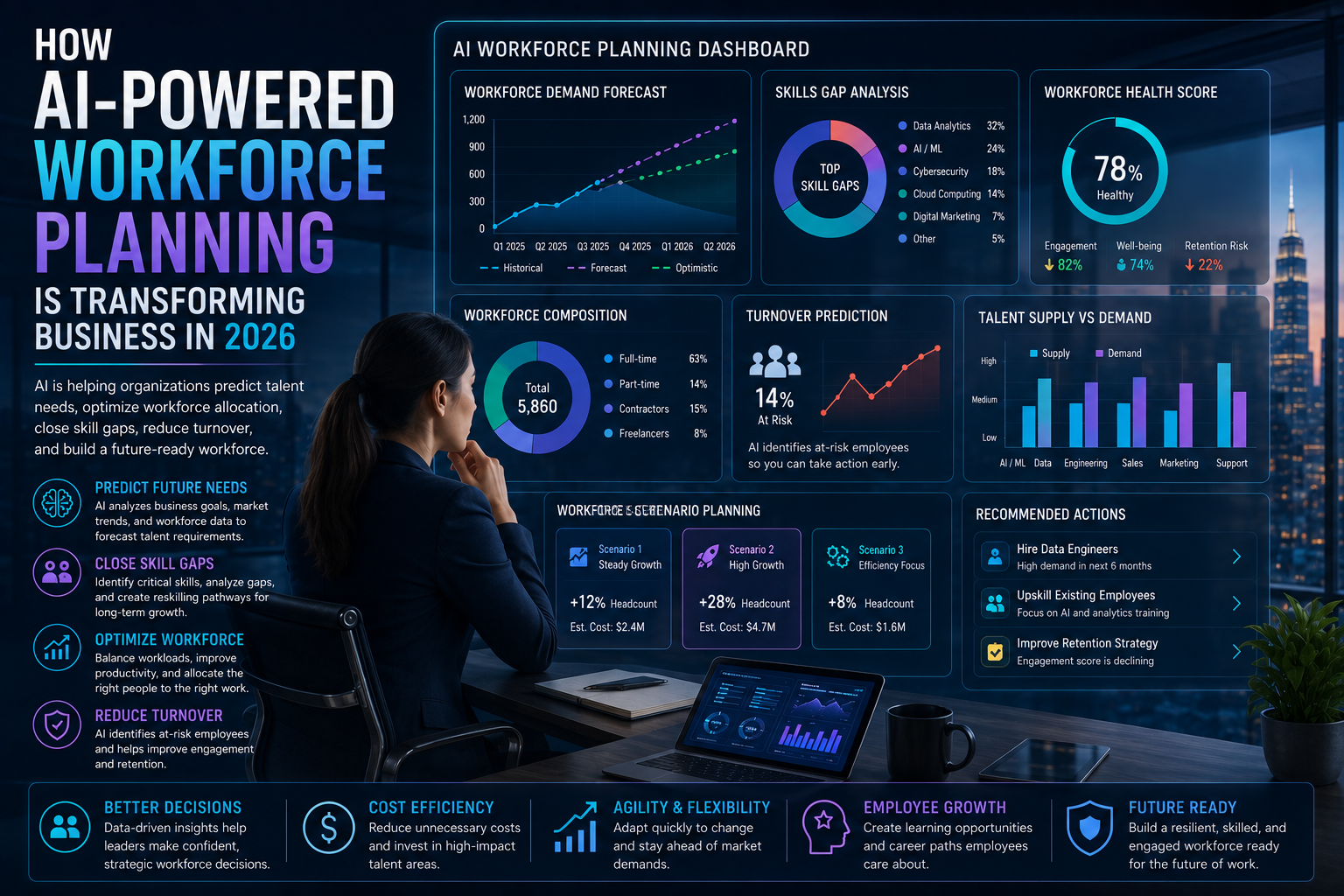
The workplace is changing faster than many businesses expected. AI automation, hybrid work, changing customer demand, new digital skills, and evolving business models are forcing companies to rethink how they plan their workforce.
For years, workforce planning was largely based on historical headcount, annual budgets, employee turnover, and management forecasts. While these methods remain useful, they can struggle when business conditions change quickly.
Artificial intelligence is creating a new approach.
AI-powered workforce planning combines workforce data, predictive analytics, machine learning, and business forecasting to help organizations understand what talent they need, where they need it, and which skills may become important in the future.
In 2026, workforce planning is moving from a largely administrative activity toward a strategic capability that can influence productivity, hiring, employee development, and long-term growth.
What Is AI-Powered Workforce Planning?
AI-powered workforce planning uses artificial intelligence to analyze information about employees, business performance, workloads, skills, hiring, turnover, and future demand.
An AI system can identify patterns that may be difficult to discover through spreadsheets or manual analysis.
For example, a company expecting rapid growth may use AI to estimate how many employees it will need over the next 12 months.
The system could analyze historical hiring rates, employee turnover, productivity, expected revenue, project pipelines, and business forecasts.
The resulting insights can help leadership make better workforce decisions.
Why Workforce Planning Is Becoming More Important
Businesses are facing a complicated talent environment.
Some roles are becoming increasingly automated, while demand for technical, analytical, creative, and AI-related skills is growing.
At the same time, companies need to control costs and ensure that employees are working on activities that generate meaningful value.
Hiring too many people can increase costs.
Hiring too few can create productivity problems and employee burnout.
AI-powered workforce planning can help businesses find a better balance.
Predicting Future Workforce Demand
One of the biggest applications of AI is forecasting future workforce requirements.
A company can provide information about expected sales, projects, customers, seasonal demand, and strategic initiatives.
AI can analyze this information and estimate future staffing requirements.
For example, a retailer preparing for a seasonal increase in demand may need additional employees in certain locations.
An AI forecasting system can analyze historical patterns and current business conditions to estimate the required workforce.
This allows companies to prepare earlier instead of reacting after demand increases.
Identifying Critical Skills
Headcount is only one part of workforce planning.
Companies also need the right skills.
A business may have hundreds of employees but still lack expertise in cybersecurity, data analysis, AI implementation, cloud infrastructure, or other important areas.
AI can analyze job descriptions, employee profiles, project requirements, and organizational priorities to identify potential skill gaps.
This can help companies determine which capabilities they already possess and which ones they need to develop or acquire.
The Rise of Skills-Based Workforce Planning
Traditional workforce planning often focuses on job titles.
AI is helping organizations think more in terms of skills.
Instead of asking how many software engineers a company needs, leadership can ask which technical capabilities are required for future projects.
This approach can reveal that existing employees already possess some of the required skills.
The company may then be able to provide training instead of hiring externally.
Skills-based planning can therefore support both workforce flexibility and employee development.
AI and Employee Reskilling
AI is changing job responsibilities across many industries.
Some repetitive tasks can increasingly be automated, while employees may be expected to work with AI tools and manage more complex responsibilities.
Organizations need strategies for reskilling their workforce.
AI can help identify employees whose existing skills are closely related to emerging roles.
For example, an employee with strong data-analysis skills may be suitable for training in AI-assisted analytics.
A customer-service employee may be able to transition into a role focused on managing AI-supported customer operations.
This creates opportunities to develop talent internally.
Improving Recruitment Decisions
AI can also support recruitment planning.
Organizations can analyze hiring patterns, workforce turnover, business growth, and future skill requirements to determine when new employees may be needed.
AI can help recruiters prioritize roles and identify where hiring demand is likely to increase.
However, businesses need to be careful when using AI in recruitment.
Automated systems can reproduce biases found in historical hiring data.
Companies should therefore maintain human oversight and regularly evaluate AI systems for fairness, accuracy, and compliance.
Predicting Employee Turnover
Employee turnover can create significant costs.
Replacing experienced employees takes time and resources, while losing critical expertise can affect productivity.
AI can analyze permitted workforce information to identify patterns associated with employee turnover.
Possible signals might include changes in workload, tenure, role progression, compensation structures, engagement information, or organizational changes.
These systems should not be treated as perfect predictors.
Instead, they can help HR teams identify areas where employee experience may require attention.
The goal should be to improve workplace conditions rather than simply predict which individuals might leave.
Workforce Planning and Business Growth
Workforce strategy should be closely connected to business strategy.
If a company plans to enter new markets, launch products, expand operations, or increase customer capacity, workforce requirements will change.
AI can connect business forecasts with workforce planning.
For example, a company expecting a 30% increase in customer demand may need additional sales, customer-service, operations, and technical capacity.
An AI system can model how different growth scenarios could affect staffing requirements.
This creates a more integrated planning process.
Optimizing Employee Allocation
Businesses often have employees with different workloads.
Some teams may be overloaded while others have available capacity.
AI can analyze workload information and identify potential imbalances.
For example, if one project team is approaching capacity while another has relevant available skills, management may be able to redistribute work.
This can improve resource utilization without immediately increasing headcount.
Human managers should still consider employee preferences, expertise, development goals, and organizational context when making these decisions.
AI and Hybrid Work
Hybrid work has added another layer of complexity to workforce planning.
Companies need to understand how employees collaborate, where teams are located, and which roles require physical presence.
AI can analyze operational information to help organizations plan office capacity, collaboration schedules, team structures, and resource requirements.
However, businesses should avoid turning workforce analytics into excessive employee surveillance.
The purpose should be organizational planning and productivity improvement rather than constant monitoring of individuals.
Reducing Workforce Costs
AI-powered planning can help businesses control workforce costs by improving resource allocation.
Instead of automatically hiring whenever workloads increase, companies can examine whether existing employees, automation, outsourcing, or reskilling could address the requirement.
This can create a more flexible workforce strategy.
The objective is not necessarily to reduce the number of employees.
Rather, it is to ensure that workforce investment is aligned with actual business needs.
AI Agents and HR Operations
The emergence of AI agents could make workforce planning more dynamic.
An AI workforce agent could monitor business forecasts, workforce capacity, open positions, skills gaps, and hiring activity.
It could alert HR leaders when projected demand exceeds available capacity.
It could also prepare workforce scenarios for management review.
For example, an agent could compare three options:
Hire additional employees
Reskill existing employees
Increase automation
Management could then evaluate the cost, timeline, and risks associated with each option.
Workforce Planning and Employee Experience
AI should not be used only from the employer's perspective.
It can also improve employee experiences.
Employees may benefit from AI-powered learning recommendations, career-development suggestions, personalized training, and internal job matching.
An intelligent system could identify opportunities that match an employee's existing skills and career interests.
This can make internal mobility easier.
When employees can see clearer development pathways, organizations may also improve retention.
The Importance of Responsible AI
Workforce AI involves sensitive information, making responsible implementation essential.
Employee data should be protected through appropriate security and access controls.
Organizations should clearly explain how workforce analytics are being used.
AI recommendations should not automatically determine important employment decisions without human review.
Businesses should also regularly evaluate AI systems for unintended bias.
Transparency and accountability will become increasingly important as AI becomes more involved in workforce management.
Data Quality Matters
Workforce planning depends on accurate information.
Employee skills may not be fully reflected in HR databases.
Job descriptions may be outdated.
Turnover data may not explain why employees leave.
Project forecasts may change.
AI systems need reliable and regularly updated information to produce useful insights.
Organizations should therefore establish strong data governance before relying heavily on automated workforce recommendations.
Building a Future-Ready Workforce
The most important role of AI-powered workforce planning may be helping companies prepare for change.
Businesses cannot always predict exactly which jobs will exist several years from now.
They can, however, identify capabilities that are becoming strategically important.
AI can help organizations continuously compare current workforce skills with future requirements.
This creates a more adaptive approach to talent management.
Instead of conducting workforce planning once a year, businesses can treat it as an ongoing process.
How Companies Can Start
Businesses interested in AI workforce planning can begin with a focused use case.
Possible starting points include:
Workforce demand forecasting
Skills-gap analysis
Employee reskilling
Recruitment planning
Internal talent matching
Workload optimization
Turnover analysis
Workforce cost forecasting
Companies should establish measurable objectives before deployment.
They should also involve HR, IT, legal, security, and business leaders in the implementation process.
The Future of Workforce Strategy
The future workplace is likely to combine human employees, AI assistants, automation, and increasingly autonomous systems.
This does not mean every role will disappear.
Instead, many jobs may change as employees work alongside AI.
Workforce planning will therefore become less about counting employees and more about understanding the relationship between people, skills, technology, and business objectives.
Organizations that understand this relationship can potentially become more flexible and resilient.
Conclusion
AI-powered workforce planning is becoming an important strategic capability in 2026.
By analyzing workforce data, business forecasts, skills, workloads, hiring requirements, and future demand, AI can help organizations make more informed talent decisions.
The technology can support hiring, reskilling, employee development, workload management, cost planning, and long-term business growth.
However, workforce AI must be implemented responsibly.
Employee privacy, fairness, transparency, security, and human judgment should remain central to the process.
The strongest organizations will not simply use AI to manage employees more efficiently.
They will use it to help people develop new skills, find better opportunities, and work more effectively alongside increasingly intelligent technology.
As the workplace continues to evolve, AI-powered workforce planning could become one of the key tools businesses use to prepare for the future—creating organizations that are not only more efficient, but also more adaptable and ready for the next generation of work