Artificial intelligence is becoming an essential part of modern business, but not every AI workload needs to run in a distant cloud data center. As companies deploy more connected devices, sensors, cameras, vehicles, machines, and intelligent systems, there is growing demand for AI that can operate closer to where data is created.
This is where Edge AI is becoming increasingly important.
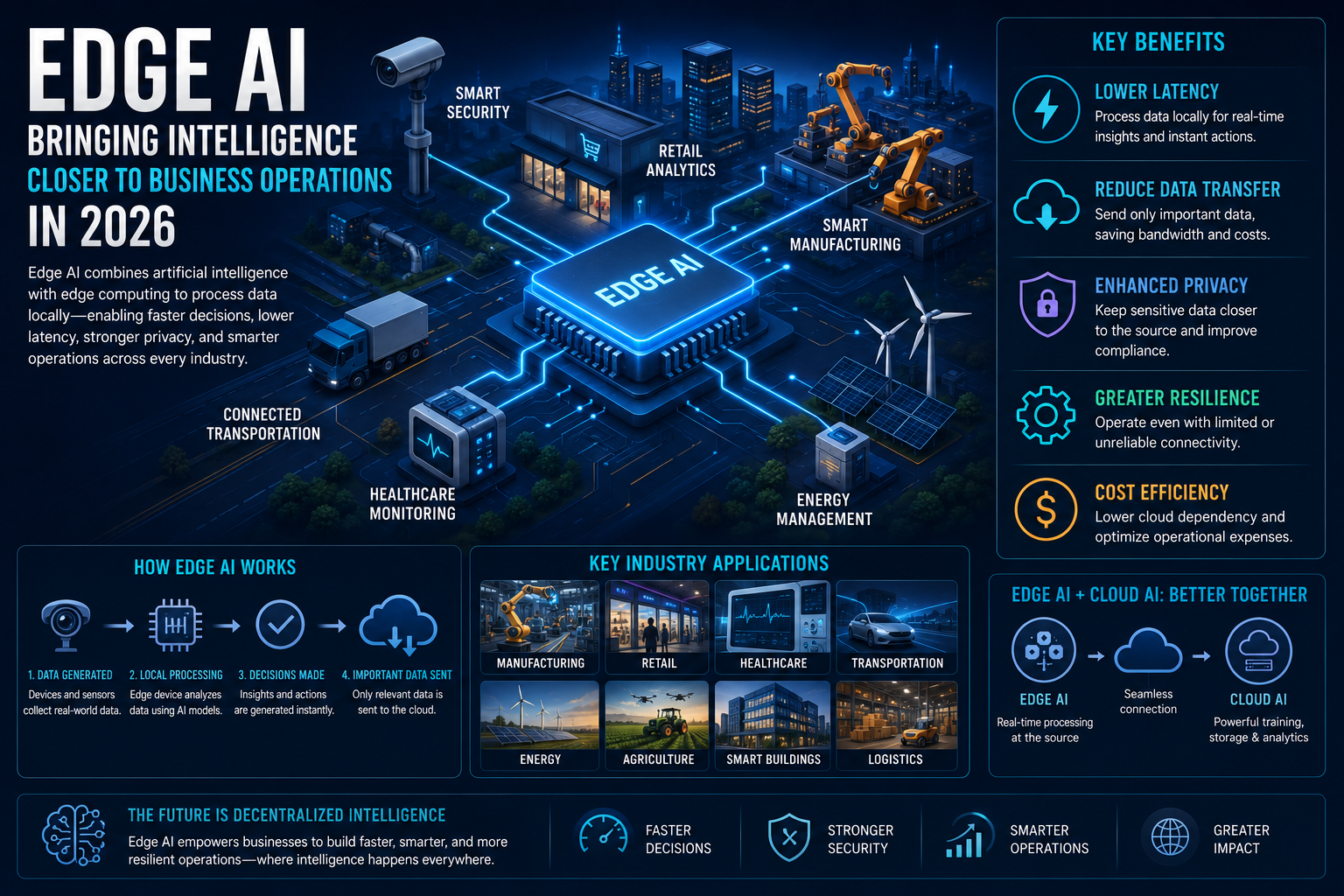
Edge AI combines artificial intelligence with edge computing, allowing devices to process information locally or near the source instead of sending every piece of data to a centralized cloud environment. Smartphones, industrial machines, vehicles, cameras, medical devices, robots, and other connected systems can potentially analyze information and make decisions in near real time.
In 2026, Edge AI is becoming an important part of the broader enterprise technology landscape because businesses want faster responses, lower data-transfer requirements, greater resilience, and more control over sensitive information.
What Is Edge AI?
Edge AI refers to artificial intelligence that operates directly on a device or at an edge-computing location close to the source of data.
Traditional cloud-based AI generally sends information to centralized servers for processing. The results are then returned to the device or application.
Edge AI changes this model.
Instead of sending every image, sensor reading, audio signal, or machine measurement to the cloud, an edge device can process some or all of the information locally.
For example, a smart factory camera could identify a manufacturing defect without sending every video frame to a remote server.
A vehicle could analyze sensor information locally to support real-time driving functions.
A retail camera could count customers without continuously uploading raw video.
The cloud can still play an important role, but intelligence becomes distributed across the technology environment.
Why Businesses Are Turning to Edge AI
One of the biggest reasons businesses are exploring Edge AI is speed.
Some decisions need to happen immediately.
A factory machine detecting a dangerous operating condition cannot always wait for information to travel to a remote data center and return with a response.
Similarly, an autonomous vehicle needs to process information about its surroundings extremely quickly.
Edge processing can reduce the distance between data creation and decision-making.
This can lower latency and make AI-powered systems more responsive.
For businesses operating physical environments, this can be particularly valuable.
Reducing Data Transfer
Connected devices can generate enormous amounts of information.
Factories may have thousands of sensors. Retail stores can operate extensive camera networks. Vehicles can generate information from cameras, radar, and other sensors.
Sending all of this data continuously to the cloud can consume significant bandwidth.
Edge AI allows devices to process information locally and send only the most relevant results to centralized systems.
For example, instead of transmitting hours of video, a security system could send alerts when it detects a specific event.
This can reduce network traffic and potentially lower infrastructure costs.
Edge AI and Manufacturing
Manufacturing is one of the strongest applications for Edge AI.
Modern factories increasingly use sensors, cameras, robots, and connected equipment to monitor production.
AI running at the edge can analyze information from these systems in real time.
Computer vision systems can inspect products as they move through production lines.
AI can identify defects and immediately alert operators or trigger an automated response.
Because processing happens close to the production environment, the system does not necessarily need constant communication with a centralized cloud platform.
This can improve responsiveness and help maintain operations even when connectivity is limited.
Predictive Maintenance at the Edge
Industrial equipment produces large amounts of sensor data.
Temperature, vibration, pressure, sound, energy consumption, and other measurements can reveal changes in machine behavior.
Edge AI can analyze these signals locally and identify patterns associated with potential equipment problems.
Instead of sending every measurement to the cloud, a machine can determine when a situation appears unusual and transmit an alert.
This can support predictive maintenance strategies.
Maintenance teams can investigate equipment before a minor issue becomes a major failure.
The combination of edge processing and AI can therefore help businesses reduce downtime while using network resources more efficiently.
Edge AI in Retail
Retail businesses are also exploring local AI processing.
Stores can use cameras and sensors to understand customer movement, inventory conditions, queue lengths, and other operational factors.
Edge AI can process this information locally.
For example, an intelligent system could identify when a checkout area becomes crowded and alert employees.
Computer vision can also help detect empty shelves or identify products that need restocking.
Because much of the processing can happen locally, businesses may reduce the amount of raw video that needs to be transmitted and stored centrally.
This can also support privacy-conscious system design when implemented appropriately.
Smarter Healthcare Devices
Healthcare is another area where Edge AI can be valuable.
Medical devices and monitoring systems can generate information continuously.
Local AI processing can help devices identify patterns quickly and potentially alert healthcare professionals when specific conditions require attention.
For example, an intelligent monitoring device could analyze physiological signals locally and identify unusual changes.
However, healthcare AI requires especially strong validation, reliability, privacy protections, and professional oversight.
Edge computing can improve technical responsiveness, but it does not eliminate the need for clinical testing and appropriate regulation.
Edge AI and Autonomous Vehicles
Vehicles are becoming increasingly dependent on intelligent computing.
Advanced driver-assistance systems and autonomous technologies need to process information from cameras, sensors, navigation systems, and other sources.
Many of these decisions need to happen locally.
A vehicle cannot rely entirely on a remote cloud connection when responding to an obstacle or changing road condition.
Edge AI allows vehicles to interpret information and respond within the vehicle's computing environment.
Cloud infrastructure can still support mapping, software updates, fleet analytics, and model development, but time-sensitive processing can remain local.
Robotics and Physical AI
The rise of physical AI is also accelerating interest in Edge AI.
Robots operate in environments where they need to perceive objects, understand their surroundings, and make rapid decisions.
A warehouse robot, for example, may need to recognize obstacles and adjust its route immediately.
An industrial robot may need to respond to changes on a production line.
Processing these tasks locally can reduce latency.
Edge AI therefore provides an important computing foundation for increasingly autonomous machines.
Better Resilience for Business Operations
Another advantage of Edge AI is resilience.
Cloud connectivity can sometimes be interrupted because of network problems, infrastructure failures, or environmental conditions.
If an AI system depends entirely on remote processing, connectivity problems can disrupt operations.
Edge AI allows critical functions to continue locally.
A factory may continue monitoring equipment even if its cloud connection temporarily fails.
A vehicle can continue processing sensor information without relying on continuous internet access.
This can make certain business systems more resilient.
Privacy and Data Control
Data privacy is another important consideration.
Businesses often collect sensitive information from customers, employees, patients, facilities, and connected devices.
Sending all raw information to centralized systems can increase privacy and security considerations.
Edge AI can process some information locally before transmitting anything externally.
For example, a camera system could analyze video locally and send only an event notification rather than the complete video stream.
This does not automatically guarantee privacy, but it can reduce unnecessary data movement.
Organizations still need appropriate security, access controls, encryption, retention policies, and governance.
The Role of Specialized AI Chips
Edge AI depends heavily on hardware.
Small devices often have limited processing power compared with large data centers.
Specialized AI chips, neural processing units, and other accelerators are helping devices perform increasingly sophisticated AI workloads.
These processors are designed to execute machine-learning operations efficiently while managing power consumption.
This is particularly important for battery-powered devices, vehicles, industrial sensors, and portable equipment.
As semiconductor technology improves, more AI capabilities can potentially move from centralized infrastructure onto smaller devices.
Edge AI and Cloud AI Will Work Together
The growth of Edge AI does not mean that cloud computing is disappearing.
The future is more likely to involve a hybrid architecture.
Edge devices can handle immediate processing.
Cloud platforms can manage large-scale model training, historical analytics, data storage, centralized management, and software updates.
For example, a factory could use edge devices to detect machine anomalies in real time while sending selected information to a cloud platform for long-term analysis.
This creates a continuous relationship between local intelligence and centralized computing.
Challenges Businesses Must Consider
Edge AI also creates challenges.
Managing thousands of intelligent devices can be more complicated than managing centralized servers.
Businesses need systems for software updates, device security, model management, monitoring, and hardware maintenance.
Cybersecurity is especially important.
If an edge device is compromised, attackers may gain access to business networks or manipulate AI-driven operations.
Organizations therefore need strong authentication, encryption, network segmentation, device monitoring, and secure update processes.
Managing AI Models at the Edge
AI models deployed on edge devices may need to be smaller and more efficient than models running in large data centers.
Businesses may need to optimize models for limited computing resources.
Techniques such as model compression and quantization can help reduce computational requirements.
Organizations also need processes for updating models as conditions change.
A model that works well today may require adjustment as products, environments, customer behavior, or operating conditions evolve.
The Growing Role of 5G and Advanced Networks
High-speed wireless networks can complement Edge AI.
While edge devices can process information locally, fast networks can connect them to other systems when additional information is required.
This creates flexible architectures where devices can decide what information should remain local and what should be sent elsewhere.
For industries such as logistics, transportation, manufacturing, and smart infrastructure, the combination of Edge AI and advanced connectivity could create highly responsive operational environments.
Edge AI and Business Decision-Making
Edge AI is not limited to automated machines.
It can also support business decisions.
Retail devices can provide real-time information about store activity.
Industrial systems can report operational conditions.
Connected vehicles can provide fleet information.
Smart buildings can analyze energy and occupancy patterns.
The key advantage is that information can be processed close to the source, allowing organizations to respond more quickly.
The Future of Edge AI
As AI models become more efficient and specialized hardware becomes more powerful, Edge AI is likely to expand across industries.
Smart factories, connected vehicles, healthcare devices, retail systems, robots, security platforms, and industrial equipment may increasingly contain their own AI capabilities.
Instead of one centralized AI system controlling everything, businesses could operate networks of intelligent devices that cooperate with cloud platforms and enterprise software.
This distributed model could make organizations more responsive and resilient.
How Businesses Can Prepare
Companies considering Edge AI should begin by identifying workloads where local intelligence provides a clear benefit.
Good starting points may include:
Real-time quality inspection
Predictive maintenance
Retail analytics
Fleet monitoring
Smart building management
Robotics
Security systems
Industrial automation
Businesses should evaluate latency, connectivity, privacy, device capabilities, energy consumption, and security requirements.
Pilot projects can help organizations determine whether Edge AI delivers measurable operational improvements before larger investments are made.
Conclusion
Edge AI is bringing artificial intelligence closer to the physical environments where business activity actually happens.
By processing information locally, organizations can potentially reduce latency, limit unnecessary data transfers, improve resilience, and create faster intelligent systems.
Manufacturing, healthcare, retail, transportation, robotics, logistics, and smart infrastructure are among the industries that can benefit from this approach.
The future is unlikely to be a choice between cloud AI and Edge AI.
Instead, businesses will increasingly combine both.
Cloud platforms can provide massive computing resources and centralized intelligence, while edge devices can provide real-time awareness and local decision-making.
As AI becomes more deeply embedded in everyday business operations, this distributed approach could become an important foundation for the next generation of intelligent enterprises.