Artificial intelligence is moving beyond systems that understand only text. The next stage of enterprise AI is increasingly multimodal, allowing AI systems to work with different types of information at the same time, including text, images, audio, video, documents, charts, and other data.
This development is changing how businesses interact with AI.
Traditional AI applications often focused on a single type of information. A language model could process text, while computer-vision systems analyzed images and speech-recognition tools processed audio. Multimodal AI brings these capabilities closer together.
A single AI system can potentially analyze a customer email, examine an attached image, understand a voice message, interpret a document, and combine all of that information to produce a useful response.
For businesses, this could create a new generation of AI applications capable of understanding more of the real-world context surrounding a task.
What Is Multimodal AI?
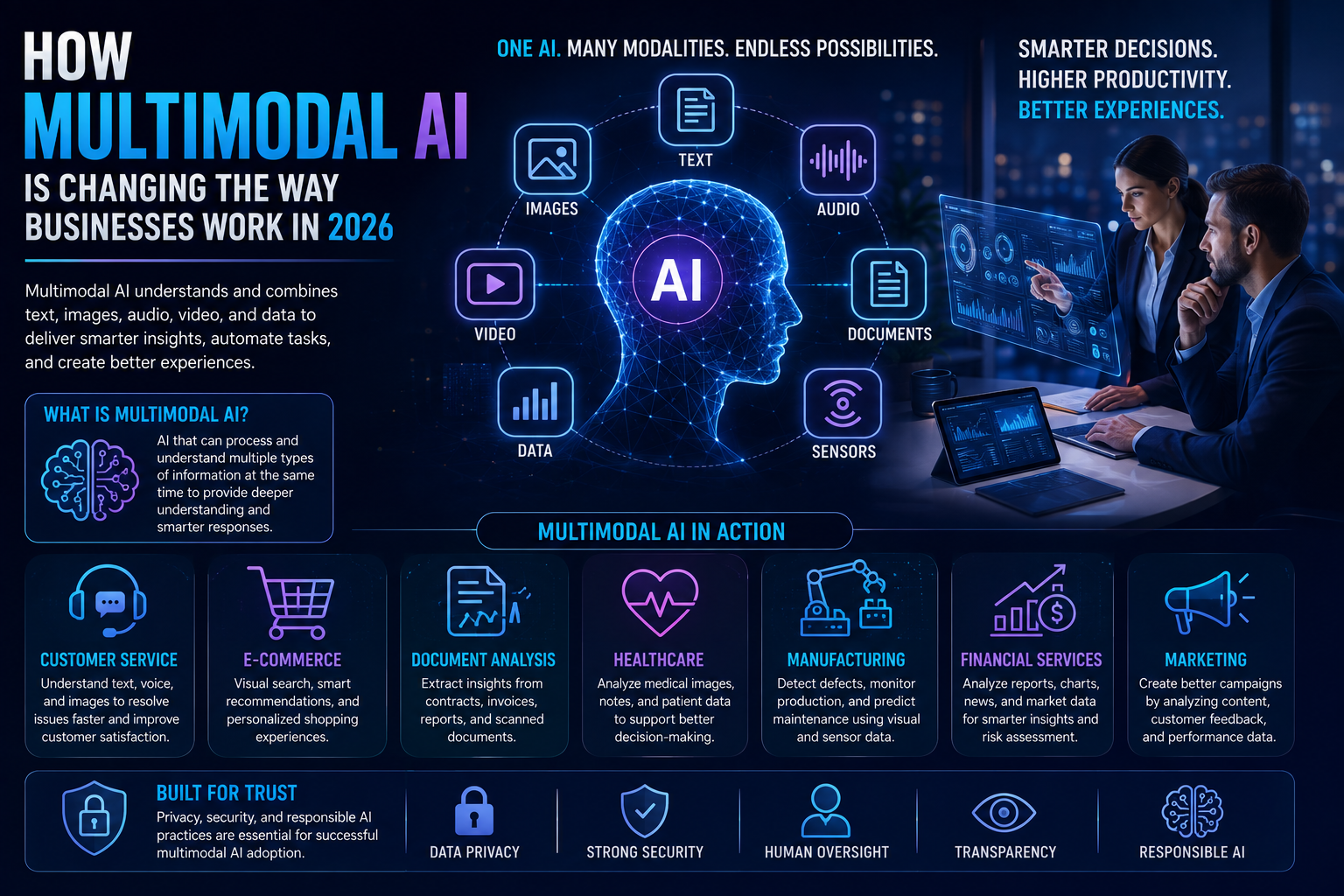
Multimodal AI refers to artificial intelligence systems capable of processing and combining multiple forms of information.
These modalities can include:
Text
Images
Audio
Video
Documents
Charts and diagrams
Sensor information
Structured business data
For example, an AI system used by an insurance company could analyze a written claim, photographs of property damage, an audio conversation, and relevant policy documents.
Instead of treating each source separately, the system could combine the information to provide a more complete analysis.
This ability to connect different types of information is one of the most important developments in enterprise AI.
Why Multimodal AI Matters for Businesses
Businesses rarely operate using one type of information.
Employees receive emails, documents, spreadsheets, images, presentations, phone calls, videos, and database records every day.
Much of this information is difficult to process manually because it exists in different formats.
Multimodal AI can help bring these sources together.
Instead of requiring employees to manually review every piece of information, AI can analyze multiple inputs and highlight important patterns.
This could reduce repetitive work while giving employees a broader view of business situations.
Transforming Customer Service
Customer service is one of the clearest applications of multimodal AI.
Customers may contact businesses through text, voice, photographs, screenshots, or video.
A traditional chatbot may understand a written question but struggle when a customer attaches an image.
A multimodal AI assistant could potentially understand both.
For example, a customer experiencing a technical problem could send a screenshot of an error message.
The AI could analyze the image, understand the customer's written explanation, identify the likely problem, and provide appropriate troubleshooting steps.
This creates a more natural support experience.
Multimodal AI in E-Commerce
E-commerce businesses can also benefit from multimodal capabilities.
Customers do not always know the exact name of the product they are looking for.
They may have an image, a description, or a general idea.
A customer could upload a photograph of a piece of furniture and ask an AI system to find visually similar products.
The system could combine image recognition with product descriptions, pricing information, inventory data, and customer preferences.
This can make product discovery easier.
Instead of relying entirely on keyword searches, customers can interact with online stores using images and natural language together.
Improving Business Document Analysis
Modern companies produce enormous quantities of documents.
Contracts, invoices, presentations, reports, spreadsheets, forms, receipts, and scanned documents can contain important information.
Traditional document-management systems often require employees to search through files manually.
Multimodal AI can analyze both the written content and visual structure of documents.
For example, an AI system could examine an invoice, identify the supplier, extract amounts, recognize tables, and compare the information with purchasing records.
A contract-analysis system could interpret text while also considering tables, signatures, diagrams, and other visual elements.
This can make document-heavy business processes more efficient.
Multimodal AI and Financial Services
Financial organizations process many different types of information.
Analysts may examine financial reports, charts, market data, news, presentations, and regulatory documents.
Multimodal AI can potentially combine these sources.
An analyst could ask an AI system to summarize a company's financial report while also examining charts and comparing information across multiple documents.
This does not mean AI should independently make important investment decisions.
Instead, it can help analysts process information faster and identify areas requiring closer human review.
Human expertise remains essential for financial judgment and risk management.
Healthcare Applications
Healthcare generates information in many forms.
Medical professionals may work with written notes, laboratory results, medical images, audio recordings, and other data.
Multimodal AI could potentially combine these sources to support information retrieval, documentation, education, and certain analytical tasks.
For example, a healthcare AI system could help organize information from a patient's records and summarize relevant findings for professional review.
Medical imaging is another potential area.
AI systems can analyze visual information while considering associated text and clinical context.
However, healthcare applications require particularly strong validation, privacy protections, security, and professional oversight.
Multimodal AI should support healthcare professionals rather than replace clinical judgment.
Manufacturing and Quality Inspection
Manufacturing companies can use multiple information sources to monitor production.
A factory may collect machine sensor data, photographs, video footage, maintenance records, and production reports.
Multimodal AI can potentially combine these inputs.
For example, an AI system could analyze a photograph of a defective product, compare it with historical inspection records, and examine machine data from the production line.
This can provide a broader picture of why a problem may have occurred.
The combination of visual and operational information could help manufacturers identify quality issues more efficiently.
Multimodal AI for Employees
The impact of multimodal AI will not be limited to customer-facing applications.
Employees can use multimodal assistants as general-purpose workplace tools.
An employee could upload a presentation and ask the AI to summarize it.
They could provide a spreadsheet and request an explanation of important trends.
They could upload a diagram and ask for a simplified description.
They could record a meeting and ask for action items.
The ability to interact with different formats through one interface can make AI more useful across departments.
AI Assistants Become More Context-Aware
Multimodal capabilities can make AI assistants more context-aware.
Consider an employee working with a piece of equipment.
Instead of describing the problem entirely through text, the employee could take a photograph, record a short explanation, and provide relevant maintenance information.
An AI system could analyze all of these inputs together.
This creates a more natural interaction because humans communicate using multiple forms of information.
The AI does not need to rely exclusively on carefully written prompts.
Multimodal AI and Marketing
Marketing teams are also likely to benefit.
Modern campaigns involve written copy, images, videos, customer data, product information, and performance metrics.
Multimodal AI can help marketers work across these formats.
An AI system could analyze an advertising image, campaign text, audience information, and performance results to identify opportunities for improvement.
Generative AI can then help create alternative content.
Human marketers remain responsible for brand strategy, messaging, creativity, ethics, and final approval, while AI can accelerate analysis and production.
Improving Accessibility
Multimodal AI could also make digital products more accessible.
AI systems can describe images for users who cannot see them, convert speech into text, translate information, and simplify complicated documents.
Businesses can incorporate these capabilities into websites, applications, customer-service platforms, and workplace tools.
This can help organizations create more inclusive digital experiences.
Accessibility is therefore not only a technology issue but also an important part of customer experience and employee productivity.
The Challenge of AI Accuracy
Multimodal AI is powerful, but it is not infallible.
AI systems can misunderstand images, misinterpret documents, incorrectly identify objects, or generate unsupported conclusions.
Combining multiple data types does not automatically guarantee accuracy.
Businesses therefore need appropriate evaluation processes.
High-impact applications should include human review, especially when AI outputs could affect financial, legal, medical, employment, or safety-related decisions.
The more important the decision, the stronger the need for verification.
Data Privacy Becomes More Important
Multimodal systems may process more information than traditional AI applications.
A single interaction could contain a person's voice, face, documents, location, written information, and other sensitive data.
Businesses need clear policies governing how this information is collected, stored, processed, and retained.
Privacy should be considered during system design rather than after deployment.
Organizations should also minimize unnecessary data collection and ensure that employees understand what information can safely be submitted to AI tools.
Integration With Existing Business Systems
Multimodal AI becomes significantly more valuable when it can interact with existing business systems.
A customer-service assistant could connect with CRM software.
A manufacturing AI could access equipment data.
A financial assistant could retrieve approved company documents.
An employee assistant could search internal knowledge bases.
However, integrations introduce security risks.
Businesses need strong access controls to ensure that AI systems can access only the information and tools necessary for their assigned tasks.
The Rise of Multimodal AI Agents
The next development could be multimodal AI agents.
An AI agent can perform tasks rather than simply respond to questions.
A multimodal agent could receive information from text, images, audio, and documents, determine what needs to be done, and interact with approved business tools.
For example, a field-service agent could receive a technician's voice message and equipment photograph, identify the likely issue, check maintenance records, and prepare a service recommendation.
Human approval can remain part of the process when actions have significant consequences.
The Future of Business Interaction
Multimodal AI may eventually change how employees interact with software.
Instead of navigating multiple applications and entering information manually, employees could communicate with business systems through natural language, images, voice, and other inputs.
An employee could simply show an AI assistant a problem and explain what they need.
The system could determine which information and applications are relevant.
This could make enterprise software more accessible and reduce the complexity of traditional interfaces.
Preparing for Multimodal AI
Businesses interested in multimodal AI should start with practical use cases.
Customer support, document processing, product discovery, employee assistance, marketing analysis, and visual quality inspection are potential starting points.
Companies should establish clear performance metrics before deployment.
They should also evaluate privacy, security, integration requirements, employee training, and human oversight.
The goal should not be to adopt multimodal AI simply because it is technologically impressive.
The objective should be measurable improvement in productivity, customer experience, operational efficiency, or decision-making.
Conclusion
Multimodal AI is changing the way businesses interact with artificial intelligence.
By allowing systems to understand text, images, audio, video, documents, and other information together, businesses can create AI applications that are more context-aware and useful.
The technology can support customer service, e-commerce, healthcare, manufacturing, finance, marketing, document management, accessibility, and employee productivity.
However, successful adoption requires responsible implementation.
Businesses need strong data governance, privacy protections, security controls, evaluation systems, and human oversight.
The future of enterprise AI will likely not be limited to chatbots that respond to text.
Instead, AI systems will increasingly understand the same variety of information that people encounter every day.
As multimodal AI becomes more capable, businesses may move toward a new model of human-computer interaction—one in which employees and customers can communicate with intelligent systems through words, images, voices, documents, and real-world context.
That shift could make AI more natural, more useful, and more deeply integrated into everyday business operation.