The financial industry is entering a new phase of digital transformation. Blockchain technology, smart contracts, digital currencies, and tokenized assets are creating new ways for businesses and investors to represent, transfer, and manage value.
One of the most significant developments is the tokenization of real-world assets.
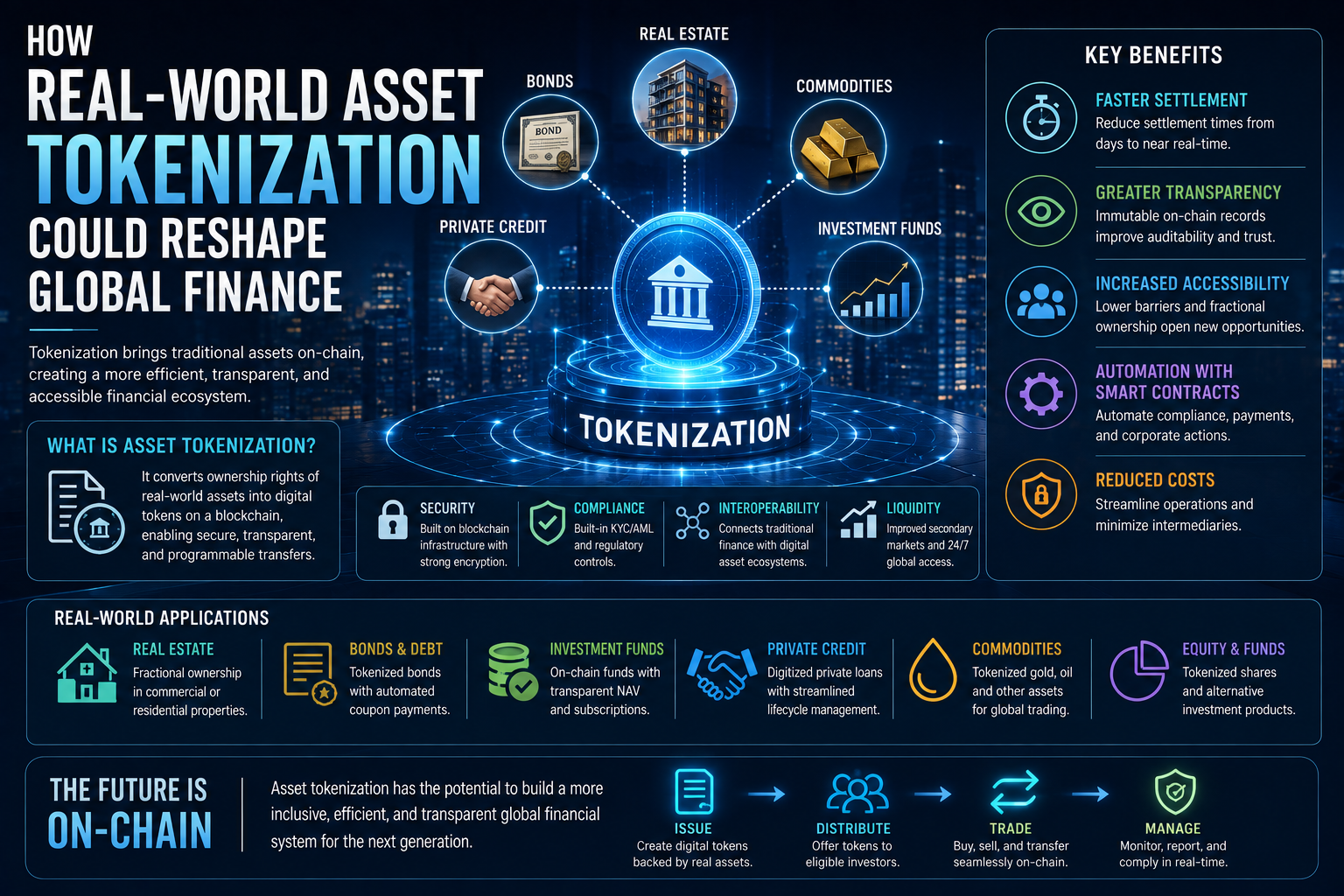
Real-world asset tokenization involves representing ownership or economic rights connected to physical or traditional financial assets through digital tokens on a blockchain or similar distributed ledger. These assets can include real estate, bonds, private credit, commodities, investment funds, and other forms of value.
Although the technology is still developing, tokenization could eventually change how assets are issued, traded, settled, and managed.
For financial institutions, businesses, and investors, the opportunity goes beyond cryptocurrency. Tokenization could create a bridge between traditional financial markets and digital asset infrastructure.
What Is Real-World Asset Tokenization?
Tokenization converts rights associated with an asset into digital representations that can be recorded and transferred through a blockchain-based system.
Instead of relying entirely on traditional databases and intermediaries, ownership information can be represented through digital tokens governed by predefined rules.
For example, a property could theoretically be divided into digital interests that represent specific ownership or economic rights. Similarly, a bond or investment fund could be issued in tokenized form.
The exact legal structure depends on the asset, jurisdiction, and platform.
The important idea is that blockchain technology can provide a programmable digital layer for assets that traditionally exist within conventional financial infrastructure.
Why Financial Institutions Are Interested
Traditional financial markets can involve multiple intermediaries.
Issuance, settlement, custody, recordkeeping, compliance, and transfers may each involve separate systems and organizations.
Tokenization could potentially connect some of these processes through shared digital infrastructure.
Smart contracts can automate predefined actions, while blockchain-based records can provide a transparent and auditable history of transactions.
This could reduce certain administrative processes and potentially make asset management more efficient.
Financial institutions are therefore exploring tokenization as a possible evolution of existing market infrastructure rather than simply treating it as another cryptocurrency application.
Increasing Accessibility to Certain Assets
One potential advantage of tokenization is improved accessibility.
Some traditional investments require significant capital, specialized accounts, or complex administrative arrangements.
Tokenization could potentially allow certain assets to be represented in smaller digital units, depending on applicable securities laws and the structure of the investment.
For example, a qualifying investment vehicle could potentially represent ownership interests through digital tokens.
However, tokenization does not automatically make an asset available to everyone.
Regulatory requirements, investor eligibility, minimum investments, custody arrangements, and transfer restrictions can still apply.
The technology changes the infrastructure, but it does not remove legal obligations.
Tokenized Real Estate
Real estate is frequently discussed as a potential application for tokenization.
Property markets involve large assets, substantial paperwork, and multiple parties.
Tokenization could create digital representations of ownership interests or economic rights connected to properties.
This may eventually make certain transactions easier to manage and could improve the ability to track ownership and transfers.
Investors could also potentially gain exposure to property-related investments through digital platforms.
However, real estate tokenization requires careful legal structuring.
Property ownership is governed by local laws, and a blockchain record alone does not necessarily establish legal ownership of physical property.
Successful platforms therefore need to connect digital tokens with legally enforceable rights.
Tokenized Bonds and Financial Instruments
Financial securities may represent another major opportunity.
Traditional bonds and other financial instruments already exist in digital databases, but tokenization can introduce programmable features and blockchain-based settlement.
A tokenized bond could potentially include automated payment rules, compliance requirements, and transfer conditions within its digital infrastructure.
This could reduce certain manual processes and improve transparency.
Financial institutions could also potentially use tokenized securities to connect issuance and settlement more efficiently.
The technology could become particularly valuable when multiple financial processes can operate on compatible digital infrastructure.
Faster Settlement
Settlement is one of the areas where tokenization could have a meaningful impact.
Traditional financial transactions may require time for different parties to reconcile records and complete settlement.
Blockchain-based systems can potentially allow assets and payments to move through coordinated digital processes.
If the necessary infrastructure is connected, transactions could settle more quickly and with fewer reconciliation steps.
Faster settlement could improve capital efficiency by reducing the time that money or assets remain tied up during transactions.
However, achieving this at scale requires more than blockchain technology. Financial institutions need compatible systems, appropriate regulations, reliable digital identities, and sufficient liquidity.
Smart Contracts Add Programmability
One of the most important features of tokenized assets is programmability.
Smart contracts are software programs that can automatically execute predefined rules when specified conditions are met.
For tokenized assets, these rules could potentially govern transfers, payments, eligibility requirements, or other processes.
For example, a tokenized financial instrument could be designed so that certain payments occur automatically according to predefined conditions.
This could reduce manual administration.
However, smart contracts are software, and software can contain errors.
Financial institutions need strong testing, auditing, security controls, and governance before relying on automated contracts for significant transactions.
Improving Transparency
Blockchain-based tokenization can also improve transaction visibility.
Depending on the network and system design, authorized participants may be able to verify transaction records through a shared ledger.
This can reduce the need for multiple organizations to maintain completely separate records of the same transaction.
Greater transparency could make auditing and reconciliation more efficient.
However, transparency does not mean that all information should be publicly visible.
Financial systems often contain sensitive customer and business information.
Tokenization platforms therefore need appropriate privacy mechanisms and permission structures.
Tokenization and Global Markets
Another potential benefit is the ability to connect financial markets across geographic boundaries.
Traditional markets can be fragmented by different infrastructures, operating hours, settlement systems, and regulatory frameworks.
Digital asset infrastructure operates differently, potentially allowing transactions to occur through connected networks beyond traditional market schedules.
Tokenized assets could eventually support more continuous financial activity.
However, global interoperability remains difficult.
Different jurisdictions have different rules concerning securities, ownership, taxation, investor protection, and financial reporting.
Technology can connect systems, but regulatory compatibility remains essential.
The Role of Stablecoins and Digital Payments
Tokenized assets also require efficient payment infrastructure.
If an investor buys a tokenized asset, the transaction needs a corresponding payment mechanism.
Stablecoins and other digital payment technologies could potentially provide a settlement layer for tokenized markets.
This could allow asset transfers and payments to occur within connected digital environments.
The combination of tokenized assets and digital payment infrastructure could therefore create financial systems where transactions, settlement, and recordkeeping operate more closely together.
The development of appropriate regulation will be important as these markets mature.
New Opportunities for Businesses
Tokenization could create opportunities beyond financial institutions.
Companies could explore new financing structures, digital ownership models, loyalty programs, and asset-management systems.
Businesses holding eligible assets may eventually have additional ways to represent and transfer economic interests.
Tokenized markets could also create new financial products.
Entrepreneurs and technology companies may build infrastructure for custody, compliance, trading, identity verification, analytics, and asset issuance.
This could create an expanding ecosystem around tokenized finance.
Major Challenges Remain
Despite its potential, tokenization faces significant challenges.
Regulatory uncertainty is one of the largest.
A token representing an asset may be classified differently depending on the jurisdiction and structure.
Legal enforceability is another critical issue. Investors need confidence that the digital token corresponds to clearly defined rights.
Security is equally important.
Blockchain networks and smart contracts can be targeted by attackers, while poorly designed systems can create vulnerabilities.
Liquidity is another challenge.
Creating a tokenized market does not automatically create buyers and sellers. Assets need sufficient market participation to support efficient trading.
The Importance of Digital Identity
Tokenized financial markets will also require reliable digital identity systems.
Financial institutions need to know who is participating in transactions and whether participants meet relevant eligibility requirements.
Know-your-customer and anti-money-laundering processes therefore remain important.
Future tokenization platforms may combine blockchain-based asset records with verified digital identities and automated compliance systems.
This could allow financial institutions to manage regulatory requirements more efficiently while maintaining appropriate controls.
The Future of Tokenized Finance
The future financial system may not be entirely traditional or entirely blockchain-based.
Instead, a hybrid model is likely to emerge.
Traditional banks, exchanges, custodians, asset managers, and regulators could increasingly interact with blockchain-based infrastructure.
Some assets may remain within conventional systems, while others are issued or settled through tokenized platforms.
Interoperability will become particularly important.
If different tokenization platforms cannot communicate effectively, markets may remain fragmented.
Common technical standards, regulatory clarity, and institutional cooperation could therefore determine how quickly tokenized finance develops.
Conclusion
Real-world asset tokenization represents one of the most interesting potential applications of blockchain technology.
By creating digital representations of traditional assets, tokenization could improve settlement, increase transparency, automate financial processes, and create new approaches to asset ownership and investment.
Real estate, bonds, investment funds, private credit, and other financial assets could potentially become part of increasingly digital markets.
However, tokenization is not simply a technical transformation. Legal rights, regulation, investor protection, cybersecurity, liquidity, identity, and governance are equally important.
The most successful tokenization platforms will likely be those that combine blockchain technology with strong financial infrastructure and regulatory compliance.
As digital finance continues to mature, tokenization could become an important bridge between traditional markets and the emerging digital economy. For businesses and financial institutions, understanding this development today could help them prepare for a financial system in which ownership, settlement, and asset management become increasingly programmable and digitally connected.