
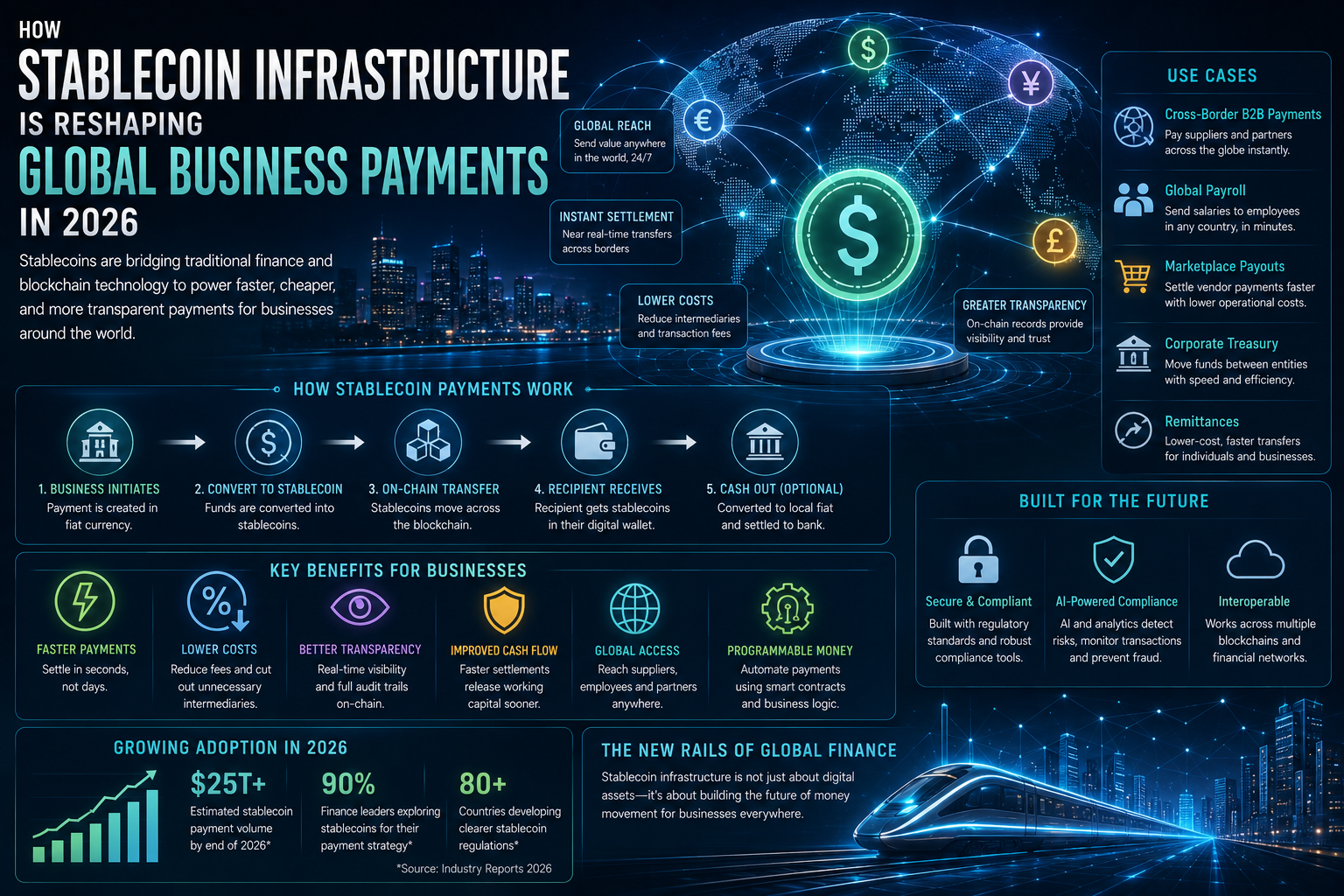
Global payments are entering a new phase of transformation. Businesses increasingly expect money to move as quickly as information, while finance teams want greater visibility, lower settlement friction, and more efficient cross-border operations.
Stablecoins are emerging as one potential piece of that infrastructure.
A stablecoin is a digital asset designed to maintain a relatively stable value, typically by referencing a fiat currency or another asset. While stablecoins have historically been closely associated with cryptocurrency trading, financial institutions and payment companies are increasingly exploring them for business payments, settlement, treasury operations, and cross-border money movement.
The shift is significant because stablecoins can combine blockchain-based programmability with digital representations of fiat value.
Recent developments show that this is moving beyond experimentation. Visa launched a platform in July 2026 designed to help financial institutions, fintechs, and payment providers manage stablecoin operations, while Mastercard announced expanded settlement capabilities involving regulated stablecoins.
BullNext's own coverage is also increasingly focused on blockchain-native payment infrastructure, making stablecoin payments a natural extension of its financial-technology coverage.
What Is Stablecoin Payment Infrastructure?
Stablecoin payment infrastructure is the technology and financial ecosystem that allows businesses to use stablecoins for moving value.
It can include:
Digital wallets
Blockchain networks
Stablecoin issuance and redemption
Custody
Compliance systems
Liquidity providers
Fiat on- and off-ramps
Payment orchestration
Transaction monitoring
Accounting and reconciliation systems
This is important because enterprise payments require much more than simply transferring a token.
A business needs to know who is receiving the money, whether the transaction complies with applicable regulations, how the payment is recorded, how it is converted into local currency, and how it integrates with existing financial systems.
The infrastructure around stablecoins is therefore becoming just as important as the stablecoins themselves.
Why Businesses Are Exploring Stablecoins
Traditional cross-border payments can involve multiple intermediaries, currencies, banking relationships, and settlement processes.
Depending on the corridor and payment structure, this can increase costs and introduce delays.
Stablecoin-based systems can potentially reduce some of these layers by allowing value to move through blockchain networks.
Visa notes that stablecoin-based cross-border payments can offer potentially faster settlement and improved transaction visibility, although the benefits depend on network, compliance, and off-ramp conditions.
For businesses operating internationally, even modest improvements in settlement efficiency can have meaningful effects on working capital and treasury operations.
Faster Cross-Border Settlement
One of the strongest potential advantages is speed.
Traditional international transfers can require several stages before funds become available to the recipient.
Stablecoin transactions can settle on blockchain infrastructure continuously, potentially reducing settlement time.
This could be valuable for:
International suppliers
Global payroll
Marketplace payouts
Remittances
Treasury transfers
Cross-border commerce
However, blockchain settlement is only one part of the process.
If a business still needs to wait for a local bank transfer or currency conversion, the overall payment experience may not be instant.
The real opportunity therefore lies in connecting stablecoin networks with efficient fiat payment infrastructure.
Stablecoins and B2B Payments
Business-to-business payments represent an important potential use case.
Companies regularly pay suppliers across borders.
These transactions can involve invoices, purchase orders, currency conversions, bank accounts, compliance checks, and reconciliation.
Stablecoin infrastructure could potentially simplify the settlement layer.
A company could initiate a payment digitally, move value through a blockchain network, and allow the recipient to receive stablecoins or convert them into local currency.
The surrounding infrastructure can handle compliance, transaction records, and settlement processes.
This creates the possibility of a more programmable B2B payment environment.
Global Supplier Payments
Consider a company headquartered in the United States with suppliers across Asia, Europe, and Latin America.
Today, each payment corridor can have different banking requirements and settlement characteristics.
A stablecoin-based system could provide a common digital settlement layer.
The company could maintain a treasury balance in a supported stablecoin, initiate approved payments, and allow recipients to convert funds into their preferred currencies.
This does not eliminate banking relationships.
Instead, it can potentially reduce some of the friction between digital business systems and traditional financial rails.
Corporate Treasury
Stablecoins could also become relevant to corporate treasury.
Treasury teams are responsible for managing cash, liquidity, payments, and financial risk.
If stablecoin infrastructure becomes sufficiently regulated and reliable, treasury departments may use it for selected cross-border settlement activities.
For example, a multinational company could use digital settlement assets to move funds between corporate entities.
This could potentially reduce settlement delays and provide greater visibility into transaction status.
However, treasury adoption requires careful consideration of custody, liquidity, accounting, regulatory requirements, and counterparty risk.
The Rise of Programmable Money
One of the most interesting features of stablecoins is programmability.
Traditional money can be transferred electronically, but the payment itself is often separated from the business logic surrounding it.
Blockchain-based payments can potentially connect payment execution with predefined conditions.
For example, a smart-contract-based workflow could release payment after an agreed event occurs.
Businesses could potentially automate:
Supplier payments
Escrow arrangements
Recurring settlements
Marketplace payouts
Revenue distribution
Corporate transfers
This creates the concept of programmable money.
The payment becomes part of the software workflow rather than a separate administrative step.
Stablecoins and AI Agents
The combination of stablecoins and AI agents could create another major development.
AI agents are increasingly being designed to perform multi-step business tasks.
In the future, an authorized AI agent could potentially identify an approved invoice, verify relevant information, determine whether the payment meets company rules, and prepare a stablecoin transaction.
Human approval could remain necessary for higher-risk payments.
This creates a potential financial workflow:
Business event → AI analysis → compliance check → approval → programmable payment → automated reconciliation.
The combination of AI and digital payment infrastructure could significantly reduce administrative friction.
Payment Reconciliation
Reconciliation remains a major challenge for businesses.
Finance teams need to match payments with invoices, customers, suppliers, and accounting records.
Blockchain transactions provide digitally recorded transaction histories, which can potentially simplify parts of reconciliation.
Modern stablecoin platforms can also integrate payment data with enterprise systems.
This can help finance teams understand where funds moved and connect transactions with business records.
The result could be a more automated financial workflow.
The Importance of Fiat On- and Off-Ramps
Stablecoins cannot operate in isolation from traditional currencies.
Most businesses ultimately need to pay employees, suppliers, taxes, and other expenses in local fiat currencies.
This makes on- and off-ramp infrastructure critical.
A business might receive stablecoins and then convert them into dollars, euros, pounds, or another local currency.
The quality of these conversion systems can determine how useful stablecoins are for real-world commerce.
This is why payment providers, banks, and fintech companies are increasingly building infrastructure around stablecoin settlement.
Institutional Adoption
Institutional adoption is becoming an important part of the stablecoin story.
Financial institutions generally require:
Regulatory clarity
Strong custody
Reliable reserves
Compliance systems
Transaction monitoring
Operational resilience
Privacy controls
Recent industry developments show financial institutions actively exploring these requirements.
Visa announced a stablecoin platform designed for financial institutions, fintechs, and payment providers, while its collaboration with Brale is exploring privacy-enabled stablecoin settlement for institutional payments.
This suggests the market is increasingly focused on infrastructure rather than simply token creation.
Stablecoin Regulation
Regulation will play a major role in determining how quickly stablecoin payments become mainstream.
Governments and financial regulators are increasingly establishing frameworks around stablecoin issuance, custody, reserves, and payment activity.
The United Kingdom, for example, published a coordinated framework for regulating systemic stablecoin issuers through the Bank of England and Financial Conduct Authority.
Regulatory clarity can give businesses greater confidence.
At the same time, compliance requirements can make stablecoin infrastructure more complex.
The winning platforms will likely be those that combine blockchain efficiency with financial-grade compliance.
Stablecoin Reserves Matter
A stablecoin's usefulness depends heavily on confidence in its value.
Users need to understand how the stablecoin maintains its peg and what assets or mechanisms support it.
For businesses, reserve transparency is particularly important.
Corporate finance departments are unlikely to treat a digital asset as reliable payment infrastructure without confidence in its liquidity and redemption mechanisms.
This is why regulated issuance and transparent reserve management are becoming increasingly important.
Stablecoins Are Not Yet Traditional Payments
Despite the rapid development of the ecosystem, stablecoins have not replaced traditional payment systems.
The Federal Reserve Bank of Kansas City noted in April 2026 that stablecoins were still used predominantly within crypto finance, with limited real-economy payment usage and interoperability challenges.
The BIS similarly reported that payment-related stablecoin flows were still modest relative to traditional payment systems, despite large overall on-chain transaction volumes.
This distinction is important.
The technology has potential, but widespread business adoption still depends on regulation, interoperability, liquidity, user experience, and integration.
Stablecoins and Emerging Markets
Stablecoins could be particularly relevant in markets where access to international financial infrastructure is more difficult or expensive.
Dollar-linked digital assets can provide another way to access digital representations of dollar value.
However, this can also raise monetary-policy, regulatory, and financial-stability questions.
Businesses operating in emerging markets must therefore evaluate local rules carefully.
Stablecoin infrastructure should complement legitimate financial operations rather than bypass regulatory requirements.
The Challenge of Interoperability
The stablecoin ecosystem includes multiple blockchains, issuers, wallets, payment providers, and financial institutions.
These systems do not automatically communicate with one another.
Interoperability is therefore a major issue.
A business should ideally be able to send value through one infrastructure provider while the recipient can receive and convert it through another.
Standards and connectivity between payment systems will be essential for broader adoption.
Security and Custody
Stablecoin payments introduce digital-asset security considerations.
Businesses need to protect wallets, private keys, APIs, and transaction authorization systems.
A compromised corporate wallet could potentially expose significant funds.
Enterprise-grade custody and authorization systems are therefore critical.
Companies may also prefer managed infrastructure that allows them to use stablecoin settlement without directly controlling private keys.
This approach is already emerging in the market. Circle's managed payments offering, for example, is designed to let financial institutions and businesses access stablecoin settlement while the provider manages parts of the digital-asset lifecycle.
Stablecoins and Global Commerce
The long-term opportunity is broader than cryptocurrency.
Imagine a global marketplace where a customer in one country purchases a service from a company in another.
The marketplace could accept traditional payment methods from the customer while using stablecoin infrastructure behind the scenes for international settlement.
The customer may never interact with a blockchain.
The business may receive local currency.
The stablecoin could simply function as an efficient settlement layer between financial institutions and payment providers.
This is arguably one of the most important directions for stablecoin adoption.
How Businesses Can Prepare
Businesses interested in stablecoin payments should begin with specific use cases rather than attempting to rebuild their entire payment infrastructure.
Potential starting points include:
Cross-border supplier payments
International payouts
Treasury transfers
Marketplace settlements
Digital-asset transactions
Selected B2B payment corridors
Companies should evaluate regulatory requirements, fees, liquidity, settlement speed, custody, accounting, and integration before deployment.
A controlled pilot can provide valuable operational experience.
The Future of Global Payments
Stablecoins are unlikely to eliminate banks, cards, payment processors, or traditional currencies.
Instead, they may become another layer within the global financial infrastructure.
Banks can provide accounts and custody.
Payment networks can provide customer access.
Fintech companies can provide APIs and interfaces.
Blockchain networks can provide settlement infrastructure.
Stablecoins can represent digital units of value.
AI can automate and optimize the workflows connecting them.
This creates a potentially powerful financial ecosystem.
Conclusion
Stablecoin infrastructure is evolving from a cryptocurrency-focused technology into a potential component of modern business payments.
The biggest opportunities are likely to emerge in cross-border settlement, B2B payments, treasury operations, global payouts, and programmable financial workflows.
Recent moves by major payment and financial institutions demonstrate growing interest in making stablecoin infrastructure usable within regulated financial environments.
But adoption will not happen automatically.
Businesses need reliable reserves, regulatory clarity, secure custody, strong compliance, liquidity, interoperability, and easy integration with existing financial systems.
The most important development may therefore be the infrastructure surrounding stablecoins rather than the tokens themselves.
If the industry succeeds in connecting blockchain settlement with banks, payment networks, enterprise software, and regulatory frameworks, stablecoins could become a largely invisible part of global commerce.
Customers may simply see faster payments.
Businesses may see improved settlement and treasury efficiency.
And financial institutions may gain a programmable new layer for moving value around the world.
In 2026, that transformation is still developing—but the infrastructure required to make digital money useful for everyday global business is being built now.