Innovation is one of the most important drivers of business growth, economic development, and technological progress. In a rapidly changing world, organizations must continuously explore new ideas, improve existing processes, and find better ways to meet customer needs. Businesses that embrace innovation can identify new opportunities, respond to market changes, and build stronger competitive advantages.
Innovation is not limited to inventing new products or developing advanced technology. It also includes improving customer experiences, redesigning business processes, introducing new services, and discovering more efficient ways to solve everyday problems.
From small businesses to multinational corporations, innovation helps organizations adapt to changing expectations and create long-term value. By encouraging creativity, investing in research, and learning from experience, businesses can turn promising ideas into practical solutions.
Understanding the different types of innovation, their benefits, and the strategies used to support them can help business leaders make better decisions and prepare their organizations for the future.
What Is Innovation?
Innovation is the process of developing and implementing new or significantly improved products, services, processes, or business models that create value.
An idea becomes meaningful innovation when it is put into practice and produces a useful outcome. This may involve improving an existing product, reducing operational costs, making a service easier to access, or creating an entirely new way to serve customers.
For example, a retailer that introduces a more convenient online ordering system is innovating its customer experience. A manufacturer that uses sensors to identify equipment problems before breakdowns occur is improving its operations through technology.
Innovation can be incremental, involving small improvements over time, or more transformative, changing how an industry operates.
The most appropriate approach depends on the organization's resources, objectives, market conditions, and willingness to experiment.
Why Is Innovation Important in Business?
Innovation allows businesses to remain relevant, improve performance, and respond to emerging opportunities. Organizations that consistently evaluate their products and processes are often better positioned to identify areas for improvement.
1. Creates a Competitive Advantage
Businesses compete on factors such as price, quality, convenience, customer service, and product features. Innovation can help an organization distinguish its offerings from competitors.
A company might develop a faster service, introduce a unique product feature, or create a more personalized customer experience.
A competitive advantage is more sustainable when the innovation provides genuine value that customers recognize and competitors cannot easily reproduce.
2. Improves Operational Efficiency
Innovation can help organizations reduce waste, simplify workflows, automate repetitive tasks, and use resources more effectively.
For example, digital inventory systems can help retailers monitor stock levels and reduce the likelihood of shortages or excess inventory.
Improved efficiency may reduce costs and allow employees to focus on activities that require greater judgment or specialized expertise.
3. Enhances Customer Experience
Customer expectations continue to evolve. Businesses must understand what customers need and identify ways to make products and services more useful, accessible, and convenient.
Innovation can improve the customer journey through better website design, faster support, personalized recommendations, simpler payment systems, and more responsive service.
Organizations that collect feedback and test improvements can develop solutions that address real customer problems.
4. Opens New Revenue Opportunities
New products, services, markets, and business models can create additional sources of income.
A traditional retailer, for example, may expand into e-commerce, subscriptions, or specialized services. A professional services company might introduce digital products or remote consulting options.
Successful expansion requires research, financial planning, and an understanding of customer demand.
5. Supports Long-Term Growth
Innovation helps organizations adapt when customer preferences, technologies, or market conditions change.
Rather than depending entirely on existing products or established practices, innovative businesses regularly assess new opportunities and prepare for possible challenges.
This approach can improve resilience and help organizations remain competitive over time.
Different Types of Innovation
Innovation takes many forms. Businesses should understand the main categories to identify which approaches best match their objectives.
1. Product Innovation
Product innovation involves creating new products or significantly improving existing ones.
Improvements may include better functionality, greater reliability, improved design, new materials, or additional features.
For example, a company might redesign a household appliance to reduce energy consumption or develop software that helps customers complete tasks more efficiently.
Product innovation should be guided by customer needs, technical feasibility, and the ability to deliver sustainable value.
2. Service Innovation
Service innovation focuses on improving how services are designed, delivered, and experienced.
Examples include online appointment booking, remote consultations, faster customer support, and flexible subscription options.
Service innovation can be especially important for organizations whose success depends on customer satisfaction and convenience.
3. Process Innovation
Process innovation involves improving the methods used to produce goods, deliver services, or manage internal operations.
Organizations may introduce automation, redesign workflows, improve quality control, or adopt better inventory systems.
The objective is to improve performance through greater efficiency, reliability, quality, or speed.
4. Business Model Innovation
Business model innovation changes how an organization creates, delivers, and captures value.
Examples include moving from one-time sales to subscriptions, introducing a marketplace connecting buyers and sellers, or offering digital services alongside physical products.
A business model change can create new opportunities, but it may also require new capabilities, pricing structures, and customer relationships.
5. Marketing Innovation
Marketing innovation involves introducing new approaches to product promotion, customer engagement, positioning, or distribution.
Examples include interactive campaigns, personalized communication, new content formats, and improved customer segmentation.
Businesses should measure whether these approaches attract relevant customers and contribute to meaningful commercial outcomes.
6. Organizational Innovation
Organizational innovation involves improving how people collaborate, how responsibilities are structured, and how work is managed.
Examples include cross-functional teams, flexible project structures, new knowledge-sharing systems, and improved decision-making processes.
Effective organizational innovation can help companies respond more quickly to problems and encourage employees to contribute ideas.
The Role of Technology in Innovation
Technology has expanded the possibilities for developing new products, improving services, and transforming business operations.
Digital tools allow organizations to collect information, automate routine tasks, connect with customers, and test new ideas more efficiently.
Artificial Intelligence
Artificial intelligence can support research, forecasting, customer service, content development, data analysis, and workflow automation.
For example, an organization may use AI to categorize customer inquiries or help analysts identify patterns in large datasets.
However, AI systems can make mistakes and may introduce privacy, security, or fairness concerns. Businesses should review outputs, protect sensitive information, and maintain appropriate human oversight.
Cloud Computing
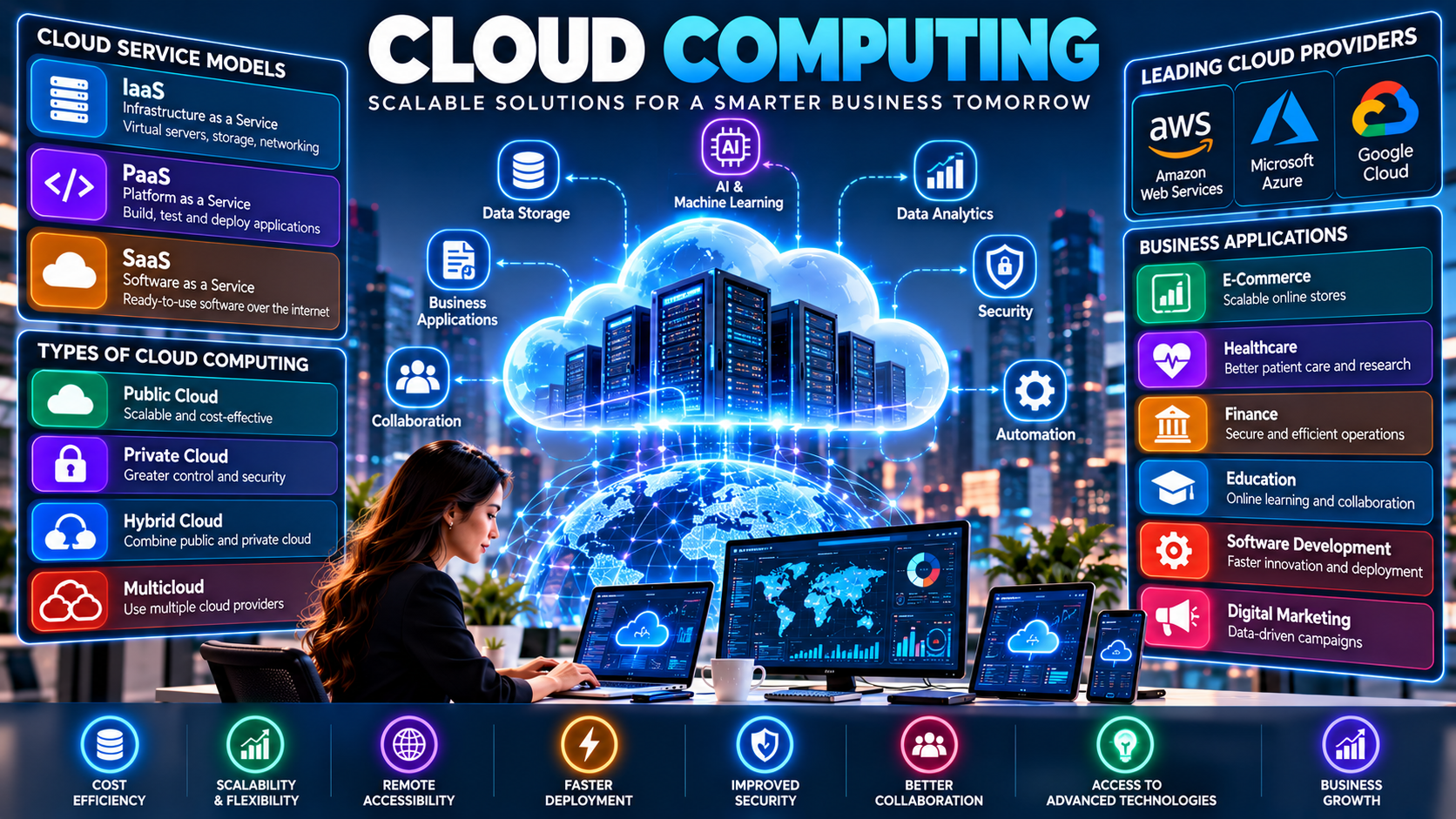
Cloud computing allows organizations to access computing resources, software, and data storage through internet-based services.
It can make it easier for teams to collaborate, scale digital operations, and deploy new services without managing all infrastructure themselves.
Businesses should still evaluate costs, security, reliability, and data governance before adopting cloud platforms.
Internet of Things
The Internet of Things (IoT) connects physical devices equipped with sensors and network capabilities.
In manufacturing, logistics, agriculture, and buildings, connected devices can monitor conditions, track assets, and provide information that supports operational decisions.
These applications may improve efficiency, but they also require attention to cybersecurity and data quality.
Data Analytics
Data analytics helps organizations identify patterns, evaluate performance, and understand customer behavior.
Businesses can use analytics to improve inventory planning, assess marketing campaigns, forecast demand, and monitor operational performance.
The value of analytics depends on reliable data, appropriate methods, and the ability to translate findings into practical decisions.
Automation
Automation can reduce repetitive manual work and improve consistency in routine processes.
Examples include automated invoice processing, warehouse sorting, software testing, and appointment reminders.
Before automating a process, organizations should understand the existing workflow and ensure that automation addresses a genuine problem rather than adding unnecessary complexity.
How Innovation Drives Business Growth
Innovation contributes to growth when it connects new ideas with customer needs and organizational objectives.
Identifying Untapped Markets
Businesses can explore customer groups whose needs are not adequately served by existing products or services.
Market research, customer interviews, competitor analysis, and small-scale experiments can help determine whether an opportunity is worth pursuing.
Improving Product Quality
Customer feedback and operational data can reveal weaknesses in existing offerings.
Companies can use these insights to improve reliability, usability, design, and performance.
Expanding Into New Markets
Innovation may help businesses adapt their offerings for new regions or customer segments.
Successful expansion requires an understanding of local preferences, pricing, regulations, distribution channels, and competitive conditions.
Increasing Customer Retention
Improved services and useful new features can give customers stronger reasons to continue using a product or service.
Retention also depends on trust, reliability, fair pricing, and consistent customer support.
Developing New Partnerships
Collaboration with technology providers, research institutions, suppliers, startups, and other businesses can provide access to expertise and resources that an organization may not possess internally.
Strong partnerships require clear objectives, compatible expectations, and appropriate agreements regarding intellectual property and confidential information.
Building a Culture of Innovation
Innovation is more effective when employees are encouraged to identify problems, suggest improvements, and test ideas responsibly.
A culture of innovation does not require every employee to invent something revolutionary. Often, meaningful progress comes from small improvements suggested by people who understand everyday operations.
Encourage Employee Ideas
Create opportunities for employees to share suggestions, identify inefficiencies, and discuss customer concerns.
Leaders should respond constructively, explain decisions, and recognize useful contributions.
Allow Responsible Experimentation
Not every idea will succeed. Businesses can reduce the cost of failure by testing promising concepts on a small scale before making major investments.
Experiments should have clear objectives, defined budgets, and appropriate risk controls.
Support Cross-Functional Collaboration
Employees from different departments often understand different parts of a business problem.
Bringing together marketing, finance, operations, technology, and customer support can help organizations develop more complete solutions.
Invest in Learning and Development
Training helps employees understand new tools, improve problem-solving skills, and respond to changing requirements.
Organizations should connect training with practical projects so that employees can apply what they learn.
Recognize Meaningful Results
Rewarding useful improvements can reinforce innovative behavior. Recognition should focus on the value created, lessons learned, and contributions to organizational objectives.
A Practical Innovation Process
Businesses can follow a structured process to move from an initial idea to a tested solution.
Step 1: Identify a problem or opportunity.
Start with a customer need, operational challenge, market gap, or business objective. A clearly defined problem makes it easier to evaluate possible solutions.
Step 2: Research the situation.
Gather relevant customer feedback, operational data, market information, and competitor insights. Confirm that the problem is real and worth addressing.
Step 3: Generate possible solutions.
Invite ideas from relevant employees, customers, and external experts. Consider multiple approaches rather than committing to the first suggestion.
Step 4: Evaluate feasibility.
Assess potential benefits, costs, required skills, technical limitations, legal considerations, and risks.
Step 5: Build a prototype or pilot.
Develop a small-scale version of the solution or test it with a limited group. This helps reveal problems before a wider launch.
Step 6: Measure results.
Compare performance with the original objective. Useful measures may include customer satisfaction, processing time, conversion rates, cost savings, product quality, or revenue.
Step 7: Improve and scale.
Use the findings to refine the solution. Expand successful initiatives when the evidence supports further investment.
Step 8: Review long-term performance.
Continue monitoring the innovation after implementation. Customer needs and market conditions can change, making further adjustments necessary.
Common Barriers to Innovation
Although innovation offers significant opportunities, businesses may face challenges when trying to develop and implement new ideas.
Limited Budgets
Research, development, training, and technology investments can be expensive.
Businesses can manage costs by prioritizing high-value problems, testing ideas on a small scale, and expanding initiatives only when results justify the investment.
Resistance to Change
Employees may be concerned about unfamiliar systems, changing responsibilities, or the possibility of job disruption.
Leaders can reduce resistance by explaining the reasons for change, involving employees in planning, providing training, and responding honestly to concerns.
Lack of Clear Direction
Innovation efforts may become ineffective when organizations pursue too many ideas without clear priorities.
Connecting innovation projects to specific business objectives helps leaders allocate resources and evaluate results.
Fear of Failure
If employees are punished for every unsuccessful experiment, they may avoid suggesting new ideas.
Organizations should distinguish between reasonable experiments that do not produce expected results and avoidable failures caused by poor planning or ignored risks.
Skills Gaps
Some innovations require expertise that the organization does not currently possess.
Businesses can address these gaps through training, recruitment, external partnerships, or carefully selected technology providers.
Poor Implementation
An innovative idea may fail if it is not supported by adequate planning, communication, resources, or employee training.
Implementation should be treated as an essential part of innovation rather than an afterthought.
How to Measure Innovation Success
Innovation should be evaluated according to the objectives of each initiative. A new product, an internal process improvement, and a research project may require different performance measures.
Useful indicators include:
Revenue generated by new products or services.
Customer satisfaction and retention.
Reduction in operating costs.
Improvement in product quality.
Reduction in delivery or processing time.
Adoption rates for new services or tools.
Number of successful experiments.
Time required to move from idea to implementation.
Employee participation in improvement initiatives.
Return on innovation investment.
Businesses should avoid relying on the number of ideas alone. A large number of proposals does not necessarily indicate meaningful innovation.
A balanced evaluation considers the quality of ideas, implementation progress, customer value, financial outcomes, and lessons learned.
Innovation in Small Businesses and Startups
Innovation is not limited to large corporations with extensive research budgets. Small businesses and startups can innovate by understanding customer needs, responding quickly to feedback, and improving how they deliver value.
For example, a local service provider might introduce online booking, a small retailer could improve inventory tracking, or a startup could test a new subscription model.
Smaller organizations may have the advantage of shorter decision-making processes and closer relationships with customers.
However, limited resources make prioritization especially important. Business owners should focus on problems that affect customers or operations directly and test solutions before committing substantial resources.
Partnerships, affordable digital tools, and customer feedback can help small businesses explore opportunities without taking unnecessary risks.
The Future of Innovation
Innovation will continue to influence how businesses operate, compete, and serve customers.
Artificial intelligence, robotics, biotechnology, clean energy, advanced materials, and connected digital systems are creating opportunities across many industries. At the same time, organizations must evaluate the practical value, costs, and risks associated with new technologies.
Sustainability is also becoming an important consideration. Businesses may explore ways to reduce waste, improve energy efficiency, extend product life, and use resources more responsibly.
Future innovation will require collaboration among business leaders, employees, researchers, technology specialists, and customers. Organizations that learn continuously and evaluate ideas carefully may be better prepared to respond to new challenges.
The goal should not be to adopt every new technology. It should be to identify meaningful opportunities and use appropriate solutions to create measurable value.
Conclusion
Innovation is an essential part of business growth, competitiveness, and long-term adaptability. By developing new products, improving services, optimizing processes, and exploring better business models, organizations can respond to customer needs and identify new opportunities.
Successful innovation requires more than creativity. It depends on research, collaboration, responsible experimentation, practical implementation, and ongoing measurement.
Businesses that encourage employees to share ideas, invest in relevant skills, and learn from experience can create stronger foundations for continuous improvement.
Whether an organization is a startup, a small business, or a multinational company, innovation can help turn useful ideas into practical results and support sustainable growth in an evolving business environment.
Frequently Asked Questions About Innovation
What is innovation in business?
Innovation in business is the development and implementation of new or significantly improved products, services, processes, or business models that create value for customers or the organization.
Why is innovation important?
Innovation helps businesses improve efficiency, respond to customer needs, develop competitive advantages, explore new revenue opportunities, and adapt to changing markets.
What are the main types of innovation?
Common types include product innovation, service innovation, process innovation, business model innovation, marketing innovation, and organizational innovation.
How does technology support innovation?
Technology can help organizations automate tasks, analyze data, improve communication, develop new products, and create more convenient customer experiences.
How can small businesses innovate?
Small businesses can innovate by listening to customers, improving existing services, testing new ideas on a small scale, using appropriate digital tools, and collaborating with partners.
How can companies encourage innovation?
Companies can encourage innovation by supporting employee ideas, providing training, enabling collaboration, allowing responsible experimentation, and recognizing useful improvements.
How can innovation be measured?
Innovation can be measured through indicators such as customer satisfaction, revenue from new offerings, cost savings, product quality, adoption rates, operational efficiency, and project outcomes.
What is the future of innovation?
Future innovation will likely involve continued advances in artificial intelligence, automation, digital systems, sustainable technologies, and data-driven decision-making. The most effective solutions will address real needs while managing risks responsibly.