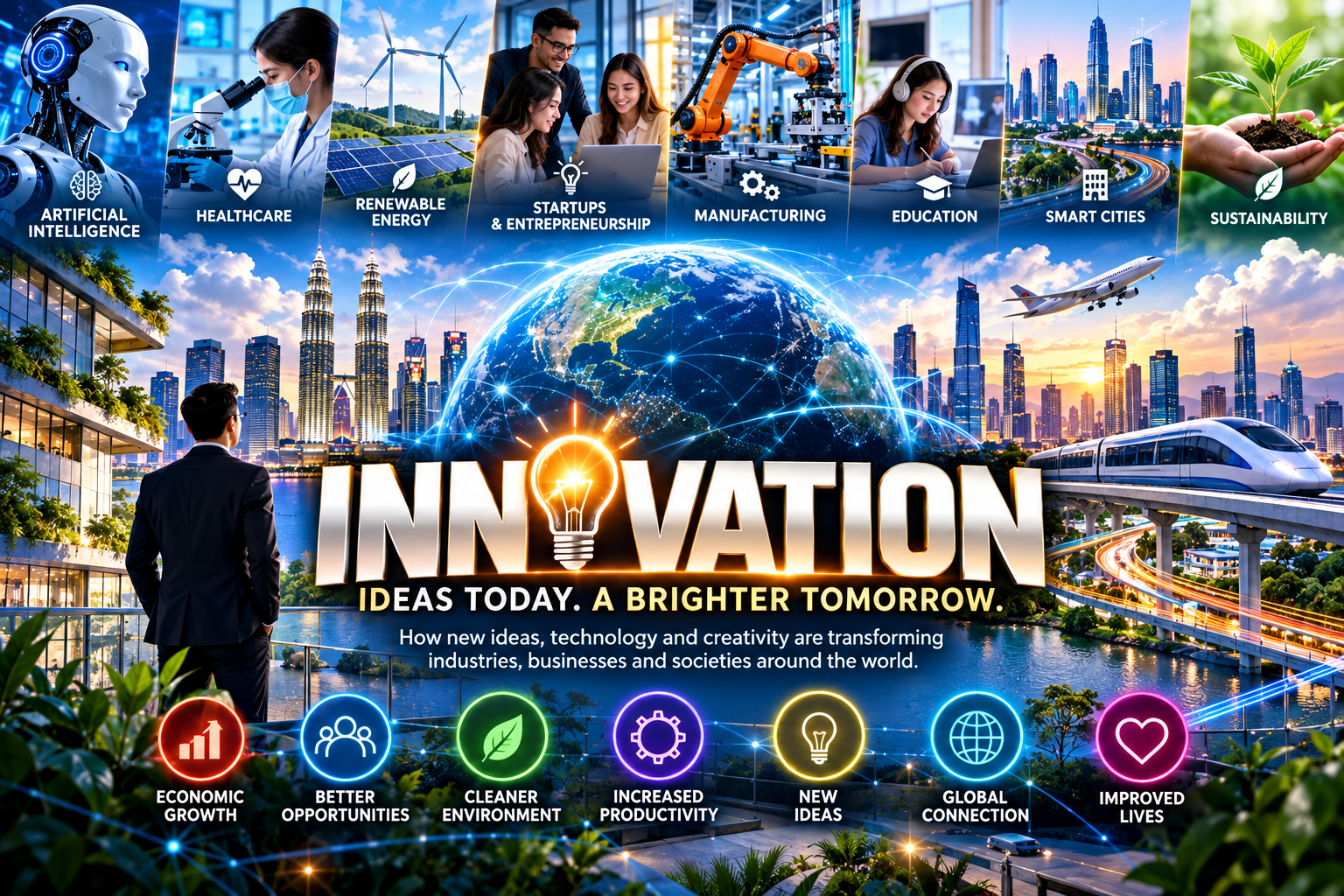
Innovation is one of the most important forces shaping the modern world. From artificial intelligence and robotics to renewable energy, biotechnology, digital finance, smart cities, and advanced manufacturing, innovation is changing how people live, work, communicate, and conduct business.
Innovation is not limited to inventing something completely new. It can also mean improving an existing product, developing a more efficient process, creating a new business model, or finding a better way to solve a social or economic problem.
Today, innovation is increasingly connected to technology, data, research, entrepreneurship, and collaboration. The World Intellectual Property Organization's Global Innovation Index 2025 examined innovation across 139 economies and found that technological progress continued even as growth in research and development investment and venture capital became more restrained.
What Is Innovation?
Innovation is the process of turning new or improved ideas into products, services, processes, technologies, or business models that create value.
An idea by itself is not necessarily an innovation. Innovation generally requires implementation. For example, developing a new software concept is an idea, while successfully turning that concept into a product that solves a real problem can become an innovation.
Innovation can happen in almost every industry, including:
Technology
Healthcare
Finance
Manufacturing
Agriculture
Education
Transportation
Energy
Real estate
Retail
Entertainment
Telecommunications
Innovation can therefore be technological, commercial, organizational, scientific, or social.
Why Is Innovation Important?
Innovation helps organizations and economies adapt to changing conditions. Businesses that develop better products and processes can respond to changing customer expectations, new technologies, and competitive pressures.
The OECD describes digital innovation as a driver of productivity, job creation, sustainable growth, new business models, and new markets. Digital technologies and data are also being used across sectors such as education, healthcare, finance, transportation, energy, agriculture, and manufacturing.
Innovation can contribute to:
Higher productivity
Better products and services
Lower operating costs
New industries
New employment opportunities
Greater business efficiency
Improved healthcare
Cleaner energy systems
Better communication
Economic growth
Solutions to social challenges
However, innovation does not automatically produce positive results. New technologies can also create challenges involving privacy, cybersecurity, inequality, employment disruption, intellectual property, and environmental impact.
Types of Innovation
Innovation takes many forms. Understanding the different categories helps explain why innovation extends far beyond technology companies.
Product Innovation
Product innovation involves creating a new product or significantly improving an existing one.
Examples include:
Smartphones with advanced computing capabilities
Electric vehicles
Wearable health devices
AI-powered software
Energy-efficient appliances
Advanced medical equipment
Product innovation often focuses on improving performance, convenience, affordability, safety, or user experience.
Process Innovation
Process innovation focuses on improving how something is produced or delivered.
Manufacturers may introduce robotics and automation to improve production efficiency. Logistics companies may use artificial intelligence to optimize routes. Banks may automate parts of their customer-service operations.
These changes may not be visible to consumers, but they can significantly affect costs and productivity.
Business Model Innovation
A company can also innovate by changing how it makes money or delivers value.
Subscription services, digital marketplaces, software-as-a-service platforms, online education, and app-based businesses are examples of business-model innovation.
A business may therefore become innovative without creating an entirely new technology.
Organizational Innovation
Organizational innovation involves changing internal structures, management systems, workflows, or methods of collaboration.
Remote and hybrid work, cross-functional teams, digital collaboration systems, and data-driven decision-making can all influence how organizations operate.
Technology and Innovation
Technology is one of the strongest drivers of modern innovation.
Digital technologies have reduced the cost of producing, processing, storing, and distributing information. The OECD notes that digital transformation has increased opportunities for experimentation, collaboration, new services, and data-driven innovation.
Technologies contributing to today's innovation landscape include:
Artificial intelligence
Cloud computing
Robotics
Internet of Things
Blockchain
Advanced semiconductors
Biotechnology
Quantum computing
5G and advanced connectivity
3D printing
Renewable energy technologies
These technologies often interact with one another. For example, an intelligent manufacturing facility may combine robotics, sensors, cloud computing, artificial intelligence, and real-time data analysis.
Artificial Intelligence and the New Innovation Era
Artificial intelligence has become a major area of innovation across industries.
AI systems can analyze large datasets, automate repetitive tasks, generate content, assist researchers, support customer service, identify patterns, and help organizations make decisions.
Generative AI has also become an important area of research and commercial development.
WIPO reported in July 2026 that published generative-AI patent families increased from approximately 14,000 in 2023 to more than 37,800 in 2025. WIPO also reported that more than 56,000 new generative-AI patent families were published during 2024 and 2025 combined.
The growth of AI innovation is creating opportunities in areas such as:
Healthcare
Software development
Financial services
Education
Manufacturing
Cybersecurity
Marketing
Scientific research
Transportation
Robotics
At the same time, AI raises questions about intellectual property, data governance, employment, safety, misinformation, and responsible use.
Innovation in Healthcare
Healthcare innovation can directly affect quality of life.
Researchers and companies are developing new diagnostic technologies, medicines, medical devices, digital health platforms, robotic surgical systems, and personalized treatment approaches.
Artificial intelligence can help researchers analyze medical information and identify patterns. Biotechnology can support the development of new therapies. Digital health platforms can make some healthcare services more accessible.
WIPO's 2025 innovation research also highlighted continuing progress in areas such as genome sequencing, although innovation performance varies considerably between health technologies and other sectors.
Innovation and Renewable Energy
Innovation is also important to the transition toward cleaner energy.
Solar panels, wind turbines, batteries, electric vehicles, smart grids, and energy-management systems have all developed significantly over recent decades.
According to WIPO's Global Innovation Tracker, battery prices continued to decline in 2024, while renewable-energy technologies also benefited from falling costs.
Innovation can help make energy systems:
More efficient
More affordable
More reliable
Less carbon intensive
Easier to manage
Future innovation may increasingly combine renewable energy with storage, smart grids, artificial intelligence, and distributed energy systems.
Innovation in Business
Businesses use innovation to respond to changing customer needs and competitive markets.
A company may innovate by:
Identifying a customer problem.
Researching possible solutions.
Developing a prototype.
Testing the idea.
Collecting customer feedback.
Improving the product.
Launching it commercially.
Measuring results.
Continuing to refine the solution.
Successful innovation is therefore often an ongoing process rather than a single event.
Startups and Entrepreneurship
Startups play an important role in innovation because they can experiment with new technologies and business models.
Young companies may focus on problems that established businesses have not addressed effectively. Some startups eventually grow into major companies, while others fail or change direction.
The startup ecosystem generally depends on several elements:
Entrepreneurs
Skilled workers
Universities
Research institutions
Venture capital
Customers
Infrastructure
Intellectual property systems
Government policies
Business networks
However, innovation investment can be uneven. WIPO reported that global venture-capital deal numbers declined for a third consecutive year in 2024, even though overall deal value increased, partly because of very large investments in generative AI.
Innovation and Small Businesses
Innovation is not only for large corporations.
Small and medium-sized businesses can innovate by adopting digital tools, improving customer service, introducing new products, automating processes, or entering new markets.
For example, a small retailer can use an e-commerce platform to reach customers beyond its local area. A restaurant can use digital ordering systems. A manufacturer can introduce automated quality control.
The OECD has highlighted the importance of innovation diffusion because differences in digital adoption can contribute to productivity gaps between businesses.
Innovation and Education
Education is another major area affected by innovation.
Digital learning platforms, online classrooms, interactive educational software, AI-assisted tutoring, virtual laboratories, and digital libraries can expand access to information.
Innovation can also change what students need to learn. As automation increases, skills such as creativity, critical thinking, communication, data literacy, problem-solving, and adaptability can become increasingly important.
Universities also contribute to innovation through scientific research, patents, entrepreneurship programs, and collaboration with industry.
Innovation in Manufacturing
Manufacturing has undergone significant technological transformation.
Modern factories increasingly use:
Industrial robots
Artificial intelligence
Sensors
Digital twins
Predictive maintenance
3D printing
Automated quality control
Connected production systems
This transformation is sometimes described as Industry 4.0.
The goal is often to make production more flexible, efficient, accurate, and responsive.
Innovation and Smart Cities
Cities are also becoming laboratories for innovation.
Smart-city technologies can connect transportation, energy systems, public services, buildings, and infrastructure through sensors and digital platforms.
Potential applications include:
Intelligent traffic management
Smart parking
Connected public transportation
Energy-efficient buildings
Digital government services
Waste-management systems
Public safety technologies
Smart water networks
The effectiveness of these systems depends not only on technology but also on infrastructure, governance, affordability, privacy, and public participation.
Innovation and Intellectual Property
Innovation often creates intellectual property.
Patents can protect qualifying inventions, while trademarks can protect brands and copyrights can protect original creative works.
Intellectual property can help innovators commercialize their ideas and attract investment. At the same time, intellectual-property systems need to balance protection with competition and the broader dissemination of knowledge.
Patenting activity is therefore one of the indicators used to understand innovation ecosystems. WIPO reported that international patent filings increased slightly in 2024 after declining in 2023, although growth remained modest.
Innovation and Sustainability
Sustainability is becoming increasingly connected to innovation.
Companies and researchers are developing technologies designed to reduce waste, conserve resources, improve energy efficiency, and lower environmental impacts.
Examples include:
Renewable energy
Electric transportation
Sustainable construction
Circular-economy systems
Low-carbon materials
Water-saving technologies
Sustainable agriculture
Battery recycling
Innovation can therefore contribute to economic development while addressing environmental challenges, although technological solutions must be evaluated for their full lifecycle impacts.
The Role of Data in Innovation
Data has become an important resource for modern innovation.
Companies can use customer information, operational data, sensor readings, market information, and scientific datasets to identify patterns and improve products.
The OECD has described data as a core input for innovation in the digital economy, while also noting that smaller businesses may face challenges in developing the capabilities needed to use data effectively.
Data-driven innovation requires attention to:
Privacy
Cybersecurity
Data quality
Data governance
Ethical use
Access
Interoperability
Challenges Facing Innovation
Innovation can create opportunities, but it also faces significant barriers.
High Costs
Research, product development, testing, infrastructure, and skilled employees can require substantial investment.
Access to Capital
Innovative startups may struggle to obtain financing, particularly during periods of economic uncertainty.
Skills Shortages
Advanced technologies require specialized knowledge in areas such as software engineering, AI, biotechnology, cybersecurity, and advanced manufacturing.
Regulation
Regulation can affect how quickly new technologies reach consumers. Effective regulation often needs to balance innovation with safety, competition, privacy, and public interests.
Unequal Access
Not every company, region, or population has equal access to advanced technology and innovation infrastructure.
Failure
Innovation involves experimentation, and experiments can fail. Businesses must therefore be able to learn from unsuccessful projects rather than treating every failure as wasted effort.
The Future of Innovation
The future of innovation will likely involve greater interaction between technologies.
Artificial intelligence could work alongside robotics. Biotechnology could combine with advanced computing. Renewable energy could connect with smart grids and battery systems. Digital twins could transform manufacturing and infrastructure planning.
WIPO's 2025 research describes innovation as being at a point of recalibration: investment growth has slowed in several areas, while breakthroughs in AI, quantum computing, batteries, computing efficiency, and other technologies continue.
This suggests that the next stage of innovation may depend not simply on creating new technologies, but on successfully adopting and scaling them.
How Businesses Can Build an Innovative Culture
Organizations can encourage innovation by:
Listening to customers
Encouraging experimentation
Supporting research and development
Investing in employee skills
Using data effectively
Collaborating with universities and startups
Testing ideas quickly
Accepting reasonable experimentation risk
Protecting intellectual property
Measuring outcomes
Learning from unsuccessful projects
Innovation becomes more sustainable when it is integrated into an organization's culture rather than treated as a one-time project.
Final Thoughts
Innovation is the continuous process of turning ideas into useful products, services, processes, technologies, and solutions.
From artificial intelligence and biotechnology to renewable energy, smart cities, digital finance, advanced manufacturing, and sustainable technologies, innovation is influencing almost every part of the global economy.
The current innovation environment presents both opportunities and challenges. WIPO's latest research shows that investment growth has slowed in several areas, while technological progress continues across fields including AI, batteries, computing, and biotechnology.
The organizations and economies that can combine research, talent, entrepreneurship, investment, responsible technology adoption, and collaboration will be better positioned to turn new ideas into practical value.
Ultimately, innovation is not simply about having the newest technology. It is about finding better ways to solve problems and creating meaningful value for businesses, communities, and society.
FAQs About Innovation
What is innovation?
Innovation is the process of developing and implementing new or improved products, services, processes, technologies, or business models that create value.
Why is innovation important?
Innovation can improve productivity, create new businesses and industries, improve products and services, and help address economic, social, and environmental challenges.
What are the main types of innovation?
Major types include product innovation, process innovation, business-model innovation, organizational innovation, technological innovation, and social innovation.
How does AI contribute to innovation?
AI can automate tasks, analyze large datasets, support research, improve decision-making, generate content, and enable new products and services.
Is innovation only about technology?
No. Innovation can involve management, business models, customer service, organizational structures, processes, education, healthcare, and social solutions.
Why do startups matter for innovation?
Startups often experiment with new products, technologies, and business models. Some successful startups grow into major companies and create new markets.
What is sustainable innovation?
Sustainable innovation focuses on developing products, technologies, and processes that create value while reducing environmental impact or improving the efficient use of resources.
What is the future of innovation?
Future innovation is likely to involve greater integration of AI, robotics, biotechnology, advanced computing, renewable energy, data, automation, and connected digital systems.