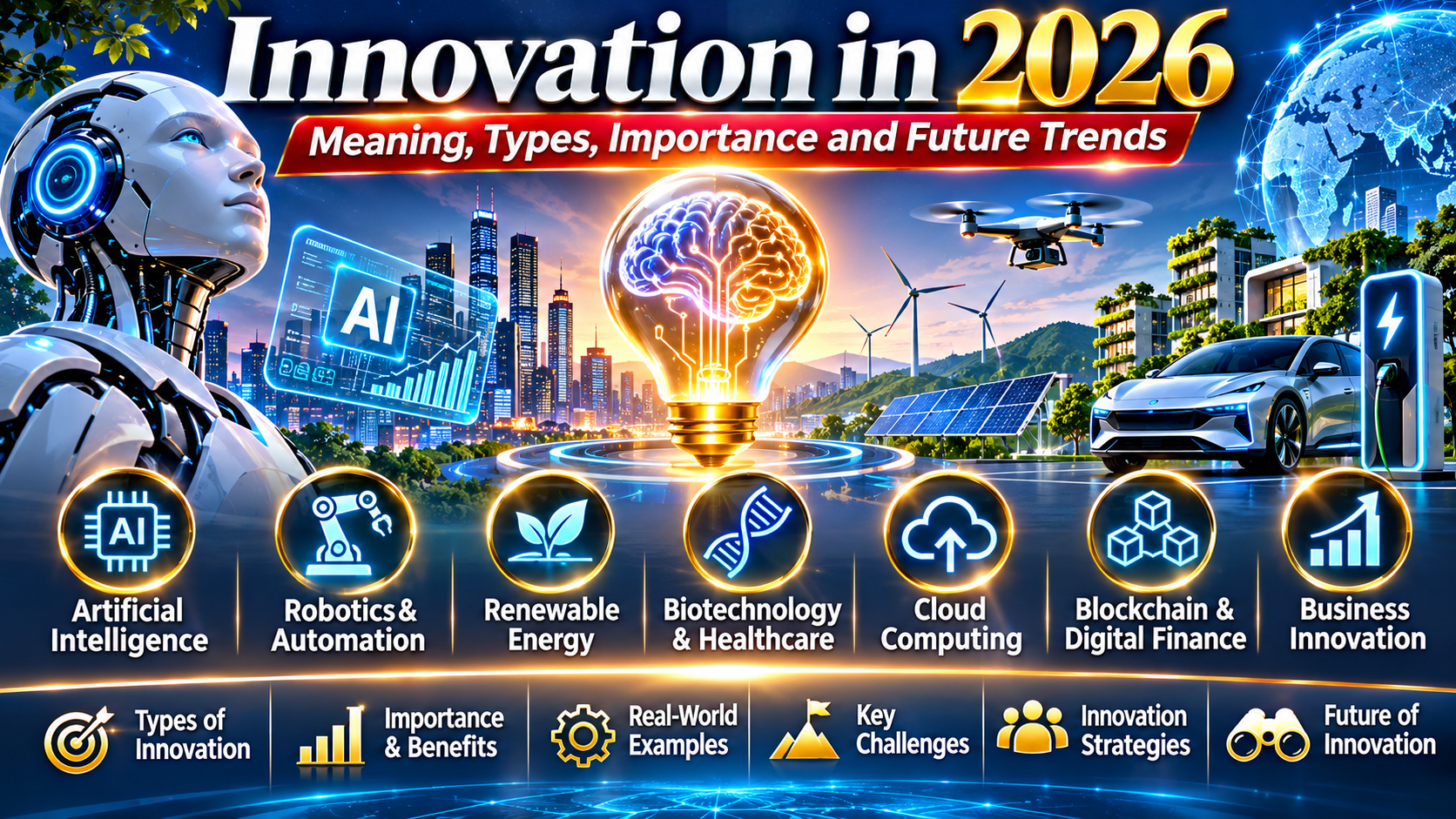
Innovation is one of the most important forces driving economic growth, business development, and technological progress. From artificial intelligence and advanced robotics to renewable energy and digital healthcare, innovation is changing how people live, work, communicate, and solve problems.
In today's competitive world, businesses and organizations cannot depend entirely on traditional methods. They must continuously explore new ideas, improve existing products, adopt modern technologies, and respond to changing customer expectations. Innovation makes this possible by turning creative ideas into practical solutions that create value.
In 2026, innovation is especially important as artificial intelligence, automation, biotechnology, clean energy, and digital transformation reshape industries around the world. Companies are investing in research and development to improve productivity, reduce costs, strengthen customer experiences, and discover new business opportunities.
This article explores the meaning of innovation, its major types, importance, real-world examples, benefits, challenges, and the technologies expected to influence its future.
What Is Innovation?
Innovation is the process of developing and implementing new ideas, products, services, technologies, or methods that create meaningful value. It involves identifying problems, exploring opportunities, and transforming creative thinking into practical improvements.
Innovation does not always mean inventing something completely new. It can also involve improving an existing product, making a process more efficient, introducing a better business model, or finding a more effective way to serve customers.
For example, online banking transformed traditional financial services by allowing customers to manage accounts, transfer money, and make payments through digital platforms. Similarly, electric vehicles are changing transportation by offering alternatives to conventional petrol and diesel-powered cars.
Innovation can happen in businesses, schools, hospitals, government organizations, scientific institutions, and everyday life.
A successful innovation generally combines three important elements:
Creativity: Developing original ideas and exploring different possibilities.
Implementation: Turning ideas into products, services, or practical solutions.
Value creation: Delivering meaningful improvements for customers, businesses, society, or the environment.
An idea becomes an innovation when it is successfully applied and creates useful results.
Why Is Innovation Important?
Innovation plays a major role in economic development and organizational success. It helps businesses remain competitive, improves productivity, and creates opportunities for solving complex problems.
1. Encourages Economic Growth
Innovation supports economic growth by creating new industries, improving productivity, and increasing business opportunities.
Technology companies, biotechnology firms, renewable energy developers, and advanced manufacturers create jobs and attract investment through innovative products and services.
Countries that support research, education, entrepreneurship, and technological development can strengthen their international competitiveness.
2. Improves Business Competitiveness
Businesses operate in competitive markets where customer expectations and industry conditions change continuously.
Innovation helps organizations develop better products, introduce new services, improve operations, and differentiate themselves from competitors.
For example, companies that adopt automation and artificial intelligence may improve efficiency and respond to customer needs more quickly.
3. Enhances Customer Experience
Customer satisfaction is an important factor in business success. Innovation helps companies understand customer preferences and create more convenient experiences.
Digital payment systems, personalized shopping recommendations, mobile applications, and online customer support are examples of innovations that have changed how people interact with businesses.
4. Increases Productivity
Innovative technologies and working methods can help organizations complete tasks more efficiently.
Automation reduces repetitive manual work, cloud computing improves collaboration, and artificial intelligence can support data analysis and decision-making.
These improvements allow employees to spend more time on complex and creative activities.
5. Helps Solve Global Challenges
Innovation is essential for addressing major global challenges, including climate change, healthcare access, food security, water shortages, and energy demand.
Renewable energy technologies, medical research, sustainable agriculture, and water-treatment systems demonstrate how innovation can improve quality of life.
Major Types of Innovation
Innovation takes different forms depending on the problem being addressed and the value being created. The following categories are among the most important.
1. Product Innovation
Product innovation involves developing new products or significantly improving existing ones.
Companies introduce product innovations to meet customer needs, improve performance, enhance convenience, or enter new markets.
Examples include:
Electric vehicles with improved battery technology.
Smartphones with advanced cameras and AI features.
Wearable devices that monitor fitness activities.
Energy-efficient home appliances.
Medical devices that improve diagnosis and treatment.
Product innovation helps businesses remain relevant and develop stronger relationships with customers.
2. Process Innovation
Process innovation focuses on improving how products and services are created, delivered, or managed.
Organizations use new technologies and working methods to reduce costs, improve quality, and increase efficiency.
Examples include automated manufacturing systems, digital inventory management, robotic warehouse operations, and AI-supported quality control.
Manufacturing companies often use process innovation to improve production speed and reduce waste.
3. Business Model Innovation
Business model innovation involves changing how a company creates, delivers, and earns value.
Instead of focusing only on products, businesses rethink pricing strategies, distribution systems, customer relationships, and revenue models.
Examples include:
Subscription-based software services.
Online marketplaces connecting buyers and sellers.
Digital banking platforms.
Streaming services offering monthly memberships.
Software companies providing cloud-based solutions.
Business model innovation can create entirely new market opportunities.
4. Technological Innovation
Technological innovation involves developing or applying new technologies to improve products, services, and operations.
Artificial intelligence, robotics, blockchain, quantum computing, biotechnology, and advanced semiconductor systems are important areas of technological development.
For example, AI-powered tools can analyze large datasets, identify patterns, and support decisions across finance, healthcare, education, and manufacturing.
5. Incremental Innovation
Incremental innovation involves making gradual improvements to existing products, services, or processes.
It does not require a completely new invention. Instead, businesses continuously improve performance, design, quality, or convenience.
Examples include smartphone software updates, improved battery life, faster payment processing, and more efficient manufacturing equipment.
Small improvements can create significant long-term benefits.
6. Disruptive Innovation
Disruptive innovation introduces a different product, service, or business approach that can transform an established market.
It may begin by serving customers who are overlooked by traditional businesses before expanding into larger markets.
Digital streaming services changed the entertainment industry, while online marketplaces transformed many traditional retail activities.
Disruptive innovation can create new competitors and change how established industries operate.
7. Social Innovation
Social innovation focuses on developing solutions to social problems and improving people's quality of life.
It can involve new programs, services, technologies, or organizational approaches.
Examples include affordable education platforms, community healthcare programs, financial inclusion initiatives, and clean drinking-water projects.
Social innovation emphasizes positive social outcomes alongside practical implementation.
8. Sustainable Innovation
Sustainable innovation aims to reduce environmental impact while supporting long-term economic and social development.
Examples include renewable energy, biodegradable packaging, electric transportation, energy-efficient buildings, and sustainable agricultural practices.
Businesses are increasingly exploring sustainable technologies to reduce waste, improve resource efficiency, and respond to environmental concerns.
Top Innovation Trends Shaping the World in 2026
Technological progress is creating new opportunities across global industries. Several major trends are influencing businesses, governments, and consumers in 2026.
1. Artificial Intelligence and Generative AI
Artificial intelligence is among the most influential areas of modern innovation.
AI systems can process information, recognize patterns, generate content, assist with software development, and support complex business activities.
Generative AI tools are being used for writing, image creation, customer support, research assistance, and productivity.
Businesses are exploring AI applications in:
Customer service automation.
Predictive analytics.
Fraud detection.
Software development.
Marketing personalization.
Supply-chain management.
Medical research.
However, responsible AI adoption requires attention to data privacy, accuracy, security, copyright, and human oversight.
2. Robotics and Automation
Robotics is changing manufacturing, logistics, healthcare, agriculture, and other industries.
Modern robots can perform repetitive tasks, move materials, inspect products, and assist workers in complex environments.
Industrial automation can improve consistency and reduce certain operational risks.
In healthcare, robotic systems can support surgeons and medical professionals. In warehouses, automated systems help manage inventory and move goods.
The development of more advanced sensors and AI systems is making robots increasingly adaptable.
3. Renewable Energy Innovation
Renewable energy technologies are becoming increasingly important as countries explore ways to diversify energy supplies and reduce emissions.
Solar power, wind energy, battery storage, and smart electricity grids are important areas of innovation.
Improvements in battery technology can help store renewable electricity and support electric transportation.
Energy innovation also includes smart meters, more efficient power systems, and technologies that improve energy management.
4. Biotechnology and Healthcare Innovation
Biotechnology is creating new possibilities in medicine, diagnostics, agriculture, and pharmaceutical research.
Scientists are developing advanced therapies, improved diagnostic tools, personalized medicine approaches, and innovative drug-delivery systems.
AI is also being explored as a tool for analyzing medical data and supporting drug discovery.
These developments could help improve disease detection and treatment, although medical innovations must undergo appropriate testing and regulatory review.
5. Blockchain and Digital Finance
Blockchain technology provides a distributed system for recording and verifying transactions.
It has applications in digital asset infrastructure, supply-chain tracking, digital identity, and certain financial services.
Digital payment systems and financial technology platforms are also transforming how people transfer money, access banking, and manage financial activities.
However, blockchain applications must address security, scalability, regulatory compliance, and consumer protection.
6. Quantum Computing
Quantum computing is an emerging field that uses principles of quantum mechanics to process information in different ways from conventional computers.
Researchers are exploring potential applications in materials science, chemistry, optimization, and scientific simulation.
Although practical quantum computing remains challenging, continued research could create important technological opportunities.
7. Cloud Computing and Edge Technology
Cloud computing allows organizations to access computing resources and software through internet-based services.
Businesses use cloud platforms for data storage, collaboration, application hosting, and digital operations.
Edge computing processes information closer to where it is generated. This can be useful for connected devices, industrial systems, smart cities, and applications that require fast responses.
Together, cloud and edge technologies provide important infrastructure for digital transformation.
Examples of Innovation in Leading Global Companies
Many well-known companies demonstrate how innovation can influence industries and create new business opportunities.
Apple
Apple has developed a global technology business through smartphones, computers, wearable devices, software, and digital services.
The iPhone transformed mobile communication by combining computing, internet access, applications, and multimedia features in one device.
Apple continues to invest in hardware development, software integration, custom chips, and services.
Tesla
Tesla has helped accelerate interest in electric vehicles and battery-powered transportation.
Its business includes electric cars, energy storage, charging infrastructure, and software-based vehicle features.
The company's development of battery systems and electric vehicle technology has influenced competition across the automotive industry.
Microsoft
Microsoft has expanded from traditional software into cloud computing, enterprise services, artificial intelligence, and productivity platforms.
Its Azure cloud business provides infrastructure and services to organizations around the world.
The company's investments in AI demonstrate how established technology businesses can adapt to major technological changes.
Amazon
Amazon has introduced innovation across e-commerce, logistics, cloud computing, and digital services.
Its marketplace changed online retail, while Amazon Web Services became a major provider of cloud infrastructure.
Automation and data-driven systems also play an important role in its logistics operations.
Google has developed major innovations in internet search, digital advertising, mobile software, cloud computing, and artificial intelligence.
Its research and development activities include machine learning, language models, computer vision, and scientific applications.
These innovations influence how people access information and use digital services.
How Innovation Transforms Different Industries
Innovation is not limited to technology companies. It influences almost every major sector of the economy.
Healthcare
Hospitals and healthcare organizations use digital records, diagnostic technology, telemedicine, and AI-supported systems to improve services.
Remote consultations can help patients access healthcare professionals without always visiting a physical facility.
Medical technology also supports more advanced imaging, monitoring, and surgical procedures.
Education
Digital learning platforms have expanded access to educational resources.
Students can use online courses, interactive learning applications, virtual classrooms, and AI-supported educational tools.
These technologies can support personalized learning, although effective education still depends on teachers, learning quality, and student engagement.
Agriculture
Agricultural innovation includes precision farming, automated irrigation, drones, improved seeds, soil monitoring, and digital crop-management systems.
These technologies can help farmers use resources more efficiently and monitor crop conditions.
Climate-resilient agriculture is also important as farmers respond to changing weather patterns and environmental challenges.
Manufacturing
Smart factories combine automation, robotics, sensors, data analytics, and connected equipment.
These systems can help manufacturers monitor production, identify equipment problems, and improve product quality.
Industrial innovation can also reduce material waste and improve supply-chain coordination.
Finance
Financial technology has changed banking, payments, lending, and investment services.
Mobile banking, digital wallets, contactless payments, and automated fraud detection have made many financial services more accessible.
Financial innovation must also address cybersecurity, consumer privacy, and responsible lending.
Transportation
Innovation is transforming transportation through electric vehicles, smart traffic systems, improved batteries, connected vehicles, and autonomous-driving research.
Airlines, logistics companies, and public transport systems are also adopting digital technologies to improve planning and operational efficiency.
Benefits of Innovation for Businesses
Innovation provides businesses with several potential advantages.
Improved efficiency: New technologies and processes can reduce unnecessary work and improve productivity.
Competitive advantage: Innovative products and services can help companies stand out in crowded markets.
New revenue opportunities: Businesses can enter new markets, introduce new services, and develop additional revenue streams.
Better customer satisfaction: Improved products and convenient services can strengthen customer relationships.
Adaptability: Organizations that continuously improve can respond more effectively to changing market conditions.
Long-term growth: Research, development, and investment in new ideas can support future business opportunities.
Challenges and Risks of Innovation
Although innovation creates opportunities, it also involves risks and difficulties.
1. High Research and Development Costs
Developing new products and technologies can require significant financial resources.
Research, testing, engineering, equipment, and specialist employees can increase costs before a product becomes commercially successful.
2. Resistance to Change
Employees and customers may be uncomfortable with new systems and working methods.
Organizations need effective communication, training, and leadership to help people adapt.
3. Cybersecurity and Privacy Risks
Digital innovation can increase exposure to cyberattacks and data breaches.
Companies must invest in security systems, access controls, data protection, and employee awareness.
4. Regulatory Challenges
Industries such as healthcare, finance, transportation, and biotechnology operate under strict regulatory requirements.
New technologies may require extensive testing, approvals, and compliance procedures before they can be introduced.
5. Failure and Uncertainty
Not every innovative idea becomes successful.
Some products fail to attract customers, while others may be too expensive or difficult to implement.
Businesses need to evaluate ideas, test assumptions, and learn from unsuccessful projects.
6. Skills Gaps
Modern technologies require employees with specialized knowledge.
Organizations may need to invest in education, professional development, and recruitment to build the skills required for innovation.
How Businesses Can Build an Innovation Culture
A successful innovation strategy requires more than purchasing new technology. It involves creating an environment where employees can identify problems, share ideas, test solutions, and improve existing systems.
Encourage Creative Thinking
Businesses should give employees opportunities to suggest improvements and explore new approaches.
Open communication can help organizations discover ideas from different departments and professional backgrounds.
Invest in Research and Development
Research and development help businesses explore new technologies, products, and processes.
Companies should identify areas where research can create meaningful value and support long-term goals.
Understand Customer Needs
Customer feedback can reveal problems that existing products and services do not adequately solve.
Organizations should use surveys, interviews, market research, and customer-support information to identify opportunities.
Support Experimentation
Small experiments and pilot projects allow businesses to test new ideas before investing heavily.
Companies can evaluate results, identify problems, and improve solutions through repeated testing.
Develop Employee Skills
Training programs help employees understand new technologies and develop the capabilities required for modern workplaces.
Businesses should encourage continuous learning in areas such as data analysis, cybersecurity, AI, and digital communication.
Measure Innovation Performance
Organizations should evaluate whether innovation projects are producing useful results.
Possible measurements include customer satisfaction, productivity, cost reduction, revenue growth, product adoption, and environmental impact.
The Future of Innovation
The future of innovation will be influenced by the interaction of artificial intelligence, scientific research, digital infrastructure, automation, and sustainability.
Artificial intelligence is expected to become increasingly integrated into business software, manufacturing systems, education, and healthcare. More advanced AI tools may help people analyze information and complete complex tasks.
Robotics could expand into additional workplaces as systems become more capable and affordable. This may influence manufacturing, agriculture, logistics, and healthcare.
Clean energy technologies will also remain important. Better batteries, renewable electricity systems, and energy-efficient buildings can support changing energy needs.
Biotechnology may create further opportunities in medicine, agriculture, and pharmaceutical development. Scientific research could lead to new treatments and more precise diagnostic methods.
At the same time, responsible innovation will become increasingly important. Businesses and governments will need to consider privacy, safety, environmental impact, employment, fairness, and the social consequences of emerging technologies.
The most successful innovations will not necessarily be the most complicated. They will be solutions that address real problems, create measurable value, and can be implemented responsibly.
Frequently Asked Questions About Innovation
What is innovation in simple words?
Innovation means creating or applying new ideas, products, services, or methods that improve something or solve a problem.
Why is innovation important?
Innovation supports economic growth, improves productivity, strengthens business competitiveness, creates new opportunities, and helps address social and environmental challenges.
What are the four main types of innovation?
Four commonly discussed categories are product innovation, process innovation, business model innovation, and organizational innovation. Other classifications include technological, social, incremental, disruptive, and sustainable innovation.
What is an example of innovation?
Electric vehicles, mobile banking, AI-powered software, online education platforms, and automated manufacturing systems are examples of innovation.
What is the difference between creativity and innovation?
Creativity involves generating original ideas. Innovation involves implementing ideas to create practical value.
How does innovation help businesses?
Innovation can help businesses improve efficiency, attract customers, reduce costs, develop new products, and enter new markets.
What are the biggest innovation trends in 2026?
Major trends include artificial intelligence, robotics, renewable energy, biotechnology, cloud computing, cybersecurity, advanced semiconductors, and digital finance.
What is sustainable innovation?
Sustainable innovation involves developing products, technologies, and processes that create economic value while reducing environmental impact and supporting long-term social well-being.
Can small businesses innovate?
Yes. Small businesses can innovate through improved customer service, new marketing methods, digital tools, better products, efficient operations, and creative business models.
What is the role of artificial intelligence in innovation?
Artificial intelligence can help analyze information, automate tasks, support research, generate ideas, improve customer experiences, and assist decision-making across industries.
Conclusion
Innovation is a powerful driver of progress, competitiveness, and economic development. It allows businesses to improve products, develop new services, increase productivity, and respond to changing customer expectations.
In 2026, artificial intelligence, automation, renewable energy, biotechnology, and digital infrastructure are creating new opportunities across global industries. These developments are changing how organizations operate and how people interact with technology.
However, successful innovation requires more than new ideas. It depends on research, investment, skilled people, effective implementation, and responsible decision-making.
Businesses that understand customer needs, encourage creativity, and continuously improve their operations can build stronger foundations for long-term growth.
As technology and society continue to evolve, innovation will remain essential for solving problems, creating opportunities, and shaping the future.