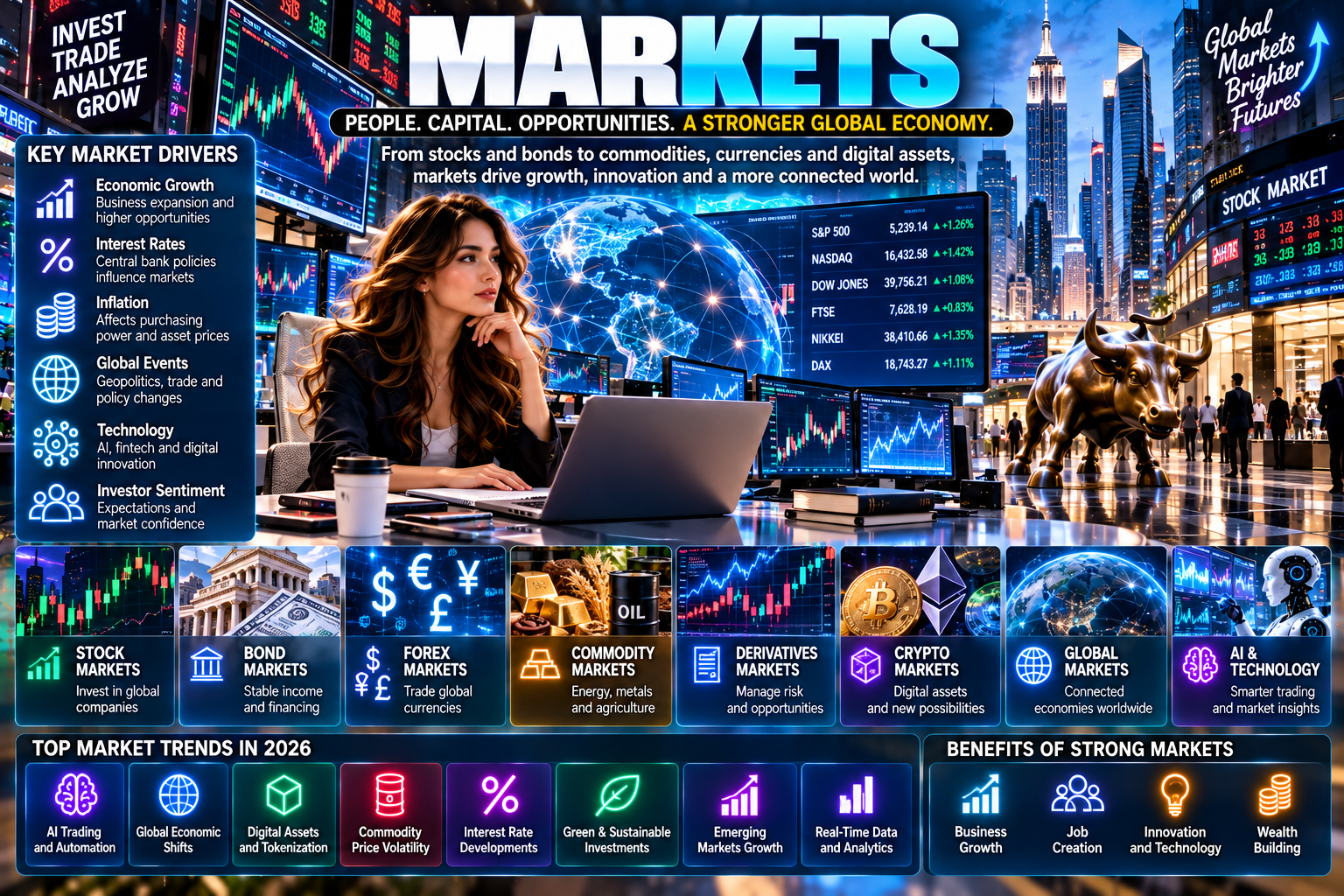
Markets are a fundamental part of the global economy. They connect buyers and sellers, help determine prices, move capital between investors and businesses, and allow governments, companies, institutions, and individuals to manage financial resources and risks.
The word markets can refer to many different economic environments, but financial markets are among the most important. These include stock markets, bond markets, foreign exchange markets, commodity markets, money markets, derivatives markets, and increasingly digital-asset markets.
Modern markets are also being transformed by artificial intelligence, algorithmic trading, electronic platforms, global capital flows, digital finance, and increasingly interconnected financial systems.
In 2026, financial markets are operating against a complex economic backdrop. The IMF's July 2026 outlook projected global growth of 3.0% in 2026 and 3.4% in 2027, while noting that geopolitical risks, financial-market repricing, and uncertainty remain important factors.
Understanding how markets work can help people interpret economic news, financial data, business performance, and changes in asset prices.
What Are Markets?
A market is an environment where buyers and sellers exchange goods, services, assets, or financial instruments.
Markets can be:
Physical
Digital
Local
National
International
Regulated
Over-the-counter
In financial markets, participants buy and sell assets such as:
Stocks
Bonds
Currencies
Commodities
Derivatives
Digital assets
Investment funds
Prices generally change as supply, demand, expectations, liquidity, economic conditions, and new information change.
Why Markets Matter
Markets perform several important economic functions.
Price Discovery
Markets help determine the prices at which buyers and sellers are willing to transact.
Capital Allocation
Financial markets allow money to move toward companies, governments, and projects seeking financing.
Liquidity
Markets can allow investors to convert assets into cash more easily.
Risk Management
Derivatives and other financial instruments allow institutions and businesses to manage certain financial risks.
Investment
Markets provide individuals and institutions with opportunities to invest capital in different types of assets.
Economic Information
Market prices can reflect expectations about:
Economic growth
Inflation
Interest rates
Corporate earnings
Currency conditions
Commodity supply
Geopolitical developments
Markets therefore provide information as well as financial infrastructure.
Major Types of Financial Markets
1. Stock Markets
Stock markets allow investors to buy and sell shares of publicly traded companies.
When someone buys a company's stock, they generally acquire an ownership interest in that company.
Stock markets include companies from industries such as:
Technology
Healthcare
Finance
Energy
Retail
Manufacturing
Telecommunications
Transportation
Stock prices can be influenced by:
Corporate earnings
Interest rates
Economic growth
Investor expectations
Industry developments
Geopolitical events
Company-specific news
Major stock-market indexes are often used as indicators of market performance, although an index represents only a particular group of securities and should not be treated as a complete measure of the economy.
2. Bond Markets
Bond markets allow governments, companies, and other institutions to borrow money from investors.
A bond generally represents a debt obligation.
Investors may receive interest payments and repayment of principal according to the bond's terms.
Major categories include:
Government bonds
Corporate bonds
Municipal bonds
Investment-grade bonds
High-yield bonds
Emerging-market bonds
Bond prices and yields generally have an inverse relationship: when the price of an existing bond rises, its yield generally falls, and vice versa.
Interest rates are therefore highly important to bond markets.
3. Foreign Exchange Markets
The foreign exchange market, commonly called forex or FX, is where currencies are traded.
Examples include:
U.S. dollar
Euro
Japanese yen
British pound
Swiss franc
Canadian dollar
Australian dollar
Pakistani rupee
Currency values can be influenced by:
Interest-rate expectations
Inflation
Economic growth
Trade flows
Capital movements
Central-bank policy
Political developments
Investor sentiment
Because currencies are involved in international trade and investment, foreign exchange markets are closely connected with the global economy.
4. Commodity Markets
Commodity markets involve raw materials and primary products.
Major commodities include:
Energy
Crude oil
Natural gas
Electricity-related products
Precious Metals
Gold
Silver
Platinum
Industrial Commodities
Copper
Aluminum
Other metals
Agricultural Commodities
Wheat
Corn
Soybeans
Coffee
Sugar
Commodity prices can be affected by:
Weather
Production
Inventories
Transportation
Geopolitical events
Global demand
Energy consumption
Currency movements
The World Bank's 2026 research has highlighted major commodity-price movements associated with the Middle East conflict, including a projected 24% increase in energy prices during 2026 and a 16% increase in overall commodity prices in its June outlook.
These are global projections and can change as economic and geopolitical conditions change.
5. Money Markets
Money markets focus primarily on short-term borrowing and lending.
They include instruments such as:
Treasury bills
Commercial paper
Certificates of deposit
Repurchase agreements
Short-term government securities
Money markets are particularly important for banks, corporations, governments, and institutional investors managing short-term liquidity.
6. Derivatives Markets
Derivatives are financial contracts whose value is linked to an underlying asset or variable.
Common derivatives include:
Futures
Options
Swaps
Forward contracts
Underlying assets can include:
Stocks
Bonds
Currencies
Commodities
Interest rates
Market indexes
Derivatives can be used for hedging, risk management, market exposure, and other financial strategies, but they can also introduce substantial complexity and leverage.
7. Digital-Asset Markets
Digital-asset markets include cryptocurrencies and other blockchain-based assets.
Examples include:
Bitcoin
Ether
Stablecoins
Tokenized assets
Digital-asset markets operate differently from traditional financial markets in several respects, including market structure, custody, regulation, trading hours, and technological infrastructure.
The IMF's 2026 financial-stability work notes that the expansion of private credit markets and stablecoins in emerging markets warrants continued and proportionate monitoring.
Digital assets can therefore be considered part of the broader financial-market ecosystem while still presenting distinct risks and characteristics.
How Markets Work
At a basic level, markets bring buyers and sellers together.
For example:
Buyer demand + Seller supply → Transactions → Price discovery
If buyers are willing to pay more while available supply remains limited, prices can rise.
If sellers are more willing to sell while demand is weaker, prices can fall.
However, real financial markets are more complex.
Prices can react to:
New economic information
Corporate announcements
Central-bank decisions
Investor expectations
Trading algorithms
Liquidity
Risk appetite
Global events
Markets are therefore forward-looking as well as responsive to current conditions.
Supply and Demand in Markets
Supply and demand are fundamental economic concepts.
Higher Demand
If demand increases while supply remains relatively limited, prices can rise.
Lower Demand
If demand falls while supply remains high, prices can decline.
Supply Shock
A sudden disruption to production or transportation can reduce supply and increase prices.
Demand Shock
A sudden change in consumer or business demand can affect prices and production.
These principles apply across many markets, from commodities to securities and consumer products.
The Role of Interest Rates
Interest rates influence many financial markets.
When interest rates change, they can affect:
Borrowing costs
Bond yields
Stock valuations
Currency markets
Housing
Corporate investment
Consumer spending
Credit availability
Investors therefore closely monitor central banks.
Major central banks include:
Federal Reserve
European Central Bank
Bank of England
Bank of Japan
People's Bank of China
State Bank of Pakistan
Central-bank decisions can influence financial conditions far beyond domestic markets.
Inflation and Markets
Inflation refers to a sustained increase in the general level of prices.
Markets pay close attention to inflation because it affects:
Purchasing power
Interest rates
Corporate costs
Consumer spending
Bond yields
Currency values
Investment valuations
Unexpected inflation can create market volatility if investors revise expectations for monetary policy or economic growth.
The IMF's July 2026 outlook reported that global disinflation had stalled following the geopolitical and energy shock, with headline inflation projected at 4.7% for 2026 in that outlook.
Markets and Economic Growth
Economic growth can influence financial markets through corporate earnings, employment, consumption, investment, and government revenues.
However, stronger economic growth does not automatically mean every asset price will rise.
Markets respond to expectations.
For example, if investors already expect strong economic growth, a positive economic report may have a smaller effect than an unexpectedly weak or strong result.
This is why market movements can sometimes appear counterintuitive.
Market Volatility
Volatility measures how significantly an asset's price changes over time.
High volatility can occur when markets react to:
Geopolitical events
Economic surprises
Corporate earnings
Interest-rate decisions
Financial crises
Commodity shocks
Political uncertainty
Unexpected technological developments
Volatility is not necessarily synonymous with market failure.
The IMF reported in April 2026 that global markets had experienced significant repricing following the Middle East conflict while market functioning remained broadly orderly, although financial-stability risks were elevated.
Market Liquidity
Liquidity refers broadly to how easily an asset can be bought or sold without causing a large price change.
Highly liquid markets generally have:
Many buyers and sellers
Large trading volumes
Narrower bid-ask spreads
Efficient transaction systems
Less-liquid markets may experience larger price movements when transactions occur.
Liquidity is particularly important during periods of financial stress.
Bull and Bear Markets
Two common terms used to describe market conditions are:
Bull Market
A bull market generally refers to a sustained period of rising asset prices.
Bear Market
A bear market generally refers to a sustained period of declining asset prices.
These terms are descriptive rather than guarantees of what will happen next.
Markets can move between rising and falling conditions as economic expectations change.
Market Indexes
Indexes combine groups of securities into a benchmark.
Examples include indexes tracking:
Large companies
Technology companies
Emerging markets
Government bonds
Specific industries
Indexes can help investors and analysts compare performance over time.
However, an index is not necessarily representative of every security or investor.
Market Participants
Financial markets involve many different participants.
Individual Investors
Individuals may invest through:
Brokerage accounts
Retirement accounts
Mutual funds
Exchange-traded funds
Institutional Investors
These include:
Pension funds
Insurance companies
Asset managers
Endowments
Sovereign wealth funds
Banks
Banks participate in lending, financing, trading, liquidity provision, and other financial activities.
Governments
Governments issue debt and influence financial conditions through fiscal and monetary policy.
Central Banks
Central banks influence monetary conditions and financial stability.
Hedge Funds and Other Nonbank Institutions
Nonbank financial institutions can provide liquidity and capital but can also transmit market stress.
The IMF's April 2026 Global Financial Stability Report highlights the growing role of nonbank financial institutions and their potential to amplify market volatility through leverage, forced deleveraging, and liquidity pressures.
Artificial Intelligence and Markets
Artificial intelligence is increasingly becoming part of financial-market infrastructure.
AI can be used for:
Market analysis
Trading signals
Risk management
Fraud detection
Credit assessment
Portfolio analysis
Financial research
Regulatory technology
Customer service
The IMF reported in July 2026 that AI is increasingly embedded in trading and investment, including machine-learning models generating trading signals and generative AI processing earnings calls, regulatory filings, and economic news.
AI can improve speed and information processing, but it can also create new risks.
If many institutions use similar models and signals, their actions may become more correlated.
The IMF has therefore highlighted the importance of monitoring AI-related dependencies, synchronized trading strategies, and operational and cyber risks.
Algorithmic Trading
Algorithmic trading uses computer systems to execute trades according to predefined rules or models.
Algorithms can analyze:
Price
Volume
Market conditions
News
Statistical relationships
High-frequency trading represents one highly specialized form of algorithmic trading.
Technology can increase market speed and efficiency, but it also creates risks involving system errors, cybersecurity, model assumptions, and market concentration.
Global Financial Markets in 2026
Financial markets in 2026 are being influenced by several major forces.
Geopolitical Risk
Geopolitical developments can affect:
Energy prices
Currency markets
Bonds
Stocks
Trade
Capital flows
The IMF's April 2026 Global Financial Stability Report identified geopolitical conflict and associated inflation pressures as significant financial-stability risks.
Technology Investment
AI and technology investment remain important drivers of economic activity.
The IMF's July 2026 outlook said technology momentum was helping offset part of the economic drag from the conflict, although it also identified a reassessment of AI-driven productivity expectations as a downside risk.
Inflation
Changes in energy and commodity prices can influence inflation expectations.
Interest Rates
Investors continue to monitor central-bank policy and its effect on borrowing costs and asset valuations.
Emerging Markets
Emerging-market assets can be particularly sensitive to global risk sentiment and capital flows.
The IMF notes that cross-border portfolio flows can create financing opportunities for emerging markets while also increasing sensitivity to global risk conditions.
Market Risks
Markets always involve uncertainty.
Important risks include:
Market Risk
Asset prices can move against an investor's position.
Credit Risk
A borrower may fail to meet its obligations.
Liquidity Risk
An asset may become difficult to sell at an expected price.
Currency Risk
Exchange-rate movements can affect international investments.
Interest-Rate Risk
Changes in interest rates can affect bonds, stocks, currencies, and credit.
Operational Risk
Failures in systems, processes, or technology can disrupt financial activity.
Cybersecurity Risk
Cyberattacks can affect financial institutions and market infrastructure.
Geopolitical Risk
Wars, sanctions, trade restrictions, and political instability can influence financial conditions.
Why Market Diversification Matters
Diversification means spreading exposure across different assets, sectors, regions, or other sources of risk.
A diversified portfolio may contain different categories such as:
Equities
Bonds
Cash or cash equivalents
Commodities
International assets
Diversification does not eliminate risk or guarantee positive returns.
Instead, it can reduce dependence on the performance of a single asset or market.
Markets and the Global Economy
Financial markets and the real economy are closely connected.
Businesses use financial markets to:
Raise capital
Issue debt
Manage risks
Finance expansion
Governments use markets to:
Borrow money
Finance public spending
Manage debt
Households interact with markets through:
Savings
Investments
Mortgages
Pension accounts
Insurance
Changes in financial conditions can therefore affect employment, investment, consumption, and economic growth.
The Future of Markets
Financial markets are likely to become increasingly digital, automated, interconnected, and data-driven.
AI-Powered Finance
AI may continue transforming research, trading, lending, risk management, and compliance.
Tokenization
Blockchain technology may enable new forms of digital representation for financial and real-world assets.
Real-Time Finance
Payments, settlement, trading, and financial information are increasingly moving toward faster digital systems.
Automated Investment
Digital platforms and algorithms may continue expanding automated investment services.
Stronger Cybersecurity
As financial systems become more connected, cybersecurity and operational resilience will become increasingly important.
New Market Structures
Technology could change how assets are issued, traded, settled, and managed.
How to Understand Markets
People following financial markets should understand several basic concepts.
Price
The current market value at which transactions may occur.
Volume
The quantity of an asset traded during a period.
Market Capitalization
The total market value of a company's publicly traded shares.
Yield
The income or return associated with certain financial assets, often expressed as a percentage.
Liquidity
How easily an asset can be bought or sold.
Volatility
The degree to which prices fluctuate.
Risk
The possibility that an investment's actual outcome differs from the expected outcome.
Return
The gain or loss generated by an investment over a period.
Understanding these concepts can make financial-market information easier to interpret.
Markets vs. Economy
Markets and the economy are related but not identical.
The economy describes the production, consumption, employment, trade, and distribution of goods and services.
Financial markets facilitate the trading and financing of financial assets.
An economy can experience strong growth while certain markets decline, or markets can rise while economic conditions remain challenging.
Markets are forward-looking and incorporate expectations, while economic statistics often describe conditions that have already occurred.
Final Thoughts
Markets are essential to the functioning of modern economies.
Stock markets provide mechanisms for equity financing and investment. Bond markets connect borrowers and lenders. Foreign exchange markets facilitate international transactions. Commodity markets help determine prices for essential resources. Derivatives provide tools for managing financial risks, while digital-asset markets introduce new technologies and structures.
In 2026, markets are being shaped by a combination of geopolitical developments, inflation, interest rates, technology investment, artificial intelligence, capital flows, commodities, and financial innovation. The IMF continues to highlight elevated financial-stability risks even as global markets have shown resilience, while its July outlook points to technology momentum as an important influence on global activity.
The most important lesson is that markets are constantly changing. Prices reflect not only current conditions but also expectations about the future.
Understanding market structure, economic indicators, financial instruments, risk, liquidity, and technology can help people interpret market developments more effectively.
This article is educational and does not constitute personalized financial or investment advice.
Frequently Asked Questions
What are financial markets?
Financial markets are systems where financial assets such as stocks, bonds, currencies, commodities, and derivatives are bought and sold.
What are the major types of markets?
Major financial markets include stock markets, bond markets, foreign exchange markets, commodity markets, money markets, derivatives markets, and digital-asset markets.
Why do market prices change?
Prices can change because of supply and demand, economic data, corporate earnings, interest rates, inflation, investor expectations, liquidity, and geopolitical events.
What is a stock market?
A stock market is a marketplace where shares of publicly traded companies are bought and sold.
What is a bond market?
A bond market is where investors buy and sell debt securities issued by governments, companies, and other institutions.
What is the forex market?
The foreign exchange market is the global marketplace for trading currencies.
What are commodity markets?
Commodity markets involve the trading of raw materials and primary products such as oil, natural gas, gold, metals, and agricultural goods.
How does AI affect financial markets?
AI can analyze large amounts of information, generate trading signals, support risk management, process financial documents, and improve certain financial processes. It can also introduce risks related to correlated trading, model errors, cybersecurity, and operational dependencies.
What is market volatility?
Market volatility refers to the degree and speed of price fluctuations in an asset or market.
What is diversification?
Diversification involves spreading exposure across different assets or sources of risk. It can reduce concentration risk but cannot eliminate investment losses.
What factors influence global markets in 2026?
Major factors include geopolitical developments, energy prices, inflation, interest rates, global growth, technology investment, AI expectations, capital flows, and financial conditions.
What is the future of financial markets?
Financial markets are likely to become increasingly digital, automated, AI-assisted, interconnected, and data-driven, with greater emphasis on cybersecurity, operational resilience, and new financial technologies.