Money is one of the most important foundations of modern economies. It allows people to buy goods and services, businesses to receive payments, workers to earn income, governments to collect taxes, and investors to transfer purchasing power across time.
Although money is usually associated with banknotes and coins, modern money takes many forms. Bank deposits, electronic payments, mobile balances, and other highly liquid financial assets are also important parts of today's monetary system.
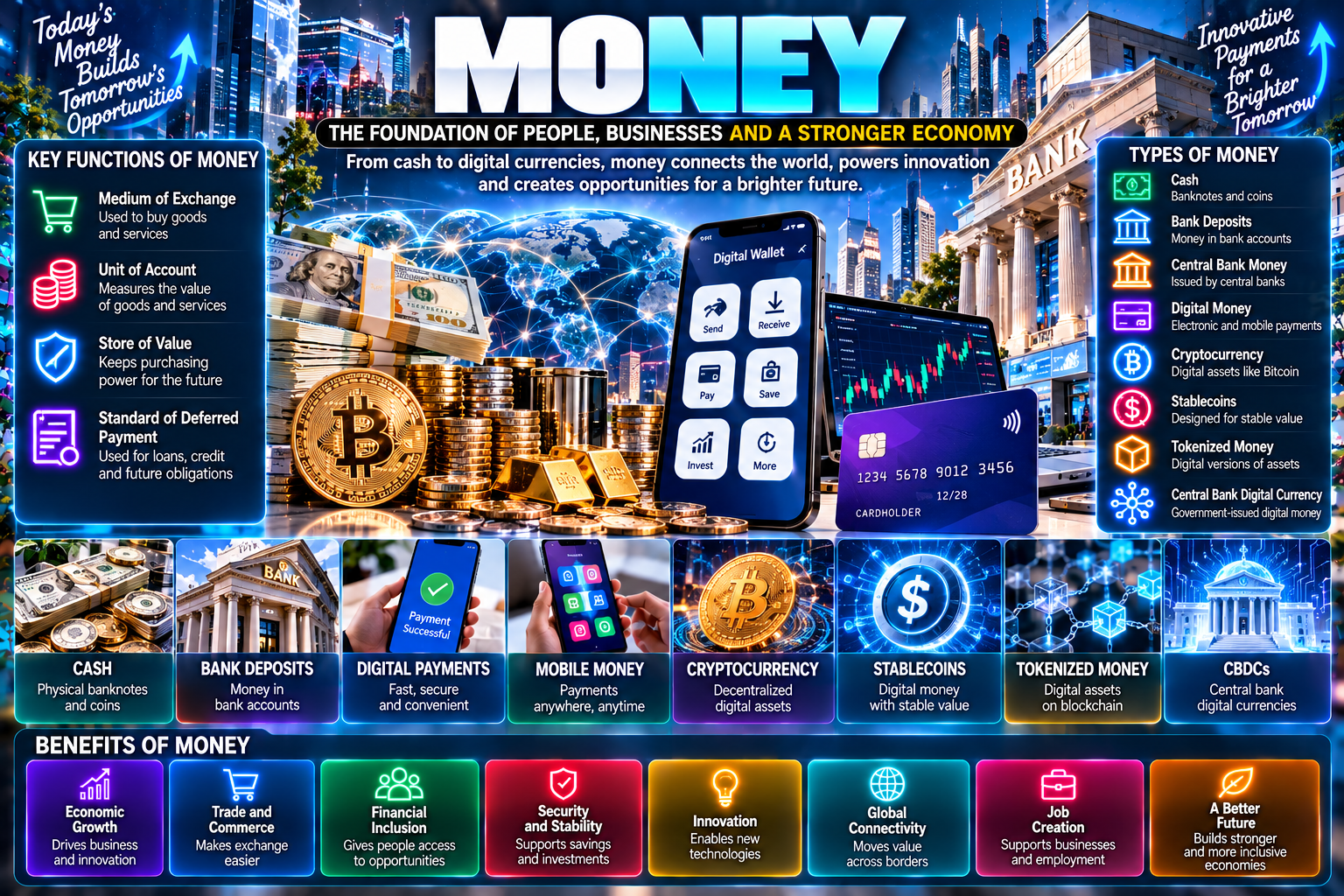
The International Monetary Fund describes money through several fundamental functions: it serves as a medium of exchange, a store of value, and a unit of account, while monetary-statistics frameworks also identify its role as a standard of deferred payment.
Technology is now changing the form and infrastructure of money. Digital payments, stablecoins, tokenized deposits, tokenized assets, and central bank digital currencies are becoming important areas of financial research and policy discussion. The IMF's 2026 annual report describes digital finance as an evolving area involving stablecoins, CBDCs, digital payments, and tokenization.
What Is Money?
Money is something that is generally accepted as payment for goods and services.
For money to work effectively, people need to trust that it can be accepted by others and that its value can be reasonably measured and transferred.
The IMF defines money as something generally accepted in exchange for goods and services and identifies its key functions as a medium of exchange, store of value, and unit of account.
In simple terms:
Money makes economic exchange easier.
Without money, people would need to rely heavily on barter.
For example, imagine a farmer who wants a computer and a computer manufacturer who wants wheat. Under pure barter, the farmer would need to find a computer seller willing to accept wheat.
Money solves this problem because the farmer can sell wheat for money and then use the money to purchase a computer.
This makes specialization, trade, and complex economies much easier.
The Four Main Functions of Money
1. Medium of Exchange
Money is used to purchase goods and services.
Instead of directly exchanging one product for another, people exchange products or services for money.
This is one of the most important functions because it eliminates many of the limitations of barter.
2. Unit of Account
Money provides a common way to measure value.
For example, a smartphone might cost $500, a laptop $1,000, and a car $30,000.
Without a common unit of account, comparing the value of thousands of different products would be extremely difficult.
3. Store of Value
Money allows purchasing power to be transferred into the future.
People can earn income today and save some of it for later.
However, money is not always a perfect store of value because inflation can reduce its purchasing power over time.
4. Standard of Deferred Payment
Money is also used to express obligations that will be settled in the future.
Loans, mortgages, bonds, salaries, and other financial contracts can be denominated in money.
The IMF's monetary statistics framework recognizes these four functions of money.
The History of Money
Money has evolved over thousands of years.
Before modern currencies, societies used various items as media of exchange.
Examples have historically included:
Livestock
Grain
Shells
Salt
Precious metals
Coins
Paper money
The development of money allowed societies to move from simple barter toward increasingly complex commercial systems.
Commodity Money
Commodity money consists of items that have value in themselves or are widely accepted because of their usefulness or scarcity.
Gold and silver historically played important roles because they were durable, divisible, portable, and relatively scarce.
Coins
Metal coins provided standardized units of value.
Governments and rulers eventually became important issuers and guarantors of currency.
Paper Money
Paper currency made large-scale transactions easier and reduced the need to physically transport valuable commodities.
Bank Money
As banking systems developed, deposits became increasingly important.
People could keep funds in banks and use those balances to make payments.
Electronic Money
Computing and telecommunications transformed banking.
Electronic transfers allowed money to move between accounts without physical cash changing hands.
Digital Money
Today, much of the money people use exists as digital balances.
The Federal Reserve describes modern U.S. money as including central bank money, commercial bank money, and certain nonbank forms of digital money.
Types of Money
Cash
Cash consists primarily of physical banknotes and coins.
It remains useful because it can allow transactions without requiring a bank account or electronic payment system.
Bank Deposits
Money held in bank accounts is an important form of modern money.
People can use deposits through:
Debit cards
Bank transfers
Online banking
Mobile applications
Direct payments
Central Bank Money
Central bank money is a liability of a central bank.
In the United States, for example, it includes physical currency issued by the Federal Reserve and digital balances held by commercial banks at the Federal Reserve.
Commercial Bank Money
Commercial bank money consists largely of deposits held by customers at commercial banks.
It is commonly used for everyday transactions.
Nonbank Digital Money
Some financial technology companies allow users to hold and transfer digital balances outside traditional bank accounts.
The exact legal and financial characteristics vary depending on the provider and jurisdiction.
What Is the Money Supply?
The money supply refers broadly to the quantity of money and highly liquid financial assets available within an economy.
Central banks and statistical agencies use different monetary aggregates to measure different forms of money.
The Federal Reserve, for example, publishes measures including the monetary base, M1, and M2. M1 captures highly liquid forms of money used for transactions, while M2 includes M1 plus certain less-liquid savings-type assets.
Money-supply measures are useful because changes in liquidity and monetary conditions can influence economic activity.
However, money supply should not be interpreted in isolation. Economic growth, velocity, interest rates, credit conditions, expectations, and financial behavior also matter.
How Banks Affect Money
Commercial banks play an important role in the monetary system.
When banks provide loans, the resulting deposits can increase the amount of bank money circulating through the economy.
Banks also provide important financial services such as:
Deposits
Loans
Payments
Credit cards
Mortgages
Business financing
International transfers
The banking system therefore connects savings, credit, investment, and payments.
Money and Credit
Money and credit are closely connected but are not identical.
Money is primarily used as a means of payment and store of value.
Credit represents the ability to borrow funds and repay them according to agreed terms.
Examples of credit include:
Mortgages
Personal loans
Business loans
Credit cards
Corporate bonds
Government debt
Credit can expand economic activity by allowing households and businesses to spend or invest before they have accumulated the required cash.
However, excessive borrowing can create financial risks.
Money and Inflation
Inflation occurs when the general price level rises over time.
When prices increase, the purchasing power of a unit of money decreases.
For example, if a product costs $100 today and $110 later, the same $100 buys less of that product than before.
Inflation can affect:
Household budgets
Savings
Salaries
Business costs
Interest rates
Investments
Government spending
Moderate and stable inflation is treated differently from periods of very high or rapidly accelerating inflation.
Central banks therefore pay close attention to inflation when setting monetary policy.
Purchasing Power
Purchasing power refers to how much goods and services a unit of money can buy.
Inflation generally reduces purchasing power.
This is why earning and saving money must be considered in relation to changes in prices.
For example, if savings increase by 5% but prices increase by 7%, the nominal amount of money has increased while its purchasing power may have declined.
This distinction between nominal and real values is important in economics and personal finance.
Interest Rates and Money
Interest rates represent the cost of borrowing money or the return associated with lending or saving.
Interest rates influence:
Loans
Mortgages
Savings accounts
Bonds
Business investment
Consumer spending
Currency markets
Asset valuations
When interest rates rise, borrowing can become more expensive.
When rates fall, borrowing may become less expensive, although the actual effects depend on financial conditions and individual products.
Central banks use monetary policy to influence financial conditions and economic activity.
Monetary Policy
Monetary policy refers to actions taken by a central bank or monetary authority to influence monetary and financial conditions.
Common policy tools include:
Policy interest rates
Open-market operations
Reserve-related tools
Communication and forward guidance
Asset-purchase programs in some circumstances
Monetary policy can influence inflation, employment, credit conditions, exchange rates, and economic activity.
However, monetary policy cannot directly control every economic outcome.
Money and the Economy
Money makes large-scale economic activity possible.
Businesses need money to:
Pay employees
Purchase supplies
Invest in equipment
Pay taxes
Expand operations
Consumers use money to:
Purchase food
Pay rent
Buy homes
Pay for education
Save
Invest
Governments use money through taxation, borrowing, and public spending.
The movement of money therefore connects households, businesses, governments, and financial institutions.
Digital Payments
Digital payments have transformed how money moves.
Examples include:
Bank transfers
Debit cards
Credit cards
Mobile wallets
QR-code payments
Instant payment systems
Online payment platforms
Digital payments can make transactions faster and more convenient.
They can also create new requirements involving:
Cybersecurity
Privacy
Authentication
Fraud prevention
Consumer protection
Financial inclusion
Mobile Money
Mobile technology has expanded access to financial services in many markets.
Users may be able to:
Send money
Receive payments
Pay bills
Purchase products
Save
Access financial services
Mobile financial services can be particularly significant where traditional banking infrastructure is limited.
Cryptocurrency
Cryptocurrencies are digital assets that use cryptographic technologies and, in many cases, decentralized networks.
Bitcoin is the best-known example.
Other digital assets have different technical and economic characteristics.
Cryptocurrency markets can differ significantly from traditional money because many cryptocurrencies are not issued by central banks and may experience substantial price volatility.
They may be used for:
Digital transfers
Investment
Payments in certain settings
Decentralized applications
Token-based ecosystems
However, cryptocurrencies involve technological, regulatory, market, custody, and security risks.
Stablecoins
Stablecoins are digital tokens designed to maintain a relatively stable value, often through reserves or other mechanisms.
They can be used for:
Digital payments
Transfers
Trading
Settlement
Cross-border transactions
The IMF's 2026 work describes stablecoins as an increasingly important part of the digital-finance discussion, while emphasizing questions around reserves, regulation, financial stability, and monetary systems.
A stablecoin's stability depends on the mechanism supporting its value and the quality and liquidity of any backing assets.
Tokenized Money
Tokenization involves representing assets or financial claims on digital programmable ledgers.
The IMF's 2026 analysis describes tokenized deposits as digital extensions of existing bank liabilities and discusses how tokenization could change the architecture of financial transactions and settlement.
Potential applications include:
Payments
Securities settlement
Deposits
Cross-border transactions
Financial-market infrastructure
Tokenization remains an evolving field, and its long-term impact depends on technology, regulation, adoption, and market structure.
Central Bank Digital Currencies
A central bank digital currency, or CBDC, is a digital form of central-bank money.
CBDCs can be designed for different purposes, including:
Retail payments
Wholesale financial settlement
Cross-border transactions
Payment-system innovation
CBDCs differ from cryptocurrencies because they can represent direct claims on a central bank when structured as such.
The IMF reported in 2026 that many countries continue to advance work on central bank digital currencies while digital finance develops more broadly.
The Future of Cash
Digital payments are growing, but cash continues to play an important role in many economies.
Cash can provide:
Direct payment
Privacy in certain contexts
Accessibility
Offline usability
An alternative during technological disruptions
The future monetary system may therefore contain multiple forms of money rather than one replacing everything else.
Money and Financial Inclusion
Access to money and financial services is closely connected to economic opportunity.
Financial inclusion can involve access to:
Bank accounts
Payments
Savings
Credit
Insurance
Digital financial services
Digital technology can reduce some barriers to financial access, although access to smartphones, internet connectivity, identification systems, infrastructure, and financial literacy can still affect participation.
Money and Personal Finance
For individuals, understanding money is essential for managing financial resources.
Important personal-finance concepts include:
Income
Money received from employment, business activity, investments, or other sources.
Expenses
Money spent on goods, services, housing, transportation, education, and other needs.
Savings
Money set aside for future use.
Debt
Money borrowed from another person or institution.
Investment
Money allocated to assets with the expectation of generating future returns.
Emergency Funds
Savings designed to help manage unexpected expenses.
A healthy personal-finance system generally requires balancing current spending with future financial needs.
Saving Money
Saving involves keeping part of current income for future needs.
Common savings goals include:
Emergencies
Education
Housing
Business
Retirement
Major purchases
The value of savings should be considered alongside inflation and the interest or return earned on the money.
Investing Money
Investing means allocating money toward assets with the expectation of future financial returns.
Examples include:
Stocks
Bonds
Mutual funds
Exchange-traded funds
Real estate
Businesses
Other financial assets
Investment returns are uncertain, and different assets involve different levels of risk.
Investing should therefore be distinguished from simply holding money in a transaction account.
Money and Wealth
Money and wealth are related but not identical.
Money is a medium used for payments and a way of measuring and storing purchasing power.
Wealth refers more broadly to the value of assets owned by an individual, household, business, or institution, minus relevant liabilities.
Wealth can include:
Cash
Bank deposits
Stocks
Bonds
Real estate
Businesses
Other assets
Someone may own significant wealth without holding a large amount of cash.
Money and Markets
Money is closely connected to financial markets.
Investors use money to purchase:
Stocks
Bonds
Commodities
Funds
Digital assets
Businesses raise money through:
Equity issuance
Debt
Loans
Private investment
Governments raise money through:
Taxes
Debt issuance
Other public-finance mechanisms
This creates a continuous flow of capital throughout the economy.
The Changing Nature of Money
The definition and form of money continue to evolve.
The Federal Reserve's September 2026 research on new forms of money notes that tokenized deposits, tokenized money funds, and payment stablecoins have characteristics relevant to the definition and measurement of money.
This illustrates a broader transformation.
Money is moving from:
Coins → Paper → Bank Accounts → Electronic Payments → Digital Assets → Tokenized Financial Systems
However, new forms do not automatically replace older forms.
Different types of money can coexist because they serve different users, markets, and purposes.
The Future of Money
The future of money is likely to be increasingly digital, programmable, interconnected, and technology-driven.
Faster Payments
Payment systems are becoming faster and more accessible.
Digital Currencies
CBDCs, stablecoins, and other digital financial instruments may become increasingly important.
Tokenization
Tokenization could transform how financial assets are issued, traded, and settled.
Artificial Intelligence
AI may improve fraud detection, financial analysis, compliance, payments, and customer services.
Blockchain Infrastructure
Distributed-ledger technologies may support new settlement and asset-transfer systems.
Cross-Border Payments
Digital systems may reduce some friction involved in international payments and remittances.
Greater Financial Connectivity
Banking, payments, investment platforms, digital wallets, and commerce may become increasingly interconnected.
The IMF's 2026 annual report describes stablecoins, CBDCs, tokenization, and digital payments as important components of the evolving financial system.
Challenges Facing the Future of Money
Technological innovation also creates challenges.
Cybersecurity
Digital money systems must protect against hacking, fraud, and operational failures.
Privacy
Digital transactions can create extensive data trails.
Financial Stability
Rapid adoption of new financial instruments can create new forms of systemic risk.
Regulation
Governments need frameworks that address innovation while protecting consumers and financial stability.
Interoperability
Different payment and financial systems need to communicate effectively.
Financial Inclusion
Digital transformation should not exclude people who lack technology or access to financial services.
Trust
Money depends fundamentally on confidence in the institutions, systems, and rules supporting it.
Money in 2026
Money in 2026 is no longer simply cash stored in wallets.
Modern monetary systems involve a combination of:
Physical currency
Bank deposits
Electronic payments
Digital wallets
Mobile money
Stablecoins
Tokenized deposits
Other digital financial instruments
The Federal Reserve's September 2026 research specifically examines how newer forms of money fit into traditional monetary aggregates and notes that the boundaries of money can evolve as financial technology changes.
Meanwhile, the IMF's 2026 annual report highlights the continued development of digital finance, stablecoins, CBDCs, and tokenization.
This means the future of money is likely to be defined not only by what money looks like, but also by how it moves, who can access it, how transactions settle, and what technologies support the system.
Final Thoughts
Money is much more than coins and banknotes.
It is an economic system that allows people and organizations to exchange value, measure prices, save purchasing power, settle debts, and participate in increasingly complex economies.
Its history demonstrates constant adaptation. Commodity money evolved into coins, paper currencies became widespread, banking created new forms of money, electronic systems transformed payments, and digital technology is now creating new forms of financial assets and monetary infrastructure.
Today, digital payments, stablecoins, tokenization, and CBDCs are reshaping discussions about what money can be and how financial systems should operate.
The fundamental functions remain remarkably consistent:
Money helps people exchange value, measure value, and transfer purchasing power through time.
What is changing is the technology used to perform those functions.
Frequently Asked Questions
What is money?
Money is something generally accepted as payment for goods and services and serves important functions including medium of exchange, store of value, and unit of account.
What are the main functions of money?
The main functions are medium of exchange, unit of account, store of value, and standard of deferred payment.
What are the different types of money?
Modern money can include cash, bank deposits, central-bank money, commercial-bank money, and certain digital financial instruments.
What is the money supply?
The money supply is a collection of money and highly liquid financial assets available within an economy. Different monetary aggregates measure different forms and degrees of liquidity.
How does inflation affect money?
Inflation generally reduces the purchasing power of money because the prices of goods and services rise over time.
What is digital money?
Digital money refers broadly to monetary value represented and transferred electronically, including bank deposits and certain digital payment balances.
What is cryptocurrency?
Cryptocurrency is a type of digital asset that typically uses cryptographic technology and blockchain or distributed-ledger networks. Its characteristics differ from government-issued currencies.
What is a stablecoin?
A stablecoin is a digital token designed to maintain a relatively stable value, often through reserves or another stabilization mechanism.
What is a CBDC?
A central bank digital currency is a digital form of central-bank money. Its design and availability depend on the issuing jurisdiction.
What is tokenized money?
Tokenized money refers to monetary claims represented on digital programmable ledgers, such as tokenized deposits or other digital settlement instruments.
Is cash going away?
Digital payments are expanding, but cash remains an important payment method in many economies. The future may involve multiple forms of money operating alongside one another.
Why is money important to the economy?
Money makes exchange easier, supports specialization and trade, provides a way to measure economic value, and allows purchasing power to be transferred across time.
What is the future of money?
The future is likely to involve increasingly digital payments, tokenization, stablecoins, potential CBDCs, AI-powered financial services, faster settlement systems, and greater integration between financial and digital technologies.