Cybersecurity has become one of the most important challenges facing modern businesses. As companies move more operations into cloud platforms, digital applications, connected devices, and online services, the number of potential entry points for cyber threats continues to grow.
At the same time, cybercriminals are becoming more sophisticated. Automated attacks, phishing campaigns, credential theft, ransomware, social engineering, and software vulnerabilities can affect organizations of almost any size.
Artificial intelligence is now becoming an important part of the response.
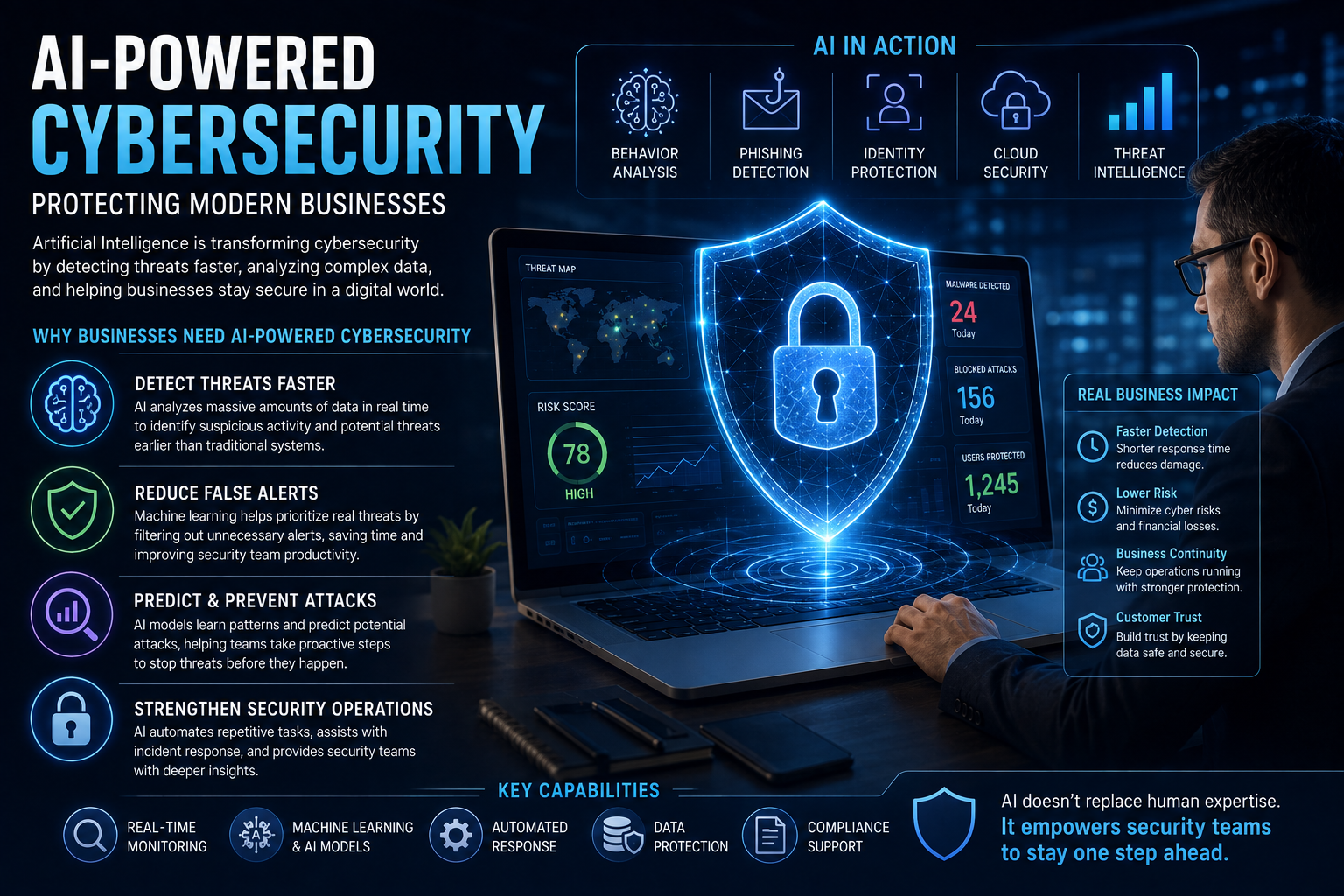
AI-powered cybersecurity systems can analyze enormous amounts of information, identify unusual activity, detect potential threats, and help security teams respond faster. Rather than relying entirely on predefined rules, modern security platforms can use machine learning and behavioral analysis to identify patterns that may indicate an emerging attack.
In 2026, AI-powered cybersecurity is moving from an emerging technology toward an increasingly important component of business security strategy.
The Growing Complexity of Cybersecurity
Traditional cybersecurity approaches were often designed around known threats.
Security teams could create rules to block suspicious files, websites, network connections, or login attempts. These methods remain useful, but modern organizations operate in much more complicated environments.
Employees may work remotely, access cloud applications from different locations, use mobile devices, and collaborate with external partners. Businesses may also operate multiple websites, databases, APIs, and connected systems.
This creates a constantly changing digital environment.
Security teams therefore need to understand not only whether a particular action is technically suspicious but also whether it is unusual in the context of normal business behavior.
AI can help analyze these patterns at scale.
How AI Detects Unusual Behavior
One of the major advantages of AI in cybersecurity is behavioral analysis.
Instead of looking only for previously identified threats, AI systems can learn patterns associated with normal activity and identify significant deviations.
For example, an employee who normally accesses company systems during business hours from a familiar device may suddenly attempt to access sensitive information from an unusual location.
That does not automatically mean an attack has occurred. However, the behavior could warrant additional investigation.
AI can evaluate multiple signals simultaneously, helping security teams prioritize activities that deserve attention.
This can be particularly valuable for large organizations where security systems generate thousands or millions of events.
AI Helps Security Teams Handle Alert Overload
Security teams often face a major problem: too many alerts.
A modern organization can generate enormous numbers of security notifications every day. If every alert requires manual investigation, security professionals can quickly become overwhelmed.
AI can help prioritize these alerts.
By analyzing relationships between events, devices, users, applications, and historical activity, intelligent security systems can identify which events are more likely to represent meaningful threats.
This allows security professionals to spend more time investigating serious incidents rather than manually reviewing every low-risk notification.
The objective is not simply to generate more alerts. It is to make security operations more intelligent and manageable.
Faster Threat Detection
Speed is critical during a cyberattack.
The longer an attacker remains inside a system, the more opportunities they may have to access information, disrupt operations, or move between systems.
AI can continuously monitor digital environments and identify suspicious behavior in near real time.
For example, an intelligent security platform could detect an unusual sequence involving account access, privilege changes, file activity, and network communication.
Looking at each event individually might not reveal a serious problem. When the events are connected, however, the pattern could become more concerning.
AI systems can help connect these signals and bring potential incidents to the attention of security teams faster.
AI Is Changing Phishing Defense
Phishing remains a major cybersecurity challenge because attackers frequently use social engineering to convince people to reveal information or click malicious links.
AI can help businesses analyze emails, websites, messages, and communication patterns for suspicious characteristics.
More advanced systems can examine context rather than relying only on a list of known malicious addresses.
For example, a message that appears to come from an executive but uses an unusual communication style or requests an unexpected financial transaction could receive additional scrutiny.
However, technology alone cannot eliminate phishing.
Employee awareness remains essential. Businesses should continue to provide cybersecurity education and establish clear procedures for handling unusual requests.
Protecting Cloud Environments
Cloud computing has become an important part of modern business infrastructure.
Companies may store data, applications, customer information, and operational systems across multiple cloud services.
This flexibility creates significant business advantages, but it also introduces security challenges.
AI can help monitor cloud environments for unusual configuration changes, unexpected access patterns, suspicious account behavior, and other potential risks.
Continuous monitoring can be especially useful because cloud environments can change rapidly.
A security system that relies only on occasional manual reviews may not identify problems quickly enough.
AI-powered monitoring can provide a more continuous view of the organization's digital environment.
AI Can Improve Identity Security
Passwords remain one of the most common targets for cybercriminals.
Businesses are increasingly adopting stronger authentication methods, but identity security remains complicated because employees, customers, contractors, and automated systems may all require access to different resources.
AI can help identify unusual identity behavior.
For example, repeated login attempts, unusual access times, unexpected privilege changes, or simultaneous activity from different locations may trigger additional investigation.
AI can also help organizations understand patterns across accounts rather than examining each login event independently.
This can strengthen identity monitoring and reduce the time required to identify potentially compromised accounts.
Predictive Cybersecurity
One of the most interesting developments in AI-powered cybersecurity is the move toward prediction.
Traditional security systems often focus on detecting attacks that are already happening.
Predictive cybersecurity attempts to identify conditions that could increase the likelihood of an attack or vulnerability being exploited.
For example, AI could analyze software vulnerabilities, exposed systems, previous incidents, configuration weaknesses, and threat intelligence to help security teams prioritize their defensive efforts.
This does not mean AI can predict every cyberattack.
Instead, it can help organizations understand where their greatest risks may exist so resources can be allocated more effectively.
AI Can Assist With Incident Response
Detecting a threat is only the beginning.
Once a serious incident is identified, security teams need to understand what happened, which systems may be affected, and what actions should be taken.
AI can assist by summarizing security events, identifying related activity, and helping analysts investigate potential attack paths.
In some environments, automated systems may also perform predefined response actions, such as isolating a suspicious device or restricting an account.
However, automated responses should be carefully controlled.
An incorrect automated action could interrupt legitimate business activity. Organizations therefore need appropriate safeguards, approval processes, and monitoring.
Cybersecurity Requires Quality Data
AI systems depend heavily on data.
If security logs are incomplete or poorly configured, an AI system may not have enough information to identify important patterns.
Businesses therefore need reliable monitoring across relevant systems.
This can include network activity, identity systems, endpoints, cloud environments, applications, and other critical infrastructure.
Data quality also matters because excessive irrelevant information can make analysis more difficult.
Organizations need to determine which signals are valuable and ensure that they are collected consistently.
Human Expertise Remains Essential
The growing use of AI does not eliminate the need for cybersecurity professionals.
Security experts understand business context, evaluate risks, investigate unusual situations, and make decisions when consequences are significant.
AI can process information quickly, but humans remain responsible for interpreting important situations and determining appropriate responses.
The strongest cybersecurity strategies are therefore likely to combine machine intelligence with human expertise.
AI can handle large-scale monitoring and repetitive analysis while professionals focus on complex investigations, strategy, and risk management.
Responsible Use of AI in Security
AI itself introduces new cybersecurity considerations.
Businesses need to protect the data used by AI systems and ensure that security tools are properly configured.
Organizations should also understand how AI-generated recommendations are produced and establish processes for reviewing important decisions.
Privacy is another consideration.
Security monitoring may involve sensitive employee or customer information. Businesses need appropriate policies governing how this information is collected, processed, stored, and accessed.
Responsible AI adoption should therefore be integrated into the broader cybersecurity strategy.
What Businesses Should Do Next
Companies do not need to implement AI across their entire security infrastructure immediately.
A practical approach is to identify areas where AI can provide measurable value.
Security alert prioritization, endpoint monitoring, phishing detection, identity analysis, cloud security, and incident investigation can all be potential starting points.
Businesses should establish clear objectives and measure results.
Useful metrics may include faster detection times, reduced investigation workloads, fewer false positives, improved response times, and better visibility into security risks.
Employee training should also remain a priority.
Technology is most effective when employees understand how to use it and recognize their own role in protecting the organization.
The Future of AI-Powered Cybersecurity
Cybersecurity is entering an increasingly intelligent phase.
As organizations generate more digital activity and attackers develop more sophisticated techniques, security systems will need to analyze larger amounts of information at greater speed.
AI can provide an important advantage by identifying patterns, prioritizing risks, and assisting security professionals with continuous monitoring and investigation.
However, AI should not be treated as a complete replacement for cybersecurity strategy.
Strong security still depends on secure infrastructure, employee awareness, access controls, software updates, data protection, and effective governance.
The future will likely involve a partnership between intelligent security systems and experienced professionals.
For businesses, the goal is not simply to adopt AI because it is a major technology trend. The real opportunity is to use AI strategically to improve visibility, reduce response times, prioritize risks, and build stronger defenses.
As digital transformation continues, AI-powered cybersecurity is becoming less of an optional innovation and more of a fundamental part of protecting the modern enterprise.