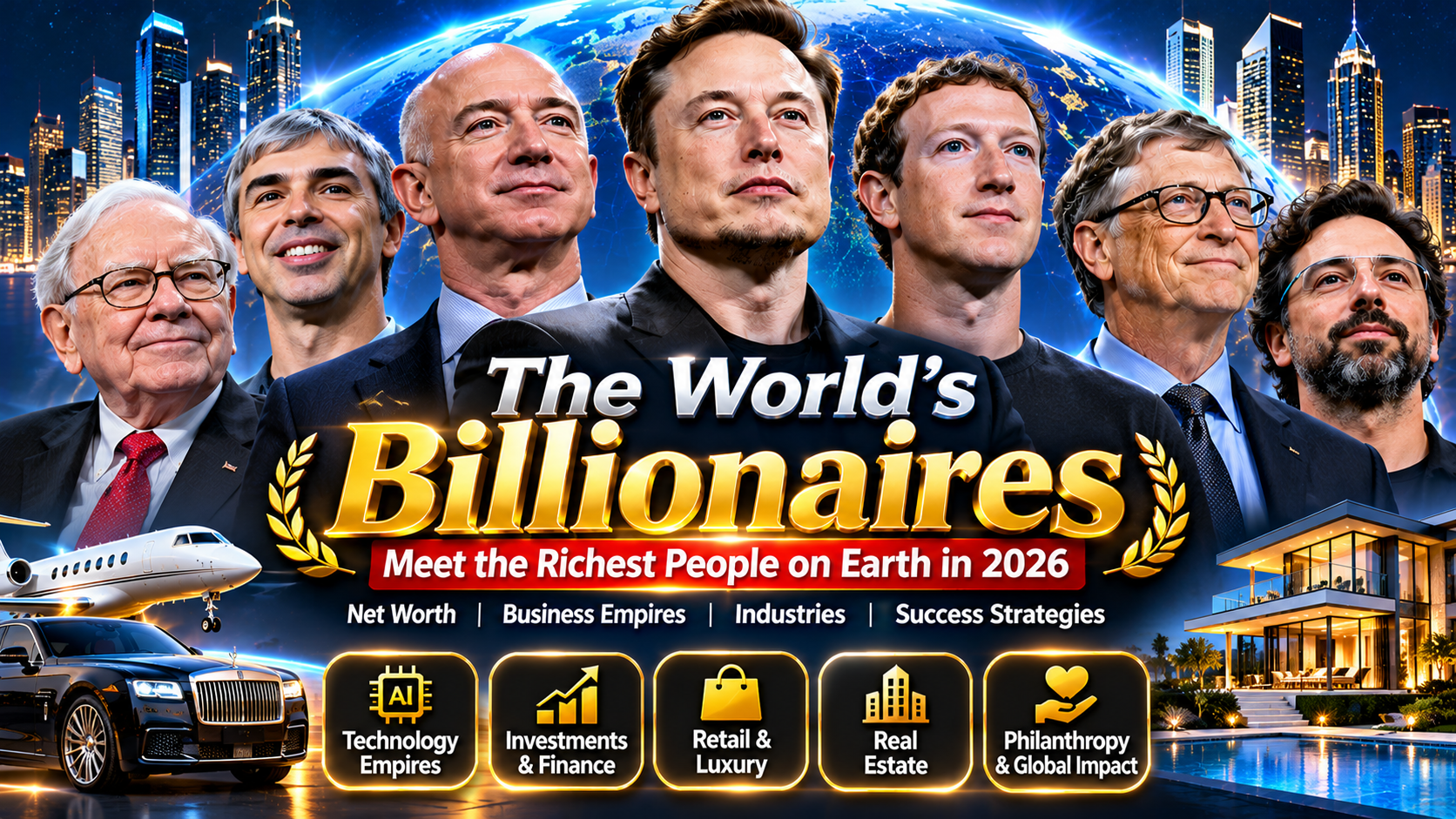
Who are the richest people in the world? How did they build extraordinary fortunes, and which companies and industries made them billionaires?
The world's billionaires include technology founders, investment experts, luxury business owners, industrial leaders, retail entrepreneurs, and heirs to major family businesses. Their decisions influence global markets, create employment, support innovation, and shape the future of entire industries.
In 2026, billionaire wealth reached another historic milestone. According to Forbes' 40th annual World's Billionaires list, published in March 2026, the world had a record 3,428 billionaires with combined estimated wealth of $20.1 trillion. Technology, artificial intelligence, financial markets, and business ownership played important roles in this growth.
From Elon Musk and Jeff Bezos to Bernard Arnault and Warren Buffett, the world's richest individuals have built fortunes through different strategies and business models.
This article explores the world's billionaires, their estimated wealth, leading industries, business achievements, investment strategies, and influence on the global economy.
1. Who Are the World's Billionaires?
A billionaire is an individual whose estimated net worth reaches at least $1 billion.
Net worth is calculated by subtracting liabilities from the total value of assets. These assets can include:
Shares in publicly traded companies
Private business ownership
Real estate and commercial properties
Investment portfolios
Cash and financial assets
Intellectual property and valuable holdings
Most billionaires do not keep their entire fortunes in cash. A significant percentage of their wealth is connected to companies they founded, inherited, manage, or invest in.
For example, an entrepreneur who owns a large stake in a successful technology company may become a billionaire as the company's market valuation increases.
This is why billionaire rankings can change frequently. When company shares rise or fall, the estimated wealth of their major shareholders can change as well.
2. World's Richest People in 2026
Forbes' 2026 annual billionaire ranking provides a snapshot of the world's wealthiest individuals. The following figures are estimates based on stock prices and exchange rates as of March 1, 2026, not live net worth figures.
Rank | Billionaire | Estimated net worth | Main source of wealth |
|---|---|---|---|
1 | Elon Musk | $839 billion | Technology |
2 | Larry Page | $257 billion | |
3 | Sergey Brin | $237 billion | |
4 | Jeff Bezos | $224 billion | Amazon |
5 | Mark Zuckerberg | $222 billion | Meta |
6 | Larry Ellison | $190 billion | Oracle |
7 | Bernard Arnault & family | $171 billion | Luxury brands |
8 | Jensen Huang | $154 billion | Nvidia |
9 | Warren Buffett | $149 billion | Investments |
10 | Amancio Ortega | $148 billion | Fashion retail |
These figures demonstrate the enormous influence of technology companies in modern wealth creation. Seven of the ten entries are associated primarily with technology, while luxury retail and investment businesses also feature prominently.
Elon Musk occupied the top position with an estimated $839 billion fortune in this annual snapshot. Larry Page and Sergey Brin, Google's cofounders, held second and third positions.
The ranking is not permanent. Public market movements, company valuations, private investments, and other financial developments can change the order over time.
3. Elon Musk: The World's Richest Person on the 2026 Annual List
Elon Musk became one of the most influential entrepreneurs of the modern technology era through his involvement in electric vehicles, space exploration, artificial intelligence, and digital platforms.
His business interests include:
Tesla
SpaceX
xAI
X
Tesla helped bring electric vehicles into the mainstream, while SpaceX transformed commercial spaceflight through reusable rocket technology.
Musk's wealth is closely connected to his ownership interests in companies and their valuations. This means his estimated net worth can change substantially when the value of those businesses changes.
His business career demonstrates how ownership in ambitious, technology-focused companies can create extraordinary wealth.
4. Larry Page and Sergey Brin: The Founders Behind Google
Larry Page and Sergey Brin built one of the most influential technology businesses in the world.
They founded Google in 1998 while studying at Stanford University. Their search engine transformed how people find information online.
Google later became part of Alphabet, a major technology group with interests in:
Online search
Digital advertising
Cloud computing
Artificial intelligence
Mobile operating systems
Advanced technology research
Page and Brin built their fortunes through ownership in the company they helped create.
Their story illustrates the financial potential of developing technology that becomes an essential part of everyday life.
5. Jeff Bezos: The Entrepreneur Behind Amazon
Jeff Bezos founded Amazon in 1994 as an online bookstore. Over time, the company expanded into a global e-commerce and technology business.
Amazon's operations now include:
Online retail
Cloud computing
Digital entertainment
Logistics
Advertising
Artificial intelligence infrastructure
One of Amazon's most important growth engines has been Amazon Web Services (AWS), which provides cloud computing services to companies and organizations worldwide.
Bezos demonstrated how a business can grow from a relatively narrow product category into a global platform serving millions of customers.
His wealth is largely associated with his ownership stake in Amazon and other investments.
6. Mark Zuckerberg: Building a Global Social Media Empire
Mark Zuckerberg founded Facebook in 2004 while studying at Harvard University.
The platform eventually became one of the world's largest social networking services. Facebook's parent company was renamed Meta Platforms in 2021.
Meta operates several major digital platforms and invests heavily in artificial intelligence, advertising technology, and virtual and augmented reality.
Its business model demonstrates the financial power of digital platforms that connect billions of users and provide services to advertisers and businesses.
Zuckerberg's fortune is primarily connected to his ownership in Meta.
7. Bernard Arnault: The Luxury Business Billionaire
Bernard Arnault built his fortune through the luxury goods industry.
He leads LVMH, one of the world's most influential luxury groups. Its portfolio includes well-known fashion, cosmetics, jewelry, and retail brands.
Major names associated with the group include:
Louis Vuitton
Dior
Sephora
Bulgari
Tiffany & Co.
Moët & Chandon
Luxury businesses often rely on brand reputation, product quality, exclusivity, global distribution, and customer loyalty.
Arnault's success demonstrates that extraordinary wealth does not come exclusively from technology. Traditional industries can also produce enormous fortunes when businesses develop powerful international brands.
8. Jensen Huang: The Rise of Artificial Intelligence Wealth
Jensen Huang is the cofounder and chief executive of Nvidia, a major semiconductor company.
Nvidia became particularly influential as demand for advanced computing hardware increased.
Its technology is widely used in:
Artificial intelligence development
Data centers
Gaming
Scientific computing
Robotics
Advanced graphics processing
The growth of AI infrastructure has made semiconductor technology a major area of global business investment.
Huang's rise highlights how companies supplying essential technology can become extremely valuable as new industries develop.
9. Warren Buffett: One of the World's Most Famous Investors
Warren Buffett is widely recognized for his long-term investment philosophy.
He built his fortune through decades of investing and leadership at Berkshire Hathaway, a major investment and holding company.
His approach is associated with:
Understanding business fundamentals
Evaluating company management
Investing for the long term
Seeking durable competitive advantages
Maintaining financial discipline
Buffett's career demonstrates that substantial wealth can be built through investment and business ownership rather than creating a new technology company.
His investment philosophy has influenced generations of investors.
10. Amancio Ortega: The Businessman Behind Zara
Amancio Ortega is the Spanish entrepreneur associated with Inditex, the parent company of Zara.
He helped transform fashion retail through a business model focused on responding quickly to customer preferences and bringing new designs into stores.
The Inditex group operates several fashion brands and has developed an extensive international retail network.
Ortega's success demonstrates the importance of supply-chain management, customer understanding, retail strategy, and operational efficiency.
11. Which Countries Have the Most Billionaires?
Billionaire wealth is distributed unevenly across countries.
According to Forbes' 2026 annual list, the United States had the highest number of billionaires, followed by China, including Hong Kong, and India.
The reported figures were:
Country or region | Number of billionaires |
|---|---|
United States | 989 |
China, including Hong Kong | 610 |
India | 229 |
These figures reflect Forbes' annual ranking methodology and should not be interpreted as a live count.
The United States benefits from major technology companies, financial markets, investment institutions, and established business infrastructure.
China has produced major fortunes through manufacturing, technology, retail, and industrial development.
India has created billionaires through technology services, infrastructure, manufacturing, energy, finance, and diversified business groups.
The geographical distribution of billionaire wealth reflects differences in economic development, investment opportunities, company valuations, and business environments.
12. Which Industries Create the Most Billionaires?
Billionaires come from many different industries. However, several sectors have played particularly important roles in creating large fortunes.
Technology
Technology companies can reach international markets through software, digital platforms, artificial intelligence, cloud computing, and hardware.
Finance and Investments
Investment firms, banking businesses, asset management, private equity, and financial services have created many wealthy individuals.
Fashion and Retail
Luxury brands, global retailers, and consumer businesses can build valuable companies through strong brands and international distribution.
Manufacturing
Industrial companies produce essential products such as vehicles, machinery, electronics, chemicals, and construction materials.
Real Estate
Property development, commercial buildings, residential portfolios, and land investments can create significant wealth over time.
Healthcare
Pharmaceutical companies, medical technology, biotechnology, and healthcare services offer opportunities for business expansion and innovation.
The strongest wealth-creating industries often combine customer demand, competitive advantages, effective management, and opportunities to scale.
13. The World's Richest Women
Women also hold significant positions among the world's wealthiest individuals.
Some built businesses themselves, while others inherited ownership stakes in major family companies.
Alice Walton, heir to the Walmart fortune, was the wealthiest woman on Forbes' 2026 annual list, with an estimated net worth of $134 billion.
Françoise Bettencourt Meyers, associated with the L'Oréal family fortune, was another prominent name, with an estimated $100 billion.
Other influential women in global wealth include:
Julia Koch
Jacqueline Mars
MacKenzie Scott
Rafaela Aponte-Diamant
Savitri Jindal
Their fortunes reflect different paths, including inheritance, business ownership, entrepreneurship, and investments.
14. How Do the World's Billionaires Build Their Wealth?
Although billionaire success stories differ, several common business principles appear repeatedly.
Ownership of Valuable Businesses
Many billionaires own significant stakes in companies that grow over time.
Innovation
Developing new products, technologies, and services can create competitive advantages and attract customers.
Global Expansion
Businesses that serve international markets may have greater opportunities to increase revenue and scale operations.
Strategic Investments
Investing in promising businesses, infrastructure, and financial assets can help build long-term wealth.
Strong Leadership
Successful companies require capable management, skilled employees, clear strategies, and disciplined operations.
Reinvestment
Reinvesting profits into research, technology, employees, and expansion can strengthen a company's future growth potential.
These principles do not guarantee billionaire status, but they help explain how large businesses create substantial economic value.
15. How Artificial Intelligence Is Changing Billionaire Wealth
Artificial intelligence has become one of the most important forces influencing technology investment.
The development of AI models, data centers, semiconductors, robotics, and automation systems is creating new commercial opportunities.
Companies involved in AI infrastructure can benefit from demand for advanced computing resources.
AI may also transform traditional industries by improving productivity and reducing operational costs.
Potential growth areas include:
AI software and applications
Semiconductor manufacturing
Cloud computing
Robotics and automation
AI-powered healthcare
Financial technology
Cybersecurity
Business intelligence
The AI industry may create new billionaires, but technological popularity alone does not guarantee profitable businesses.
Long-term success will depend on real customer demand, reliable products, sustainable revenue, and responsible development.
16. The Influence of Billionaires on the Global Economy
Billionaires can have a significant impact on economic development.
Their companies and investments may influence several important areas.
Employment: Large businesses provide jobs and support suppliers, service providers, and contractors.
Innovation: Major companies invest in research, engineering, technology, and new products.
Investment: Wealthy individuals can provide capital to startups, established companies, and infrastructure projects.
International Trade: Global businesses connect countries through manufacturing, services, distribution, and supply chains.
Philanthropy: Some billionaires fund education, healthcare, scientific research, environmental protection, and poverty reduction.
However, billionaire influence also creates debate about economic inequality, taxation, market concentration, and the responsibilities of powerful corporations.
17. Can New Entrepreneurs Become Billionaires?
The growth of digital technology has opened new opportunities for entrepreneurs around the world.
Modern businesses can reach international customers through websites, online marketplaces, digital services, and software platforms.
Some areas offering business opportunities include:
Artificial intelligence solutions
E-commerce
Digital marketing
Financial technology
Software development
Cybersecurity
Renewable energy
Real estate technology
Online education
Healthcare innovation
Entrepreneurs should focus on solving genuine problems, understanding customers, building reliable products, and managing finances carefully.
Becoming a billionaire is extremely rare, but building a profitable and sustainable company is a meaningful business achievement in its own right.
18. What Could the Future of the World's Billionaires Look Like?
The next generation of billionaires may emerge from industries that are still developing.
Artificial intelligence, robotics, biotechnology, clean energy, advanced manufacturing, space technology, and digital finance could create major business opportunities.
At the same time, established industries such as retail, real estate, healthcare, and manufacturing will continue to evolve.
Future billionaire fortunes may depend on the ability to combine technology with practical solutions that serve large markets.
The businesses that succeed will likely be those that create lasting customer value, adapt to changing economic conditions, and operate responsibly.
Conclusion
The world's billionaires represent some of the most influential figures in modern business and finance.
Their fortunes come from different industries, including technology, investments, luxury goods, retail, manufacturing, and real estate. Their companies can shape global markets, create employment, and influence the direction of innovation.
The 2026 Forbes annual ranking highlights the extraordinary scale of modern billionaire wealth, with 3,428 individuals holding a combined estimated fortune of $20.1 trillion.
However, these rankings are only snapshots of a changing financial landscape. Stock prices, business performance, ownership structures, and economic conditions can quickly change individual fortunes.
For entrepreneurs and business professionals, the most valuable lessons are about innovation, ownership, leadership, strategic investment, and long-term value creation.
The future of global wealth will continue to evolve as technology and new industries reshape the world economy.
Frequently Asked Questions (FAQs)
1. Who is the richest person in the world in 2026?
Elon Musk ranked first on Forbes' 2026 annual World's Billionaires list, with an estimated net worth of $839 billion as of March 1, 2026.
2. How many billionaires are there in the world in 2026?
Forbes counted 3,428 billionaires in its 2026 annual ranking.
3. What is the combined wealth of the world's billionaires?
Forbes estimated their combined wealth at $20.1 trillion in its 2026 annual list.
4. Who are the top five richest people on the 2026 Forbes annual list?
The top five were Elon Musk, Larry Page, Sergey Brin, Jeff Bezos, and Mark Zuckerberg.
5. Which country has the most billionaires?
The United States had the most billionaires in Forbes' 2026 annual ranking, with 989.
6. Who is the richest woman in the world in the 2026 annual ranking?
Alice Walton was the richest woman on Forbes' 2026 annual list, with an estimated fortune of $134 billion.
7. How do billionaires make their money?
They build wealth through business ownership, investments, company shares, real estate, inheritance, and entrepreneurship.
8. Which industry creates the most billionaire wealth?
Technology, finance, manufacturing, retail, and investments are among the major industries associated with billionaire fortunes.
9. Is Elon Musk richer than Jeff Bezos?
Yes. Elon Musk ranked ahead of Jeff Bezos on Forbes' 2026 annual list, based on estimates from March 1, 2026.
10. Can billionaire net worth change every day?
Yes. Public company share prices and other asset valuations can change daily, affecting estimated net worth.
11. Are all billionaires self-made?
No. Some build businesses themselves, while others inherit wealth or expand established family businesses.
12. How does artificial intelligence create billionaire wealth?
AI can create valuable businesses through software, computing infrastructure, semiconductors, automation, and other commercial applications.
13. Who is the richest person in India on the 2026 annual list?
Mukesh Ambani was India's highest-ranked individual on Forbes' 2026 annual list, with an estimated net worth of $99.7 billion.
14. What is the difference between a millionaire and a billionaire?
A millionaire has a net worth of at least one million units of currency, while a billionaire has at least one billion. A billionaire has wealth equivalent to 1,000 million.
15. Where can readers find updated billionaire rankings?
Readers can follow Forbes' Real-Time Billionaires ranking and the Bloomberg Billionaires Index for regularly updated estimates of the world's richest people.