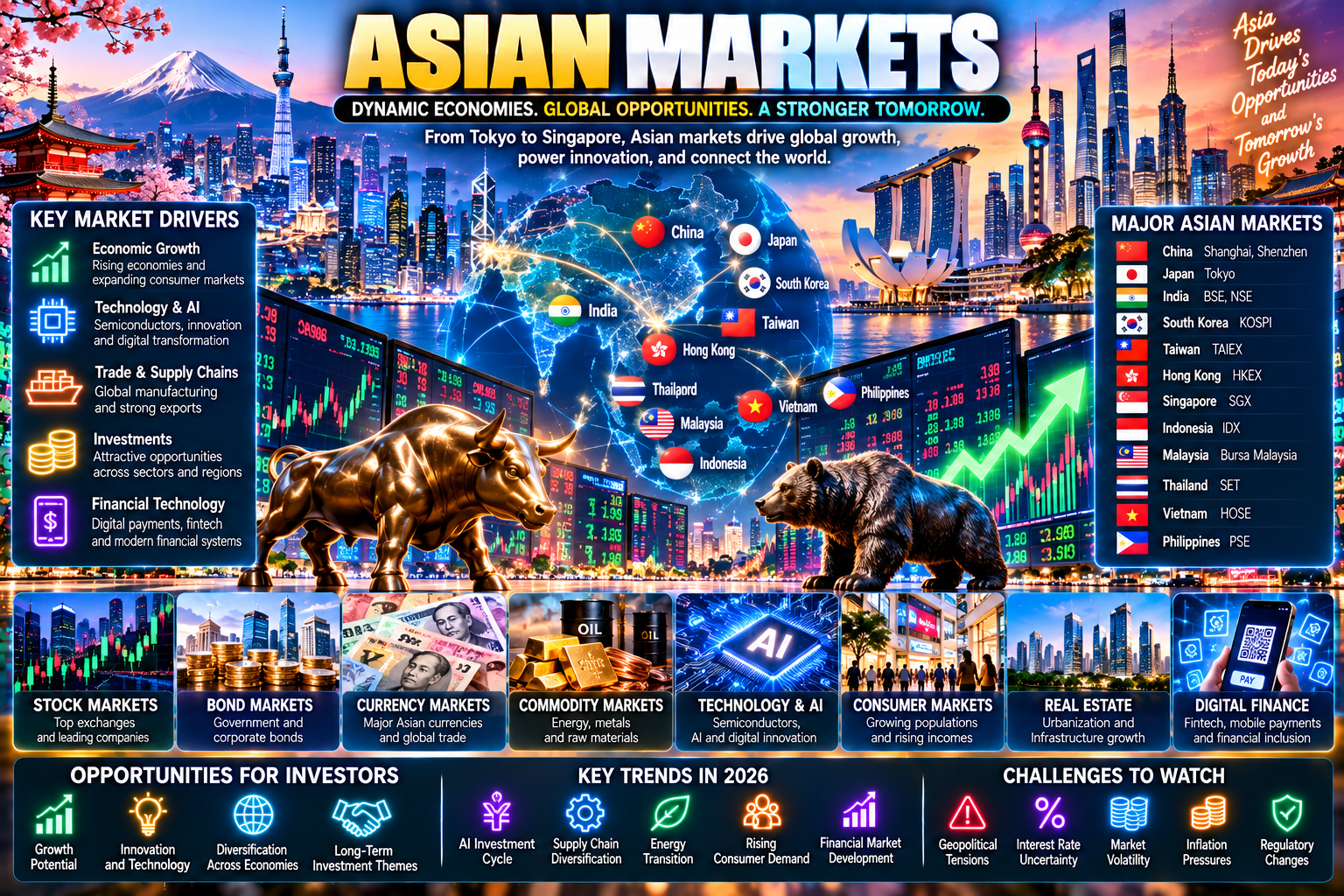
Asian markets have become one of the most important components of the global financial system. From Japan and China to India, South Korea, Taiwan, Singapore, Indonesia, Malaysia, Thailand, and the Philippines, the region contains some of the world's largest economies, financial centers, manufacturing hubs, technology companies, and consumer markets.
Asia's importance extends far beyond stock exchanges. The region plays a major role in global supply chains, semiconductor production, artificial intelligence infrastructure, electronics, automobiles, commodities, shipping, banking, foreign exchange, and digital finance.
In 2026, Asian markets are operating in a complicated environment. Trade-policy uncertainty, geopolitical tensions, energy prices, interest rates, currency movements, and the global AI investment cycle are influencing financial conditions. At the same time, domestic consumption, technology exports, infrastructure investment, and digital transformation continue to support economic activity.
The OECD's 2026 Asia Capital Markets Report says Asia accounted for about 31% of global GDP in 2025, 29% of global public equity market capitalization, 56% of listed companies, and 52% of global venture-capital activity.
What Are Asian Markets?
Asian markets refer broadly to the financial and economic markets across countries and territories in Asia.
They include:
Stock markets
Bond markets
Foreign-exchange markets
Commodity markets
Money markets
Derivatives markets
Cryptocurrency and digital-asset markets
Private-equity and venture-capital markets
Banking and credit markets
Real-estate markets
Asian markets are highly interconnected with Europe, North America, the Middle East, and other regions through international trade, investment and supply chains.
A change in U.S. interest rates, for example, can influence Asian currencies and capital flows. Higher oil prices can affect energy-importing economies, while stronger demand for semiconductors can benefit Asian technology exporters.
Why Asian Markets Matter
Asia has become central to the global economy because of its enormous population, industrial capacity, consumer markets, financial systems and technological capabilities.
The region is home to major economies such as:
China
Japan
India
South Korea
Indonesia
Australia
Taiwan
Singapore
It also includes rapidly developing markets across Southeast Asia and South Asia.
The OECD reports that Asian capital markets have expanded substantially over recent decades, improving access to long-term financing for companies and governments and supporting entrepreneurship and investment.
Asian markets are particularly important for several industries:
Technology: Semiconductors, electronics, AI infrastructure and telecommunications.
Manufacturing: Automobiles, machinery, consumer electronics, chemicals and industrial products.
Trade: Asia is deeply integrated into global production and shipping networks.
Finance: Tokyo, Hong Kong, Singapore, Shanghai, Shenzhen, Mumbai and other financial centers connect regional capital with global investors.
Consumer markets: Rising incomes and urbanization have created large markets for retail, financial services, technology and entertainment.
Major Asian Financial Markets
Asia does not have one single financial market. It consists of numerous national and regional markets with different economic structures, regulations and investment characteristics.
1. Japan
Japan has one of Asia's most developed financial systems.
Its market includes large companies in:
Automobiles
Electronics
Industrial machinery
Robotics
Financial services
Consumer products
Technology
Japan's stock market is closely watched by international investors because of the size of its corporations and its role in global manufacturing.
Currency movements are also important. The Japanese yen influences exporters, import costs and international investment flows.
Japan's financial conditions can therefore affect both Asian and global markets.
2. China
China represents one of the world's largest economic and financial markets.
Its financial system includes major stock exchanges in Shanghai and Shenzhen, along with Hong Kong's international financial market.
Important Chinese market sectors include:
Technology
Electric vehicles
Batteries
Manufacturing
E-commerce
Banking
Consumer goods
Renewable energy
Telecommunications
Artificial intelligence
China's economy remains highly significant to Asian markets, although property-sector challenges and weaker domestic demand have affected the outlook.
The World Bank projected China's growth at 4.2% in 2026, compared with 5.0% in 2025, citing weak domestic demand, property-sector challenges and a slower global environment.
China's performance also affects commodity demand, regional exports, manufacturing supply chains and neighboring economies.
3. Hong Kong
Hong Kong remains an important international financial center.
Its market provides connections between:
Mainland Chinese companies
International investors
Global banks
Asset managers
Private capital
Hong Kong's position makes it particularly important for international access to Chinese businesses and capital markets.
4. India
India has become one of Asia's most closely watched economies.
Its financial markets include major equity exchanges and a rapidly developing bond, banking, fintech and digital-payment ecosystem.
Important sectors include:
Information technology
Financial services
Manufacturing
Pharmaceuticals
Telecommunications
Consumer goods
Infrastructure
Renewable energy
Digital services
The Asian Development Bank's September 2026 outlook projected India's growth at 7.0% in FY2026, supported by consumption, investment and services exports.
India's large domestic market makes its economic drivers somewhat different from export-heavy Asian economies.
5. South Korea
South Korea is an important technology and manufacturing market.
Its economy has major exposure to:
Semiconductors
Electronics
Automobiles
Batteries
Shipbuilding
Technology
Consumer electronics
Semiconductor demand has become particularly important because AI data centers and advanced computing systems require large amounts of high-performance chips.
The IMF identified South Korea as an exception to some of the broader Asian slowdown pressures in its April 2026 regional outlook because of its strong connection to the technology cycle.
6. Taiwan
Taiwan plays a strategically important role in the global semiconductor industry.
Its market is influenced by:
Semiconductor demand
AI infrastructure
Advanced computing
Electronics
Global technology investment
Export demand
The global AI investment cycle has increased the importance of semiconductor supply chains, making Taiwan particularly relevant to technology investors and manufacturers.
7. Singapore
Singapore is one of Asia's major financial and business centers.
Its economy is closely connected to:
Banking
Asset management
International trade
Shipping
Technology
Logistics
Wealth management
Financial technology
Singapore also functions as an important gateway to Southeast Asian markets.
8. Southeast Asian Markets
Southeast Asia includes several rapidly developing markets, including:
Indonesia
Malaysia
Thailand
Vietnam
Philippines
These economies have different economic structures but share growing importance in manufacturing, services, tourism, commodities, technology and consumer markets.
The Asian Development Bank projects developing Southeast Asia to grow 4.7% in 2026, with differences among individual economies. Vietnam received the largest forecast upgrade within the subregion in the September 2026 outlook, followed by Malaysia and Thailand.
Asian Stock Markets
Stock markets are among the most visible parts of Asian financial markets.
Major exchanges include markets in:
Japan
China
Hong Kong
India
South Korea
Taiwan
Singapore
Indonesia
Malaysia
Thailand
Philippines
Vietnam
Asian stock markets contain companies ranging from traditional banks and manufacturers to AI, semiconductor, e-commerce and digital-finance businesses.
Different markets can perform differently because their economies have different exposures.
For example:
Technology-heavy markets can be strongly influenced by semiconductor and AI demand.
Commodity-oriented markets can respond to oil, gas, metals and agricultural prices.
Consumer markets can be influenced by household income, employment and domestic demand.
Export-oriented markets can be sensitive to global trade conditions and currency movements.
Asian Bond Markets
Bond markets are another major component of Asian finance.
Governments issue bonds to finance public spending and investment, while corporations issue debt to fund operations and expansion.
Important bond-market factors include:
Central-bank policy
Inflation
Interest rates
Government borrowing
Credit quality
Currency movements
Global bond yields
Investor risk appetite
The OECD reported that Asian debt markets experienced net inflows in 2025 even as net flows to Asian equity markets declined. It also noted that sovereign and corporate bond spreads widened during periods of market stress.
Asian Currency Markets
Foreign exchange is especially important in Asia because the region contains many major exporting and importing economies.
Important Asian currencies include:
Japanese yen
Chinese yuan
Indian rupee
South Korean won
Singapore dollar
Indonesian rupiah
Malaysian ringgit
Thai baht
Philippine peso
Vietnamese dong
Australian dollar
Currency values can be influenced by:
Interest-rate differences
Inflation
Trade balances
Foreign investment
Commodity prices
Central-bank policies
Economic growth
Political and geopolitical developments
U.S. dollar movements
Currency performance can also differ significantly between Asian economies rather than moving uniformly.
A July 2026 MUFG analysis described the region as increasingly characterized by divergence, with currency performance influenced by participation in the AI investment cycle, external competitiveness and domestic policy fundamentals.
Asian Commodity Markets
Asia is a major consumer of energy and raw materials.
The region's industrial and manufacturing base creates significant demand for:
Oil
Natural gas
Coal
Copper
Iron ore
Aluminum
Agricultural commodities
Battery materials
Energy prices are particularly important.
The IMF reported in April 2026 that Asia consumes about 38% of the world's oil and 24% of its natural gas, while net oil and gas imports represent around 2.5% of regional economic output.
This means higher energy prices can affect transportation, manufacturing, electricity, fertilizers and household purchasing power.
AI and Asian Markets
Artificial intelligence has become one of the major structural themes affecting Asian markets.
AI requires enormous amounts of:
Semiconductors
Data centers
Electricity
Networking equipment
Cloud infrastructure
Advanced computing
Cooling systems
Memory
Industrial equipment
This creates opportunities across several Asian economies.
The Asian Development Bank said strong technology exports driven by the global AI investment cycle are supporting growth in developing Asia and the Pacific in 2026.
The World Bank similarly identified surging AI-related exports and investment as a bright spot in East Asia and the Pacific, particularly in Malaysia, Thailand and Vietnam.
AI therefore affects Asian markets beyond software companies. It can influence semiconductor manufacturers, electricity demand, data-center construction, industrial equipment, telecommunications and logistics.
Asian Markets and Global Trade
Trade is one of the most important forces affecting Asian markets.
Asian economies are deeply integrated into global production networks.
A product sold in North America or Europe may involve:
Raw materials from one country.
Components from several Asian economies.
Semiconductor production in another market.
Assembly in another country.
Shipping through major Asian ports.
Final distribution to consumers worldwide.
This integration creates economic opportunities but also exposes markets to trade disruptions.
The OECD reports that Asia accounted for approximately 36% of U.S. imports, highlighting the region's importance in global trade.
Trade tariffs, supply-chain changes and geopolitical tensions can therefore influence Asian stocks, currencies and corporate investment.
Interest Rates and Asian Markets
Interest rates affect Asian markets through multiple channels.
When interest rates rise:
Borrowing becomes more expensive.
Corporate financing costs can increase.
Consumer credit can become more expensive.
Bond yields may rise.
Equity valuations can be affected.
Currency movements can change.
Investment flows may shift.
When rates decline, the opposite pressures can occur, although the actual effect depends on economic conditions.
Asian central banks therefore closely monitor inflation, currencies, economic growth and global financial conditions.
Inflation and Purchasing Power
Inflation is another major market driver.
Higher inflation can increase:
Food costs
Energy costs
Transportation expenses
Manufacturing costs
Wage pressures
Business operating costs
For investors, inflation matters because it can influence interest rates, corporate profits, bond yields and consumer spending.
The Asian Development Bank's September 2026 forecast puts inflation in developing Asia and the Pacific at 4.2% for 2026, before easing to 3.5% in 2027.
Geopolitical Risks
Asian markets are particularly sensitive to geopolitical developments because of the region's trade relationships, energy requirements and strategic importance.
Potential market influences include:
Trade disputes
Tariffs
Energy disruptions
Shipping interruptions
Regional conflicts
Supply-chain restrictions
Technology controls
Currency volatility
The OECD reported that equity-market volatility increased following tariff announcements in 2025 and geopolitical tensions in early 2026, while bond spreads also widened during periods of stress.
These events demonstrate why Asian markets cannot be analyzed only through domestic economic data.
Asian Markets and Technology
Technology is transforming financial markets themselves.
Modern Asian financial systems increasingly use:
Electronic trading
Mobile banking
Digital payments
AI-powered analytics
Algorithmic trading
Cloud computing
Blockchain
Digital assets
Real-time payment systems
Automated risk management
Financial technology has also expanded access to banking and payment services across many Asian economies.
Mobile payments have become particularly important in countries where consumers and businesses can adopt digital financial services without relying exclusively on traditional branch banking.
Private Capital and Venture Capital
Asian markets are also important centers for private investment.
The OECD estimates that Asia accounted for about 52% of global venture-capital activity in 2025.
Technology startups are attracting capital in areas such as:
Artificial intelligence
Fintech
Cybersecurity
Robotics
Biotechnology
Semiconductors
Climate technology
E-commerce
Digital infrastructure
However, funding conditions can change quickly when global interest rates, valuations or investor risk appetite change.
Key Differences Across Asian Markets
Market | Major Economic Drivers | Important Market Themes |
|---|---|---|
Japan | Manufacturing, technology, exports, services | Equities, yen, technology |
China | Manufacturing, consumption, technology, exports | Equities, property, technology |
India | Consumption, services, infrastructure, investment | Equities, banking, technology |
South Korea | Semiconductors, electronics, exports | Chips, technology, currency |
Taiwan | Semiconductors, electronics, AI supply chain | Advanced chips, technology |
Singapore | Finance, trade, logistics, technology | Banking, FX, global capital |
Indonesia | Commodities, consumption, manufacturing | Equities, commodities, currency |
Malaysia | Manufacturing, commodities, technology | Trade, electronics, AI investment |
Thailand | Tourism, manufacturing, services | Consumer and industrial sectors |
Vietnam | Manufacturing, exports, domestic demand | Supply-chain investment, technology |
Philippines | Consumption, services, remittances | Banking, consumer economy |
Major Opportunities in Asian Markets
Asian markets contain several long-term structural themes.
Technology and AI
AI infrastructure is increasing demand for semiconductors, data centers, networking equipment and electricity.
Digital Finance
Mobile banking, digital wallets and instant payments continue to transform financial services.
Consumer Growth
Large populations and rising incomes support demand for consumer products and services.
Manufacturing
Companies continue to diversify supply chains across Asian economies.
Infrastructure
Urbanization and economic development require transportation, electricity, telecommunications and digital infrastructure.
Renewable Energy
Asia is investing heavily in solar power, batteries, electric vehicles and other clean-energy technologies.
Healthcare
Population growth, ageing and rising incomes are increasing demand for healthcare services and technology.
Risks in Asian Markets
Investors and businesses also face significant risks.
Market Volatility
Equity prices can move sharply because of global economic news, geopolitical events or changes in investor sentiment.
Currency Risk
Exchange-rate movements can affect international investments and corporate earnings.
Trade Risk
Tariffs and trade restrictions can affect export-oriented companies.
Energy Risk
Energy-importing economies can be vulnerable to oil and gas price increases.
Interest-Rate Risk
Changes in global and domestic interest rates can influence stocks, bonds, currencies and borrowing costs.
Geopolitical Risk
Regional tensions can quickly influence financial markets and supply chains.
Regulatory Risk
Government policies can change the operating environment for financial, technology and industrial companies.
Property and Credit Risk
Property-sector weakness or excessive corporate borrowing can create pressure within financial systems.
The Outlook for Asian Markets in 2026
The 2026 outlook is mixed rather than uniform across the region.
The Asian Development Bank projects developing Asia and the Pacific to grow 5.0% in 2026, down from 5.5% in 2025, with growth expected to rise slightly to 5.1% in 2027. It identifies domestic demand, government stimulus and technology exports connected to the AI investment cycle as important supports.
The IMF's April 2026 regional outlook projected Asian growth at approximately 4.4% in 2026, assuming the energy shock proves temporary. The IMF also estimated that China and India would together contribute around 70% of the region's growth.
These figures use different regional definitions and methodologies, so they should not be treated as directly interchangeable forecasts.
The major themes for Asian markets include:
AI investment
Semiconductor demand
Trade-policy uncertainty
Energy prices
Currency movements
Interest rates
Domestic consumption
Supply-chain diversification
Digital finance
Infrastructure investment
Geopolitical developments
How to Understand Asian Markets
A useful framework for analyzing an Asian market is:
1. Economy
Understand GDP growth, inflation, employment and domestic demand.
2. Monetary Policy
Follow interest rates and central-bank decisions.
3. Currency
Examine exchange-rate trends and external balances.
4. Trade
Determine how dependent the economy is on exports and imports.
5. Industry Structure
Identify dominant sectors such as technology, manufacturing, commodities or services.
6. Corporate Earnings
Study revenue, profits, debt and investment.
7. Valuation
Compare market prices with earnings, cash flows and other financial measures.
8. Global Conditions
Monitor U.S. rates, global growth, energy prices and international capital flows.
9. Geopolitics
Consider trade restrictions, regional tensions and supply-chain risks.
10. Long-Term Structural Trends
Look at demographics, technology, infrastructure, urbanization and productivity.
Asian Markets vs. Western Markets
Asian and Western markets are increasingly interconnected, but they can have different economic characteristics.
Factor | Asian Markets | Western Markets |
|---|---|---|
Manufacturing | Major global concentration | Important but generally smaller share in many economies |
Technology | Strong semiconductor and electronics presence | Strong software, AI and platform companies |
Demographics | Highly diverse across countries | Also diverse, with ageing in many developed economies |
Trade | Very high integration into global supply chains | Large consumer and services markets |
Emerging economies | Large presence | Smaller relative share |
Digital payments | Rapid adoption in many markets | Developed but varying by country |
Commodity exposure | Significant differences by country | Also varies considerably |
Financial development | Ranges from highly developed to emerging | Generally developed, but varies |
The comparison should not be interpreted as a simple division: many Asian and Western markets have overlapping industries, investors and financial institutions.
The Future of Asian Markets
The future of Asian markets will likely be shaped by several forces simultaneously.
Artificial intelligence could transform manufacturing, financial services, logistics and technology investment.
Semiconductors will remain strategically important because AI systems, smartphones, vehicles and advanced computing depend on increasingly sophisticated chips.
Digital finance can expand access to payments, banking and investment services.
Supply-chain diversification may encourage more manufacturing investment across Southeast Asia and South Asia.
Energy transition could increase investment in solar power, batteries, electric vehicles and grid infrastructure.
Urbanization will create continuing demand for housing, transportation, infrastructure and services.
Capital-market development could improve companies' access to long-term financing and support innovation.
At the same time, climate risks, geopolitical tensions, energy shocks, trade restrictions and financial volatility will remain important considerations.
Conclusion
Asian markets represent a diverse and increasingly influential part of the global financial system. Japan, China, India, South Korea, Taiwan, Singapore and the emerging economies of Southeast Asia each have different economic structures, market drivers and risks.
In 2026, the region is being shaped by the interaction of AI investment, technology exports, domestic consumption, trade, energy prices, monetary policy, currencies and geopolitical developments.
The Asian Development Bank continues to expect strong growth across developing Asia, while the IMF and OECD highlight the region's exposure to energy shocks, trade uncertainty and changing global financial conditions.
Understanding Asian markets therefore requires looking beyond individual stock indexes. The broader picture includes economies, currencies, bonds, commodities, technology, trade, capital flows and structural changes affecting billions of consumers and businesses.
For investors, companies and researchers, Asian markets will remain an important part of understanding the direction of the global economy.
Frequently Asked Questions
What are Asian markets?
Asian markets include the stock, bond, currency, commodity, banking, credit, derivatives and digital-asset markets operating across Asian economies.
Which are the major Asian financial markets?
Major markets include Japan, China, Hong Kong, India, South Korea, Taiwan, Singapore and the major Southeast Asian economies.
Why are Asian markets important?
Asia represents a large share of global economic output, listed companies, manufacturing, trade, venture capital and technology supply chains.
How does AI affect Asian markets?
AI increases demand for semiconductors, data centers, advanced computing, networking equipment, electricity and digital infrastructure, creating effects across multiple industries.
Are Asian markets affected by U.S. interest rates?
Yes. Changes in U.S. interest rates can influence global capital flows, currencies, bond yields, borrowing costs and investor risk appetite in Asian markets.
What are the biggest risks for Asian markets in 2026?
Major risks include geopolitical tensions, trade uncertainty, energy-price shocks, inflation, currency volatility, tighter financial conditions and weaker global demand.
What is the outlook for Asian markets?
The outlook varies substantially by country. Current 2026 forecasts continue to show relatively strong regional growth, while highlighting risks from energy prices, trade uncertainty and geopolitical developments.