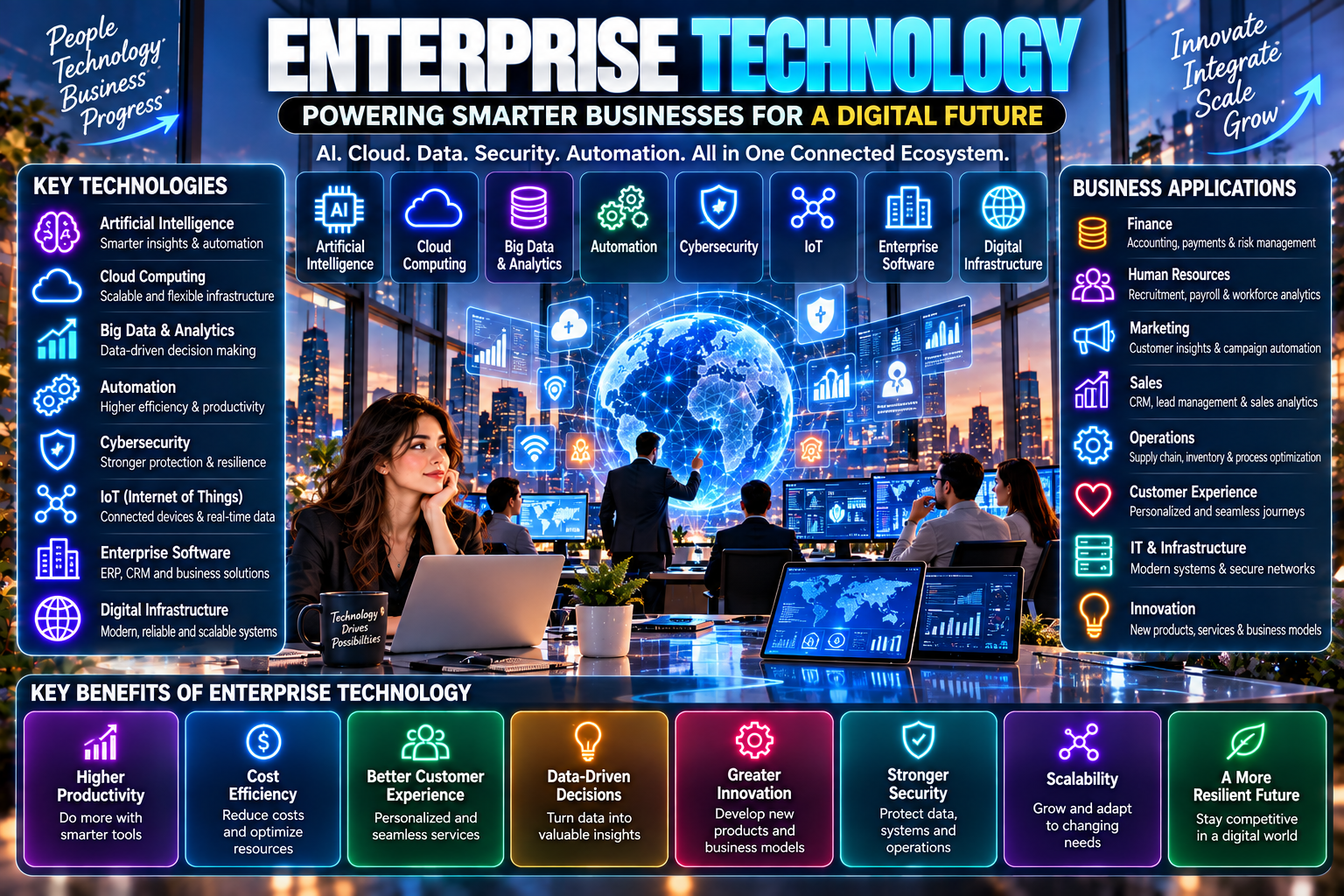
Enterprise technology is transforming how organizations operate, communicate, serve customers, manage data, develop products, and compete in the digital economy. From artificial intelligence and cloud computing to cybersecurity, automation, Big Data, enterprise software, and connected devices, modern technology has become a central part of business strategy.
Enterprise technology is not limited to large corporations. Businesses of different sizes are adopting digital platforms, cloud services, AI tools, analytics systems, collaboration software, and cybersecurity technologies to improve efficiency and create new opportunities.
Artificial intelligence is becoming particularly important. According to the OECD, 20.2% of firms across OECD countries reported using AI in 2025, compared with 14.2% in 2024 and 8.7% in 2023. Adoption was much higher among large firms, at 52%, compared with 17.4% among small firms.
This growth illustrates how enterprise technology is moving from traditional IT infrastructure toward intelligent, connected, and increasingly automated business systems.
What Is Enterprise Technology?
Enterprise technology refers to the hardware, software, platforms, infrastructure, networks, data systems, and digital services organizations use to operate and achieve business objectives.
It can include:
Enterprise software
Cloud computing
Artificial intelligence
Machine learning
Big Data analytics
Cybersecurity
Enterprise resource planning
Customer relationship management
Supply-chain technology
Automation
Internet of Things
Data warehouses
Business intelligence
Collaboration platforms
Digital payments
APIs and integration platforms
IT infrastructure
DevOps and DevSecOps
AI agents
Mobile and web applications
Enterprise technology connects different parts of an organization so employees, customers, systems, and data can work together.
Why Is Enterprise Technology Important?
Businesses operate in increasingly digital markets where customers expect fast services, employees need connected tools, and decision-makers require accurate information.
Enterprise technology can help organizations:
Improve productivity
Automate repetitive processes
Reduce operational costs
Improve customer experiences
Analyze large amounts of data
Strengthen cybersecurity
Support remote and hybrid work
Improve supply-chain visibility
Develop digital products
Accelerate innovation
Improve business decisions
Scale operations
Technology can also create entirely new business models.
For example, a traditional retailer can develop an e-commerce platform, digital payment system, personalized recommendation engine, automated warehouse, and AI customer-service system.
The result is not simply a more technologically advanced retailer. It is a different operating model built around digital capabilities.
Key Components of Enterprise Technology
Enterprise technology consists of many interconnected systems.
1. Enterprise Software
Enterprise software supports business operations across departments.
Examples include:
Enterprise resource planning (ERP)
Customer relationship management (CRM)
Human resource management systems
Accounting software
Procurement platforms
Project-management systems
Supply-chain management platforms
Business intelligence software
These systems allow organizations to standardize processes and share information across departments.
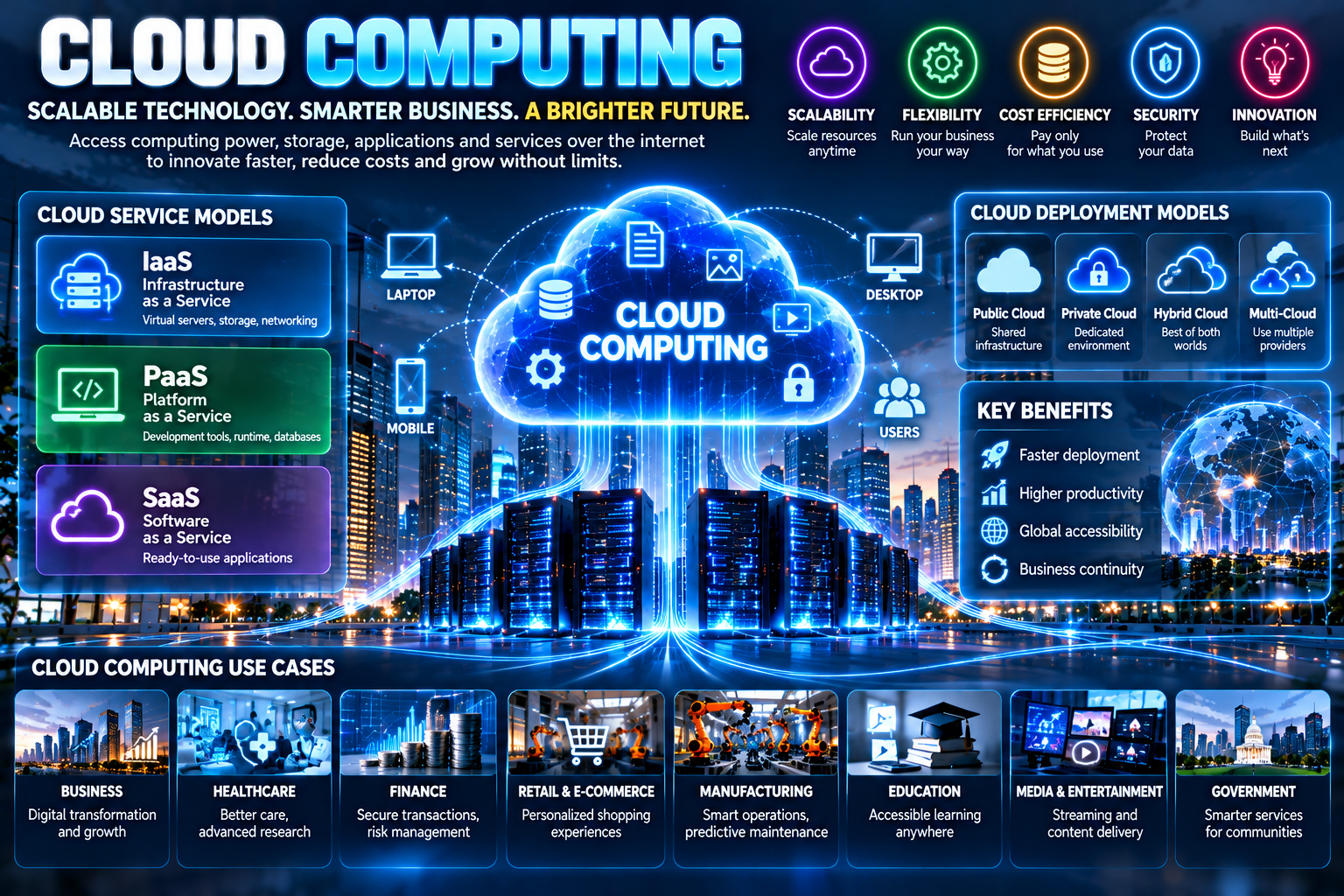
2. Cloud Computing
Cloud computing has become a major foundation of enterprise technology.
Organizations can use cloud platforms for:
Computing
Storage
Databases
Networking
Software
AI infrastructure
Backup
Disaster recovery
Application development
Cloud technology can provide greater flexibility than maintaining all infrastructure on-premises.
Organizations may use:
Public clouds
Private clouds
Hybrid clouds
Multi-cloud environments
Edge computing
Cloud adoption also makes it easier for businesses to scale digital services according to demand.
However, cloud migration requires careful planning around security, cost management, data governance, compliance, and application architecture.
3. Artificial Intelligence
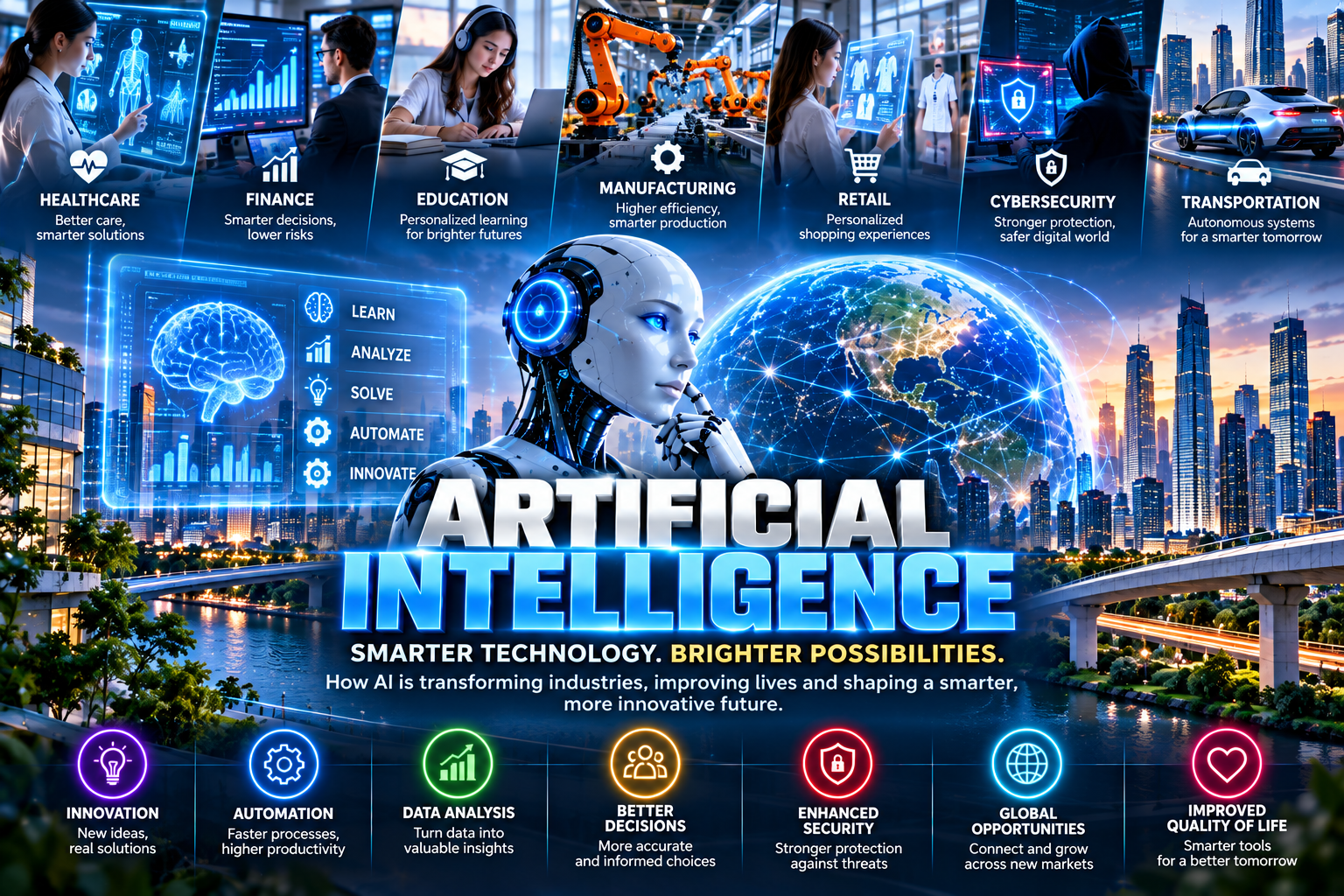
AI is rapidly becoming a major enterprise technology.
Businesses can use AI for:
Customer service
Marketing
Sales
Financial analysis
Fraud detection
Cybersecurity
Software development
Document processing
Business intelligence
Research
Forecasting
Supply-chain optimization
Employee assistance
Generative AI can also help employees create text, summarize documents, analyze information, generate software code, and interact with enterprise knowledge.
The rapid increase in enterprise AI adoption means organizations increasingly need processes for evaluating AI systems and managing associated risks.
NIST's AI Risk Management Framework provides voluntary guidance for incorporating trustworthiness considerations into the design, development, deployment, use, and evaluation of AI systems.
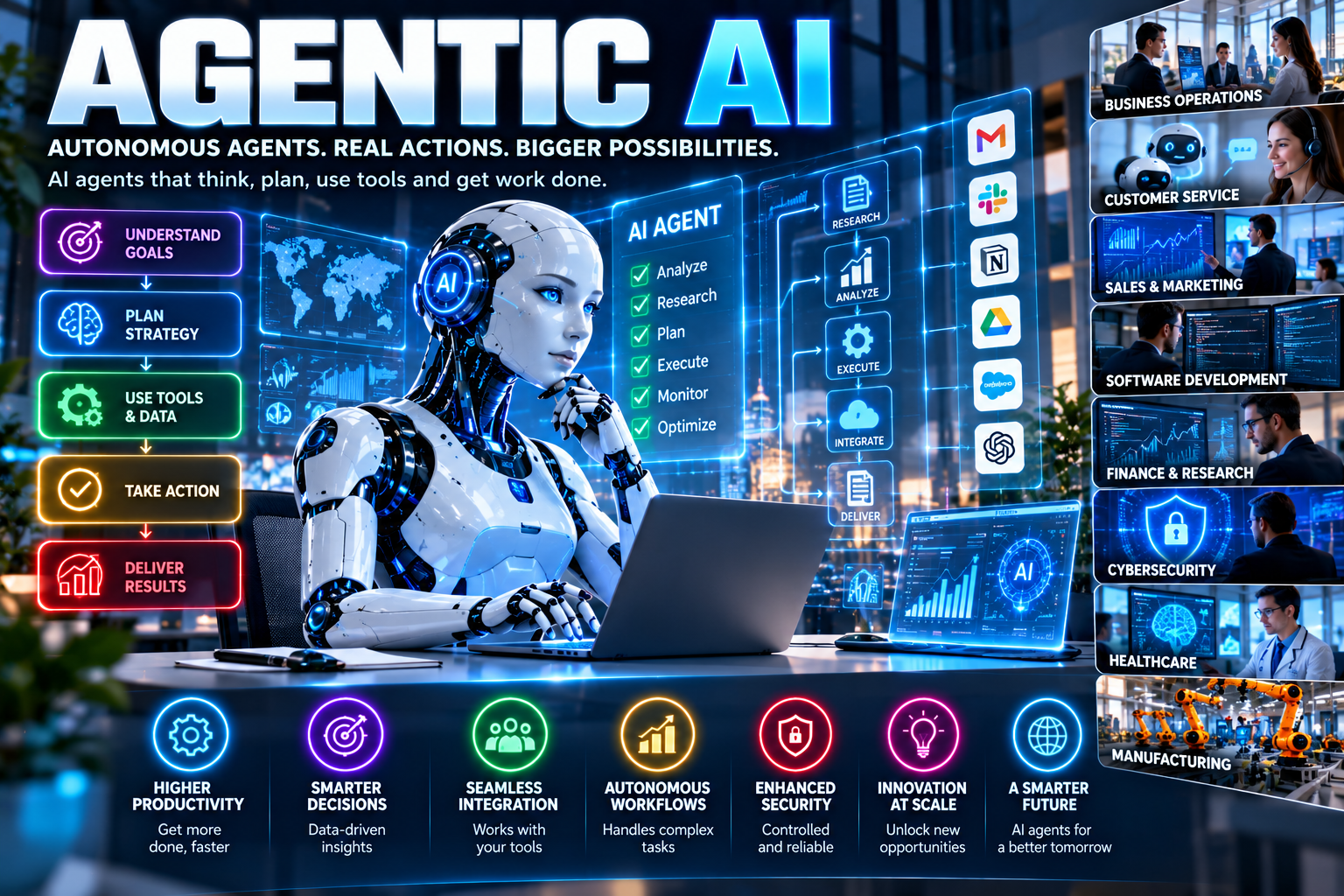
4. AI Agents and Intelligent Automation
The next stage of enterprise AI involves systems capable of handling multi-step tasks.
Traditional software typically follows predefined workflows.
AI agents can potentially interpret goals, analyze information, interact with software tools, and complete multiple steps with varying levels of human supervision.
Potential enterprise applications include:
Research assistants
Customer-service agents
Sales assistants
IT support agents
Coding agents
Financial analysis
Procurement
Workflow management
Cybersecurity operations
Internal knowledge management
However, organizations need appropriate access controls, monitoring, testing, and governance when AI systems are allowed to interact with business systems.
NIST's AI guidance emphasizes managing AI risks throughout the system lifecycle rather than treating risk management as a one-time activity.
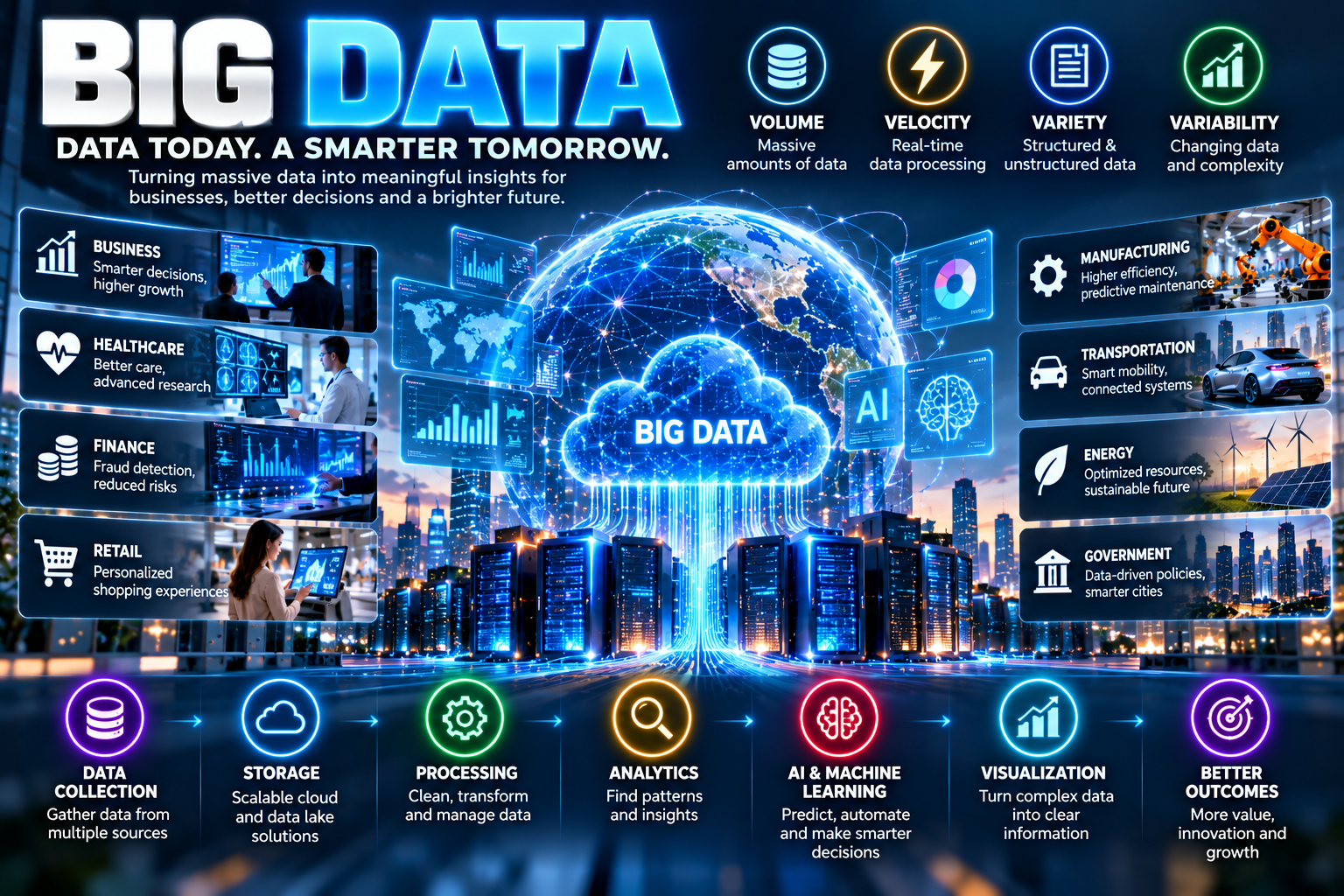
5. Big Data and Business Analytics
Modern organizations generate enormous amounts of data.
Sources include:
Customer transactions
Websites
Mobile applications
Enterprise software
IoT devices
Social media
Financial systems
Supply chains
Marketing platforms
Customer-support interactions
Enterprise analytics transforms this information into business insights.
Organizations can use:
Descriptive Analytics
What happened?
Diagnostic Analytics
Why did it happen?
Predictive Analytics
What could happen next?
Prescriptive Analytics
What actions could be considered?
Business intelligence dashboards can help executives monitor revenue, sales, costs, customer behavior, inventory, and operational performance.
6. Cybersecurity
Cybersecurity is a fundamental component of enterprise technology.
As organizations connect more applications, employees, devices, cloud platforms, suppliers, and customers, their digital attack surface can expand.
Enterprise cybersecurity includes:
Identity and access management
Multi-factor authentication
Endpoint security
Network security
Cloud security
Data protection
Encryption
Security monitoring
Vulnerability management
Incident response
Backup and recovery
Security awareness
NIST's Cybersecurity Framework 2.0 is designed to help organizations of different sizes and sectors manage cybersecurity risks. It organizes cybersecurity outcomes around six functions: Govern, Identify, Protect, Detect, Respond, and Recover.
NIST also published a 2026 quick-start guide connecting cybersecurity risk management with enterprise risk management and workforce management, highlighting the need for organizations to adapt continuously as threats and technologies evolve.
7. Enterprise Data Management
Data has become a strategic business resource.
Enterprise data management involves collecting, storing, organizing, protecting, integrating, and using information.
Important areas include:
Data governance
Data quality
Data integration
Data warehouses
Data lakes
Master data management
Data security
Data privacy
Metadata management
Data lifecycle management
Poor data can limit the effectiveness of AI and analytics.
For example, an organization may have an advanced AI model but receive unreliable results because its underlying customer or financial data is incomplete or inconsistent.
8. Internet of Things
The Internet of Things connects physical devices to networks and digital systems.
Enterprise IoT applications can include:
Manufacturing equipment
Smart buildings
Fleet management
Logistics
Healthcare devices
Energy systems
Agriculture
Retail sensors
Industrial monitoring
IoT can generate real-time information about physical operations.
When combined with cloud computing and AI, IoT systems can support predictive maintenance, automated monitoring, and operational optimization.
9. Automation and Robotics
Automation allows businesses to perform repetitive processes with limited manual intervention.
Examples include:
Automated invoice processing
Warehouse robotics
Payroll processing
Customer onboarding
Document classification
Inventory management
Software testing
Email processing
Manufacturing automation
Robotic process automation can automate structured digital tasks, while AI-powered automation can handle more complex and variable processes.
Enterprise Technology by Business Function
Enterprise technology supports almost every major department.
Finance
Technology can support:
Accounting
Financial reporting
Fraud detection
Forecasting
Budgeting
Payments
Expense management
Human Resources
HR technology can support:
Recruitment
Employee onboarding
Payroll
Workforce analytics
Training
Benefits administration
Employee communication
AI may also assist with administrative HR workflows, although organizations should consider privacy, fairness, transparency, and appropriate human oversight.
Marketing
Marketing technology can provide:
Customer analytics
Campaign automation
Personalization
Digital advertising
Content management
Social media management
Customer segmentation
Sales
Sales technology can include:
CRM systems
Lead management
Sales analytics
Automated outreach
Forecasting
Customer intelligence
AI sales assistants
Operations
Operational technology can help with:
Inventory
Procurement
Production
Logistics
Scheduling
Quality management
Process automation
Enterprise Technology and Customer Experience
Technology increasingly shapes the customer journey.
A modern customer may interact with a company through:
Search engines
Websites
Mobile applications
Chatbots
Social media
Digital payments
Customer portals
Email
Physical stores
Delivery platforms
Enterprise systems can connect these touchpoints.
For example, a customer might browse a product on a smartphone, place an order online, receive personalized recommendations, pay digitally, track delivery, and contact an AI-assisted support system.
Behind this experience may be dozens of connected enterprise applications.
Enterprise Technology and Remote Work
Cloud computing and collaboration software have changed how organizations operate.
Employees can use digital platforms for:
Video meetings
Messaging
Document collaboration
Project management
Cloud storage
Digital signatures
Workflow automation
Knowledge sharing
This allows organizations to support distributed teams while maintaining access to enterprise systems.
However, remote work also increases the importance of identity security, endpoint protection, access controls, and employee cybersecurity awareness.
Enterprise Technology and Supply Chains
Supply chains have become highly technology-driven.
Companies can use technology to monitor:
Suppliers
Inventory
Transportation
Warehouses
Production
Orders
Demand
Delivery
AI and analytics can help organizations identify patterns and forecast demand.
IoT devices can provide real-time information from warehouses, factories, vehicles, and other physical assets.
Cloud platforms can connect information across different parts of the supply chain.
The result can be greater visibility and faster responses to operational changes.
Technology Convergence in the Enterprise
Enterprise technology is increasingly moving toward technology convergence.
Instead of using AI, cloud computing, robotics, data analytics, and IoT as isolated systems, organizations are connecting them.
For example:
IoT sensors → Cloud infrastructure → Data platform → AI analytics → Automated decision → Robotic action
A manufacturing company could use sensors to monitor equipment, send information to cloud systems, use AI to identify abnormal patterns, and trigger maintenance workflows.
The World Economic Forum's 2026 technology-convergence report highlights the growing importance of combining technology domains such as AI, robotics, spatial intelligence, quantum technologies, advanced materials, and next-generation energy. It emphasizes that coordinating people, data, and workflows is important for turning combinations of technologies into practical results.
Enterprise Technology Challenges
Technology can create major opportunities, but enterprise implementation also involves significant challenges.
Legacy Infrastructure
Older systems may be difficult to integrate with modern applications.
Replacing them can be expensive and disruptive.
Cybersecurity
More connected systems can create additional security risks.
Organizations need security architecture that evolves alongside technology.
Data Silos
Departments may store information in separate systems.
This can make it difficult to obtain a complete view of customers, operations, or finances.
Skills Gaps
Organizations may need expertise in:
AI
Cloud
Data engineering
Cybersecurity
Automation
Software development
Enterprise architecture
High Costs
Enterprise technology can require significant investment in:
Software
Infrastructure
Employees
Training
Security
Integration
Consulting
Data migration
Change Management
Employees may struggle to adopt new technologies without adequate training and communication.
AI Governance
AI systems create additional considerations involving privacy, security, reliability, transparency, and accountability.
NIST's AI RMF is designed to help organizations incorporate trustworthiness considerations into AI development and use.
How to Build an Enterprise Technology Strategy
Organizations should avoid purchasing technology simply because it is popular.
A better approach is to connect technology investments with business objectives.
Step 1: Identify Business Priorities
Determine what the organization needs to improve.
Examples:
Reduce costs
Increase sales
Improve customer service
Improve security
Increase productivity
Reduce processing time
Step 2: Assess Current Technology
Review:
Applications
Infrastructure
Cloud systems
Data
Networks
Security
Legacy platforms
Step 3: Identify Technology Gaps
Determine where existing systems are preventing business improvements.
Step 4: Establish a Roadmap
Create short-term, medium-term, and long-term technology priorities.
Step 5: Prioritize High-Value Projects
Not every technology project needs to happen simultaneously.
Organizations can prioritize projects based on:
Business value
Cost
Risk
Complexity
Time to impact
Strategic importance
Step 6: Build Security Into the Architecture
Security should be considered from the beginning rather than added after implementation.
Step 7: Train Employees
Technology adoption requires people who understand how to use the systems effectively.
Step 8: Measure Results
Organizations can track:
Cost savings
Productivity
Revenue
Customer satisfaction
System availability
Processing time
Security incidents
Employee adoption
Return on investment
Enterprise Technology and Responsible AI
As AI becomes part of enterprise workflows, responsible deployment becomes increasingly important.
Organizations should consider:
Data privacy
Security
Model reliability
Bias
Transparency
Human oversight
Intellectual property
Access controls
Monitoring
Testing
NIST's AI RMF uses four core functions—Govern, Map, Measure, and Manage—to help organizations address AI risks.
The framework is voluntary and designed to be adaptable to different organizations and use cases.
For enterprises, AI governance should become part of broader technology and risk-management processes rather than operating as a completely separate activity.
The Future of Enterprise Technology
Enterprise technology is likely to become more intelligent, connected, automated, and integrated.
Several trends are shaping this future.
AI-Native Enterprise
Businesses will increasingly design workflows around AI rather than simply adding AI to older processes.
AI Agents
AI systems may increasingly perform multi-step tasks across enterprise applications.
Autonomous Operations
AI, automation, IoT, and robotics could increasingly work together to monitor and optimize physical and digital operations.
Cloud and Edge Computing
Organizations will combine centralized cloud resources with computing closer to devices and users.
Cybersecurity Automation
AI and automation will increasingly support security monitoring, detection, investigation, and response.
The World Economic Forum's 2026 cybersecurity research describes AI as having a dual role: it can strengthen defensive capabilities while also introducing new risks and opportunities for attackers.
Data-Centric Enterprises
Organizations will increasingly treat high-quality, well-governed data as foundational infrastructure for analytics and AI.
Technology Convergence
Multiple technologies will increasingly be combined into integrated systems instead of being deployed independently.
Enterprise Technology vs. Consumer Technology
Enterprise and consumer technology share many underlying technologies, but their requirements are different.
Area | Enterprise Technology | Consumer Technology |
|---|---|---|
Primary users | Businesses and organizations | Individuals |
Main objective | Business operations and productivity | Personal use and convenience |
Security | Strong organizational controls | Primarily user-focused |
Scale | Often thousands of users | Usually individual or household |
Integration | Multiple business systems | Usually simpler ecosystems |
Data | Business and operational data | Personal data |
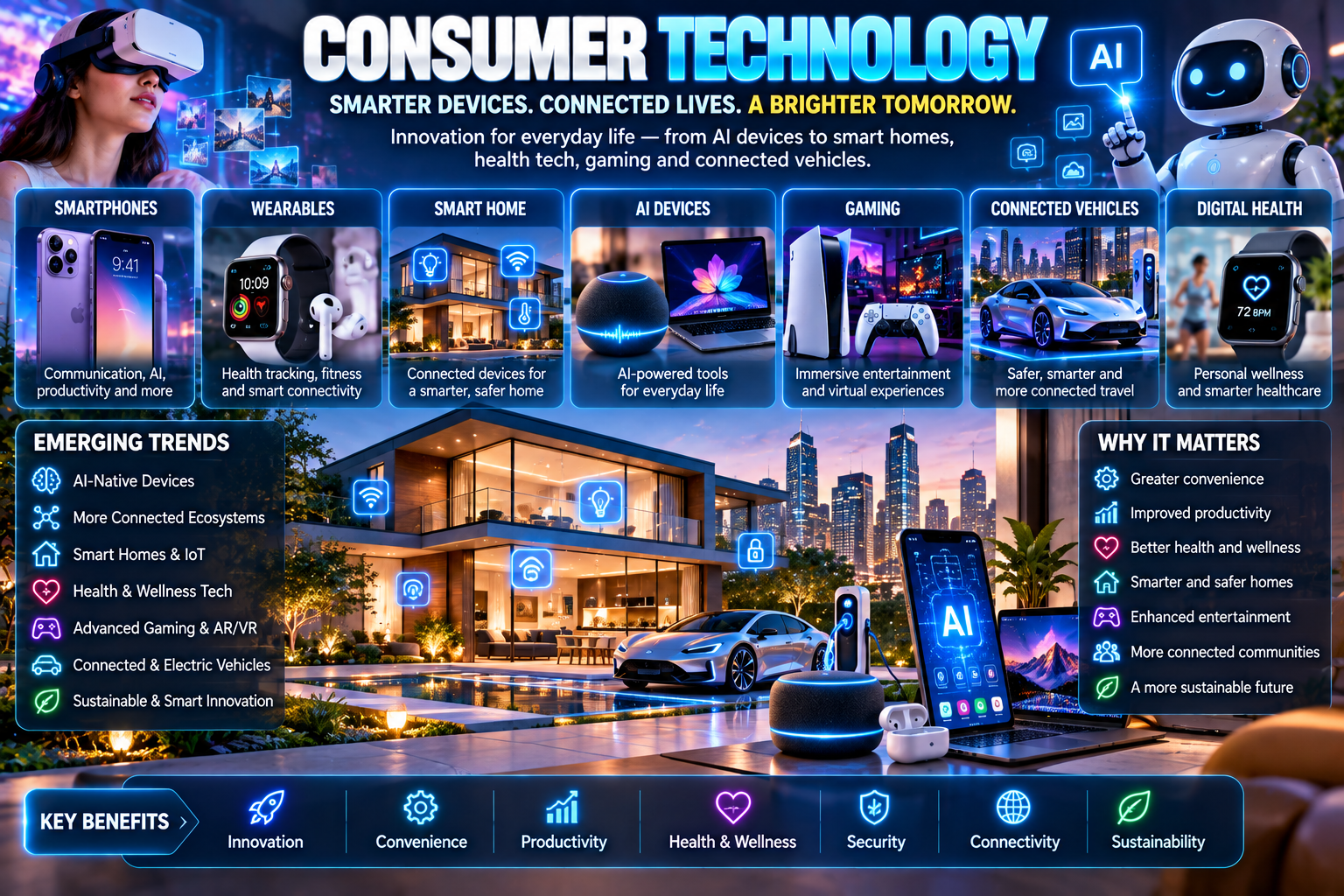
Examples | ERP, CRM, cloud platforms, SIEM | Smartphones, smartwatches, consumer apps |
The two categories increasingly overlap.
For example, AI assistants, cloud applications, collaboration platforms, smartphones, and cybersecurity technologies can be used by both consumers and enterprises.
Final Thoughts
Enterprise technology has evolved from traditional IT infrastructure into a broad ecosystem involving AI, cloud computing, Big Data, cybersecurity, automation, IoT, enterprise software, analytics, and digital platforms.
The most important objective is not to adopt every new technology. Instead, organizations need to identify where technology can solve meaningful business problems and create measurable value.
AI adoption is growing rapidly, cloud infrastructure continues to support digital operations, data is becoming increasingly important, and cybersecurity is becoming a core component of enterprise risk management.
At the same time, the convergence of AI, automation, data, cloud computing, robotics, and connected systems is creating new possibilities for enterprise operations.
Organizations that combine technology with strong strategy, skilled employees, reliable data, security, governance, and effective change management can build more adaptable digital businesses.
The future enterprise will increasingly be defined not by one technology, but by how effectively it connects people, data, software, infrastructure, and intelligent systems.
Frequently Asked Questions
What is enterprise technology?
Enterprise technology refers to the software, hardware, infrastructure, data systems, platforms, networks, and digital technologies organizations use to operate and achieve business goals.
What are examples of enterprise technology?
Examples include ERP, CRM, cloud computing, AI, cybersecurity, Big Data analytics, business intelligence, automation, IoT, data warehouses, collaboration software, and enterprise applications.
Why is AI important for enterprise technology?
AI can help organizations analyze information, automate processes, support employees, improve customer service, detect patterns, and create new digital products and services.
What is enterprise cloud computing?
Enterprise cloud computing involves using cloud infrastructure, platforms, applications, storage, databases, and computing resources to support business operations.
Is cybersecurity part of enterprise technology?
Yes. Cybersecurity is a fundamental component of enterprise technology because organizations must protect applications, data, devices, networks, identities, and cloud infrastructure.
What are the biggest enterprise technology challenges?
Common challenges include legacy systems, cybersecurity risks, high costs, data silos, integration problems, skills shortages, employee adoption, and AI governance.
How can companies start adopting enterprise technology?
Companies can begin by identifying business problems, assessing existing systems, defining measurable objectives, prioritizing high-value projects, establishing a technology roadmap, training employees, and measuring results.
What is the future of enterprise technology?
Future enterprise technology is likely to involve greater adoption of AI, AI agents, cloud and edge computing, intelligent automation, cybersecurity automation, IoT, data analytics, robotics, and technology convergence.