
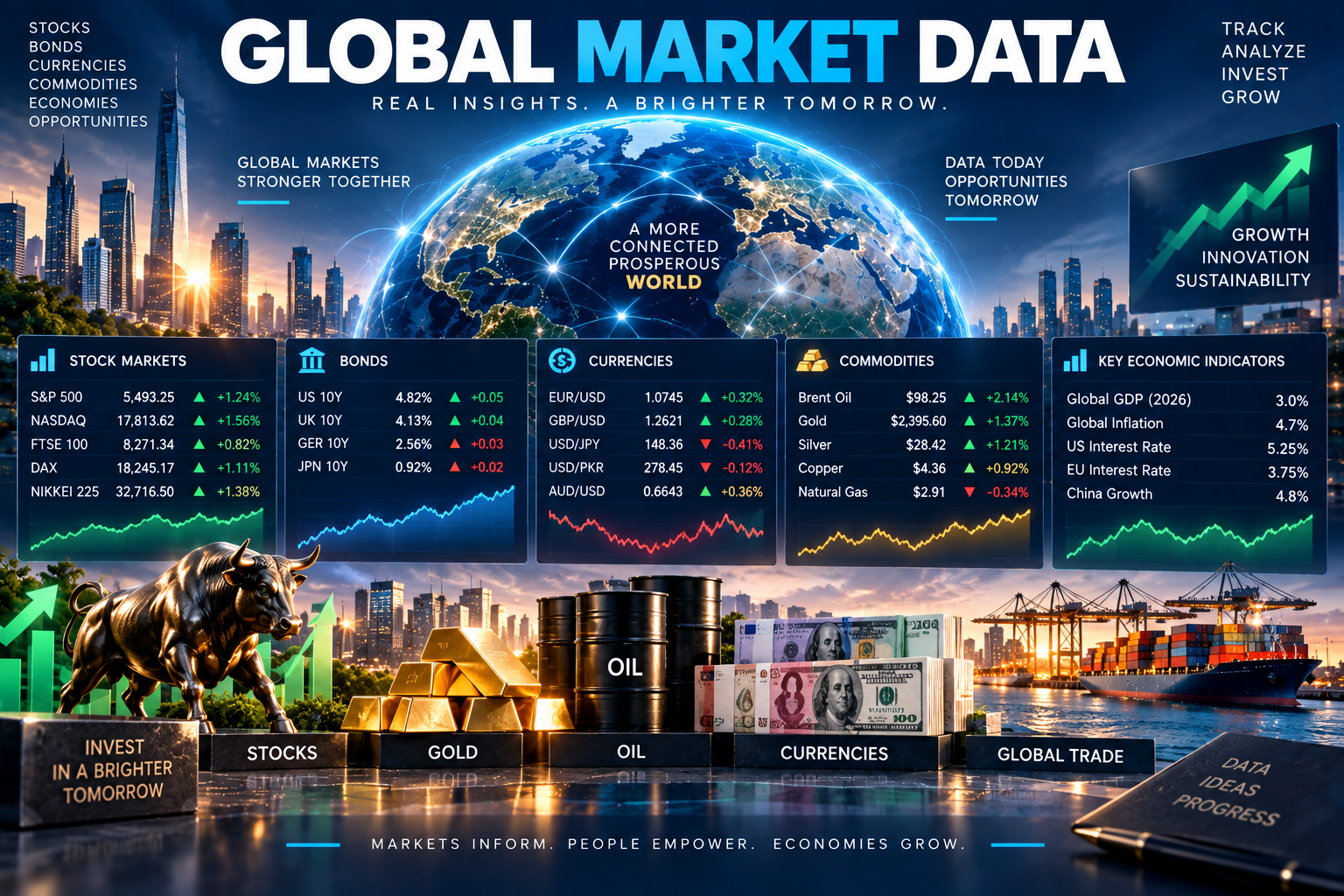
Global market data provides a real-time view of how the world's financial and economic systems are performing. It covers stock indexes, bond yields, currencies, commodities, interest rates, economic growth, inflation, and other indicators that help investors and businesses understand market conditions.
In 2026, global markets are being shaped by several competing forces. Artificial intelligence investment and resilient economic activity are supporting markets, while geopolitical conflict, higher energy prices, inflation concerns, government debt, and changing interest-rate expectations are creating volatility. The IMF projects global economic growth of 3.0% in 2026 and 3.4% in 2027, but describes the outlook as uneven.
What Is Global Market Data?
Global market data refers to financial and economic information collected from markets around the world. It helps investors evaluate current conditions and identify emerging trends.
Major categories include:
Global stock indexes
Government and corporate bond yields
Currency exchange rates
Commodity prices
Interest rates
Inflation data
GDP growth
Employment figures
Trade statistics
Market volatility
Emerging-market indicators
The World Bank's Global Economic Monitor, for example, tracks exchange rates, equity markets, interest rates, bond spreads, emerging-market bond indexes, consumer prices, industrial production, and merchandise trade. Its database was updated on September 8, 2026.
Global Stock Market Data
Stock markets are among the most closely watched sources of global market data.
Major benchmarks include the S&P 500 and Nasdaq in the United States, the STOXX Europe 600 in Europe, Japan's Nikkei 225, Hong Kong's Hang Seng Index, India's Nifty 50, and China's major equity indexes.
Stock-market performance reflects expectations about corporate earnings, economic growth, interest rates, inflation, consumer demand, and investor sentiment.
In September 2026, global equities have faced pressure from rising oil prices and geopolitical uncertainty. On September 8, the Dow Jones Industrial Average fell 1.18%, the S&P 500 declined 0.58%, and the Nasdaq Composite dropped 0.32%. MSCI's world stock index also fell 0.55%.
However, market performance has not been uniform. Technology and AI-related companies have continued to attract investor attention, particularly in Asian markets.
Bond Market Data
Bond markets provide important information about interest rates, inflation expectations, government finances, and investor risk appetite.
Government bond yields are particularly important because they influence borrowing costs throughout the economy.
In the United States, the 10-year Treasury yield was around 4.8% on September 8, 2026, close to its highest levels since late 2023.
Higher bond yields can increase borrowing costs for governments, businesses, and consumers. They can also affect stock valuations because investors may demand greater returns from equities when relatively safer bonds offer higher yields.
Bond-market data is therefore an important component of global market analysis.
Currency Market Data
Foreign exchange markets operate around the clock across major financial centers.
Currencies such as the U.S. dollar, euro, Japanese yen, British pound, Chinese yuan, Swiss franc, and Canadian dollar are closely monitored by investors and companies involved in international trade.
Exchange rates influence:
Import costs
Export competitiveness
International investment
Corporate earnings
Tourism
Inflation
Commodity prices
The Japanese yen has been particularly important in September 2026. The currency has strengthened sharply against the dollar as markets anticipate potential Bank of Japan rate increases and as investors reassess yen-funded trades.
Currency movements can also affect global stock markets because large multinational companies generate revenue in multiple currencies.
Commodity Market Data
Commodity prices provide insight into supply and demand across the global economy.
Important commodities include:
Crude oil
Natural gas
Gold
Copper
Silver
Wheat
Corn
Soybeans
Aluminum
Iron ore
Oil is especially important because it affects transportation, manufacturing, electricity generation, agriculture, and consumer prices.
As of September 9, 2026, Brent crude was approaching $100 per barrel, driven by escalating Middle East tensions and concerns about disruptions to energy supplies.
Higher energy prices can create challenges for oil-importing economies because they increase production and transportation costs. Energy exporters, however, may benefit from higher revenues.
Gold and Precious Metals
Gold is another important component of global market data.
Investors often view gold as a potential store of value during periods of economic or geopolitical uncertainty. Gold can also respond to changes in real interest rates, currency movements, inflation expectations, and central-bank demand.
When investors become concerned about financial stability or geopolitical risks, demand for gold may increase.
Precious-metals data therefore provides another perspective on investor sentiment.
Interest Rates and Central Banks
Central-bank decisions are among the most influential forces in global financial markets.
The Federal Reserve, European Central Bank, Bank of England, Bank of Japan, and other central banks use monetary policy to influence inflation and economic activity.
Markets closely follow:
Policy interest rates
Inflation forecasts
Employment data
Central-bank statements
Bond yields
Economic projections
In September 2026, investors are watching several major central banks simultaneously. The ECB is expected to raise rates, while markets are also assessing the likelihood of further Federal Reserve and Bank of Japan moves.
This divergence can produce significant movements in currencies, bonds, and equities.
Inflation Data
Inflation is one of the most important economic indicators in global markets.
When prices rise rapidly, central banks may keep interest rates higher for longer. This can reduce borrowing and investment while potentially slowing economic growth.
The IMF reported in July that global disinflation had stalled, with renewed conflict and energy pressures creating additional risks.
The recent increase in oil prices has reinforced these concerns. Higher energy costs can eventually spread through transportation, manufacturing, food production, and consumer goods.
Global Economic Growth
GDP growth provides an important measure of economic activity.
According to the IMF's July 2026 outlook, global growth is projected at 3.0% in 2026 and 3.4% in 2027. The organization notes that AI-driven demand is supporting economies integrated into global technology supply chains, while war-related energy shocks are hurting vulnerable economies and energy importers.
This divergence means global market data needs to be analyzed region by region.
The United States, Europe, China, Japan, India, Southeast Asia, Latin America, and Africa can all experience different economic conditions at the same time.
Artificial Intelligence and Global Markets
AI has become one of the most important investment themes in global markets.
Companies are investing heavily in:
AI chips
Data centers
Cloud computing
Software
Robotics
Cybersecurity
Energy infrastructure
Networking equipment
This investment is supporting demand across multiple industries.
Reuters reported in September that AI investment was one of the forces helping sustain global economic growth despite geopolitical and energy pressures. Copper prices have also surged, reflecting strong industrial demand and supply concerns.
However, AI-related investment also creates risks. High valuations, excessive capital spending, regulatory uncertainty, and expectations for rapid earnings growth could contribute to market volatility.
Emerging Market Data
Emerging markets represent an increasingly important part of the global financial system.
Countries such as India, Indonesia, Brazil, Mexico, South Africa, Vietnam, and other developing economies can offer investors exposure to expanding populations, consumer markets, infrastructure development, manufacturing, and technology.
However, emerging markets are often more sensitive to:
Dollar movements
Global interest rates
Commodity prices
Capital flows
Political developments
External debt
When U.S. interest rates rise, international investors may shift capital toward dollar-denominated assets, potentially putting pressure on emerging-market currencies and financial markets.
Global Trade Data
International trade is another important source of market information.
Trade data shows the flow of goods and services between countries and can reveal changes in consumer demand, industrial production, and supply chains.
Trade tensions and geopolitical disruptions can have major effects on global markets.
Businesses are increasingly focused not only on reducing costs but also on building more resilient supply chains. Companies may diversify suppliers, move production closer to major markets, or increase inventories of strategically important components.
Market Volatility
Market volatility measures how sharply asset prices move over time.
Periods of uncertainty can cause volatility to increase as investors react to economic data, geopolitical developments, interest-rate decisions, or unexpected corporate news.
In 2026, volatility has been influenced by oil prices, geopolitical tensions, central-bank policy expectations, bond yields, and currency movements.
The IMF's Global Markets Monitor noted that global equities and sovereign bonds experienced significant shifts as investors responded to central-bank commentary and higher energy prices.
Volatility can create both risks and opportunities, but investors should understand that large price movements can occur in both directions.
Global Market Data and Investment Decisions
Investors use market data to evaluate potential opportunities and manage risk.
For example, an investor may examine:
Stock data: to identify sectors with strong earnings growth.
Bond yields: to assess income opportunities and interest-rate expectations.
Currency data: to understand international investment risks.
Commodity prices: to evaluate inflation and economic activity.
Economic data: to assess the strength of different countries.
No single indicator provides a complete picture. Investors generally combine multiple sources of information before making decisions.
Risks in Global Markets
Global markets face several major risks in 2026.
Geopolitical Risk
Military conflicts can disrupt energy supplies, trade routes, financial markets, and investor confidence.
Inflation Risk
Higher energy and commodity prices could slow the decline in inflation and force central banks to maintain restrictive policies.
Interest-Rate Risk
Higher interest rates can increase borrowing costs and pressure asset valuations.
Debt Risk
High government debt can make economies more vulnerable to rising bond yields. Recent analysis has highlighted increasing debt-servicing pressures among major economies.
Currency Risk
Large exchange-rate movements can affect international portfolios and multinational companies.
Valuation Risk
Markets can become expensive when investors price in extremely optimistic expectations for earnings or economic growth.
The Future of Global Market Data
The importance of global market data is likely to increase as financial markets become more interconnected.
Artificial intelligence and advanced analytics are making it possible to process enormous quantities of financial and economic information faster than ever.
Real-time data can help investors monitor changes in:
Stock prices
Bond yields
Currency markets
Commodity prices
Economic indicators
Market sentiment
Global capital flows
At the same time, the growing volume of information creates a challenge: investors need to distinguish meaningful signals from short-term market noise.
What Investors Should Watch
Several indicators will remain particularly important during the remainder of 2026:
Oil prices — especially whether Brent remains near or above $100.
U.S. inflation — a major factor in Federal Reserve decisions.
Federal Reserve policy — important for global borrowing costs and currencies.
ECB policy — influential for European bonds and the euro.
Bank of Japan policy — particularly important for the yen and global carry trades.
AI investment — a major driver of technology spending and corporate earnings.
Bond yields — important for global valuations and government financing.
Global trade — critical for supply chains and manufacturing.
Emerging-market currencies — sensitive to dollar movements and capital flows.
Corporate earnings — essential for determining whether equity valuations are sustainable.
Conclusion
Global market data provides a comprehensive view of the forces influencing financial markets and the world economy. Stocks, bonds, currencies, commodities, interest rates, inflation, trade, and economic growth are all interconnected.
In 2026, the global market environment is being shaped by a combination of AI-driven investment, resilient economic activity, geopolitical conflict, elevated energy prices, inflation concerns, and changing monetary-policy expectations. The IMF continues to expect positive global growth, but emphasizes that the outlook remains uneven and vulnerable to renewed conflict and financial repricing.
For investors and businesses, monitoring global market data is essential for understanding changing opportunities and risks. The most useful approach is not to focus on one number, but to examine several indicators together and understand how they interact.
FAQs About Global Market Data
What is global market data?
Global market data is financial and economic information from markets around the world, including stocks, bonds, currencies, commodities, interest rates, inflation, and economic growth.
Why is global market data important?
It helps investors, businesses, and policymakers understand market conditions, identify trends, evaluate risks, and make informed decisions.
What are the most important global market indicators?
Major indicators include stock indexes, bond yields, exchange rates, oil and gold prices, inflation, GDP growth, employment data, and interest rates.
How does oil affect global markets?
Oil influences transportation, manufacturing, agriculture, inflation, and consumer spending. Large changes in oil prices can therefore affect stocks, bonds, currencies, and economic growth.
How does AI affect global markets?
AI is increasing investment in semiconductors, data centers, cloud computing, software, energy infrastructure, and automation, making technology an increasingly important driver of global market activity.
Where can investors find global market data?
Investors can use financial exchanges, central banks, economic institutions, market-data providers, and international organizations such as the World Bank and IMF. The World Bank's Global Economic Monitor provides regularly updated data covering major global economic and financial indicators.