
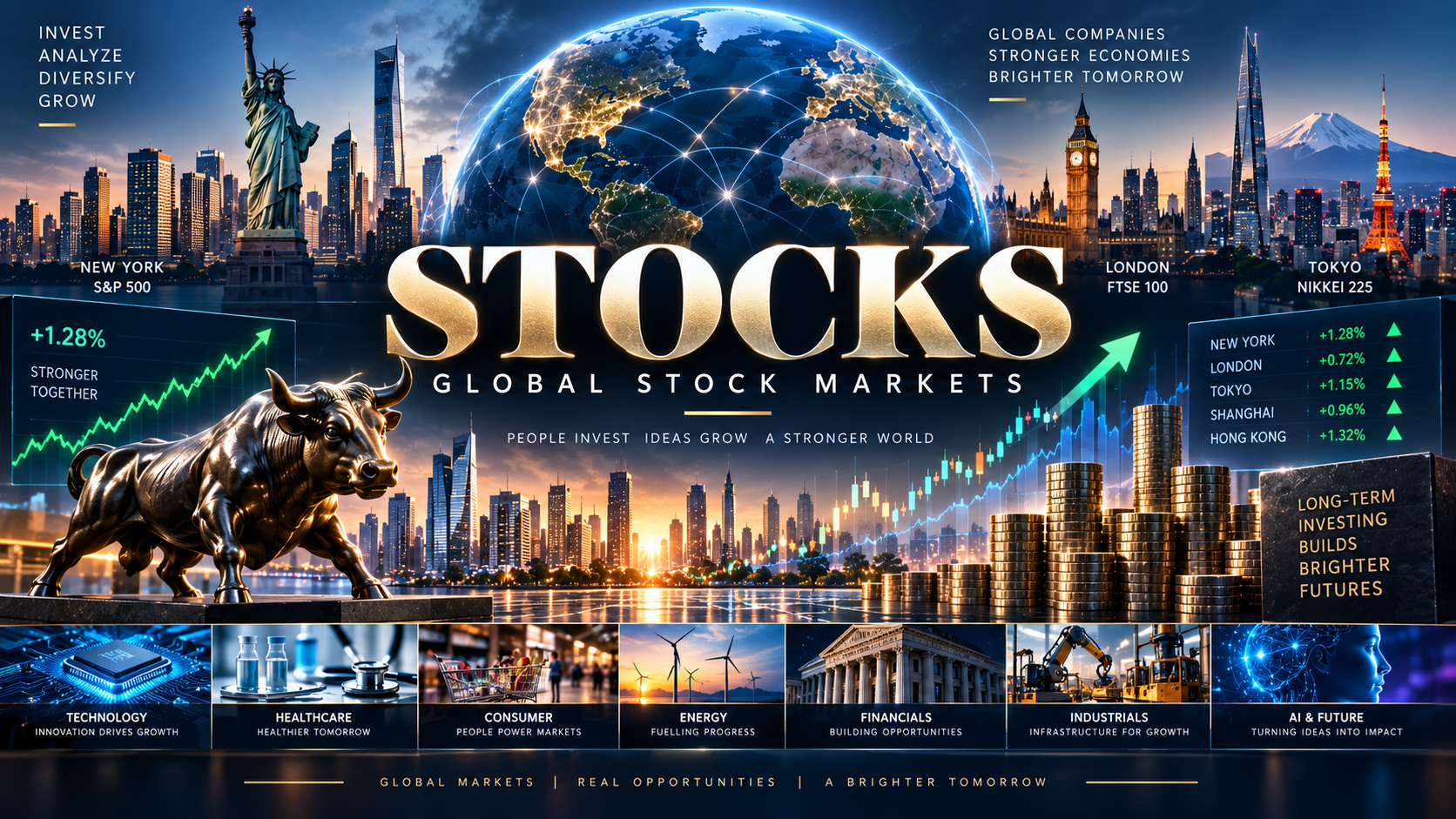
Stocks are one of the most important components of the global financial system. They allow investors to own a portion of a publicly traded company and potentially benefit from its growth through rising share prices and dividend payments.
For companies, issuing stocks provides a way to raise capital for expansion, research, acquisitions, technology, hiring, and other business activities. For investors, stocks can provide long-term opportunities for wealth creation, although they also carry market and company-specific risks.
In 2026, global stock markets are navigating a complicated environment. Strong corporate earnings, artificial intelligence investment, resilient economic activity, and rising capital expenditure are supporting equities, while inflation, interest-rate uncertainty, geopolitical tensions, elevated valuations, and higher energy prices are creating volatility.
What Are Stocks?
A stock represents an ownership interest in a company.
When a company becomes publicly traded, it can divide its ownership into shares and offer those shares to investors through a stock exchange. An investor who buys shares becomes a shareholder and may benefit if the company increases in value.
For example, if an investor purchases shares in a technology company and that company's earnings and future prospects improve, demand for its stock may increase. The share price could rise, creating a capital gain for the investor.
However, stock prices can also decline. Poor earnings, economic downturns, higher interest rates, management problems, competition, or unexpected events can negatively affect a company and its share price.
How Does the Stock Market Work?
The stock market is a network of exchanges, brokers, investors, companies, and financial institutions that facilitate the buying and selling of shares.
Major stock exchanges include the New York Stock Exchange, Nasdaq, London Stock Exchange, Tokyo Stock Exchange, Hong Kong Stock Exchange, Shanghai Stock Exchange, and many others.
Investors generally place orders through brokers or investment platforms. Buyers and sellers interact through the market, with prices changing according to supply and demand.
Stock prices can move every second during market hours because investors continuously respond to new information.
This information may include:
Corporate earnings
Economic data
Interest-rate decisions
Inflation reports
Company announcements
Mergers and acquisitions
Government policy
Geopolitical events
Commodity prices
Investor sentiment
Why Do Companies Issue Stocks?
Companies issue stocks primarily to raise capital.
A business can use the money raised through an initial public offering or subsequent share issuance to finance expansion without relying entirely on borrowing.
Companies may use equity capital to:
Build new facilities
Expand internationally
Develop new products
Invest in technology
Acquire other businesses
Hire employees
Reduce debt
Increase research and development
Unlike debt, equity financing does not generally require a company to repay the original capital on a fixed schedule.
However, issuing additional shares can dilute existing shareholders because ownership becomes divided among more shares.
Major Types of Stocks
There are many ways to categorize stocks.
Growth Stocks
Growth stocks are companies that investors expect to increase revenue and earnings rapidly.
Technology, artificial intelligence, biotechnology, and emerging consumer businesses can sometimes fall into this category.
Growth stocks can generate significant returns when expectations are met or exceeded, but they can also experience sharp declines when growth expectations weaken.
Value Stocks
Value stocks are companies that appear relatively inexpensive compared with measures such as earnings, cash flow, or book value.
Value investing focuses on finding businesses whose market prices may not fully reflect their underlying financial strength.
Dividend Stocks
Dividend stocks are shares of companies that regularly distribute part of their profits to shareholders.
They are often attractive to investors seeking income in addition to potential capital appreciation.
However, dividends are not guaranteed. Companies can reduce or eliminate payouts when financial conditions deteriorate.
Blue-Chip Stocks
Blue-chip stocks generally refer to large, established companies with strong market positions, substantial revenues, and long operating histories.
They may offer greater stability than smaller companies, although no stock is completely free from risk.
Small-Cap Stocks
Small-cap companies have relatively small market capitalizations compared with large corporations.
They can offer substantial growth opportunities but generally experience greater volatility and may have less financial strength or liquidity than larger businesses.
International Stocks
International stocks provide exposure to companies outside an investor's domestic market.
They can improve geographic diversification and provide access to different economic cycles, industries, currencies, and consumer markets.
However, international investments introduce additional currency, political, regulatory, and geopolitical risks.
Stock Market Indexes
Indexes are used to measure the performance of groups of stocks.
Some of the world's most closely watched indexes include:
S&P 500
Nasdaq Composite
Dow Jones Industrial Average
FTSE 100
DAX
CAC 40
Nikkei 225
Hang Seng Index
Shanghai Composite
Nifty 50
KOSPI
An index can provide a broad view of market performance without requiring investors to analyze every individual company.
Index-based funds and ETFs allow investors to gain exposure to these market benchmarks.
Stocks and the 2026 Market Environment
Global equities entered the second half of 2026 with strong support from corporate earnings and business investment, particularly investment connected to artificial intelligence and related infrastructure.
Charles Schwab's mid-year global equity outlook identified strong earnings and capital spending as important supports for equities but also warned about market concentration and inflation risks.
J.P. Morgan similarly described global growth as resilient and highlighted AI-driven capital spending as a major support for markets, while warning that the path for equities would likely be uneven.
More recently, however, markets have become more cautious.
On September 8, 2026, the Dow fell 1.18%, the S&P 500 declined 0.58%, and the Nasdaq Composite dropped 0.32% as investors responded to higher oil prices and geopolitical concerns.
The developments demonstrate how quickly stock-market sentiment can change even when corporate fundamentals remain relatively strong.
Artificial Intelligence and Stocks
Artificial intelligence has become one of the most important themes in global equity markets.
AI investment is creating demand for:
Semiconductors
Data centers
Cloud computing
Networking equipment
Software
Cybersecurity
Electricity
Energy infrastructure
Advanced manufacturing
Technology companies have benefited significantly from expectations of continued AI spending.
However, the concentration of market gains among a relatively small group of companies has also created a risk.
Schwab has warned that global earnings growth has become increasingly dependent on a smaller group of companies connected to AI capital expenditure.
This means investors may need to look beyond the most popular technology stocks and consider businesses that benefit indirectly from AI investment.
Energy companies, utilities, industrial firms, semiconductor suppliers, infrastructure businesses, and cybersecurity companies may all participate in the broader AI investment cycle.
Interest Rates and Stocks
Interest rates have a major influence on stock prices.
When interest rates rise, borrowing becomes more expensive for businesses and consumers. Higher rates can reduce corporate investment, increase financing costs, and lower the present value investors assign to future earnings.
Growth stocks can be particularly sensitive to higher rates because much of their expected value may depend on profits far into the future.
When rates decline, financial conditions generally become easier. Companies may borrow more cheaply, consumers may spend more, and investors may become more willing to hold riskier assets.
In 2026, rate expectations have become particularly important as inflation has re-emerged.
The IMF projects global headline inflation of 4.7% in 2026 and says the global disinflation trend has stalled.
This creates a difficult environment for equity investors because stronger inflation can limit central banks' ability to reduce interest rates.
Inflation and Stock Markets
Inflation affects stocks in several ways.
Companies may face higher costs for wages, energy, raw materials, transportation, and financing.
Some companies can pass those costs on to consumers through higher prices. Others may struggle to maintain profit margins.
Inflation can also influence consumer behavior. If household purchasing power declines, consumers may reduce spending on discretionary goods and services.
Companies with strong brands, pricing power, efficient operations, and strong balance sheets may be better positioned to manage inflationary pressures.
Oil Prices and Equities
Energy prices have become a significant factor for stock markets in 2026.
Brent crude moved close to $100 per barrel in September as Middle East tensions intensified. Higher oil prices have increased concerns about inflation and future interest-rate policy.
Higher oil prices can have mixed effects on stocks.
Energy producers may benefit from stronger revenues, while airlines, transportation companies, manufacturers, and other energy-intensive businesses may face higher costs.
For the broader market, the key question is whether higher energy prices remain temporary or become a persistent inflationary force.
Global Stocks and Geographic Diversification
Investors increasingly look beyond their domestic stock markets.
The United States remains a major center of global equity investment, but Europe, Japan, China, India, South Korea, Taiwan, Southeast Asia, Latin America, and other markets offer different opportunities.
Morgan Stanley's 2026 outlook argues that a balanced allocation across U.S., European, and Asian equities could potentially outperform a strategy concentrated entirely in U.S. stocks.
Different markets can perform differently because of variations in:
Economic growth
Interest rates
Currency movements
Valuations
Government policy
Corporate earnings
Demographics
Commodity exposure
Geographic diversification can therefore help investors reduce reliance on a single economy.
Stocks and Dividends
Dividends are payments companies make to shareholders from profits or accumulated cash.
Dividend-paying stocks can provide investors with a source of income while also offering potential capital appreciation.
Dividend strategies often focus on companies with:
Stable cash flow
Strong balance sheets
Sustainable payout ratios
Established business models
Long histories of shareholder distributions
However, investors should not select stocks based solely on dividend yield.
An unusually high yield can sometimes signal that the market expects the dividend to be reduced or that the company's share price has fallen because of underlying problems.
Fundamental Analysis
Fundamental analysis involves examining a company's financial health and business prospects.
Investors may study:
Revenue growth
Earnings
Profit margins
Cash flow
Debt
Return on equity
Valuation
Competitive advantages
Management
Industry conditions
A company with rapidly growing revenue but weak cash flow may have a different risk profile from an established company generating substantial free cash flow.
Fundamental analysis can help investors understand what they are actually buying rather than focusing only on share-price movements.
Technical Analysis
Technical analysis focuses primarily on historical price and trading-volume patterns.
Investors may examine:
Moving averages
Support and resistance
Momentum
Trading volume
Relative strength
Price patterns
Some traders use technical analysis for short-term decisions, while long-term investors may use it alongside fundamental research.
Neither approach guarantees successful investment results.
Stock Market Risks
Stocks offer long-term growth potential but carry several risks.
Market Risk
Broad economic or financial shocks can cause many stocks to decline simultaneously.
Company Risk
A company's share price can fall because of weak earnings, management problems, lawsuits, competition, or operational failures.
Valuation Risk
A strong company can still be a poor investment if investors pay an excessively high price for its shares.
Interest-Rate Risk
Higher borrowing costs can reduce economic activity and pressure equity valuations.
Geopolitical Risk
Wars, sanctions, tariffs, political instability, and trade disputes can affect companies and entire markets.
Concentration Risk
Holding too many investments in one sector, country, or theme can expose a portfolio to significant losses if that area underperforms.
Stocks vs. Bonds
Stocks and bonds play different roles in investment portfolios.
Stocks represent ownership in companies and generally offer greater long-term growth potential, but they can be volatile.
Bonds represent loans to governments or companies and generally provide interest income, although their prices can also fluctuate.
Some investors combine stocks and bonds to create a diversified portfolio.
The appropriate allocation depends on factors such as financial goals, investment horizon, income requirements, and tolerance for risk.
Stocks and ETFs
Investors do not have to select individual stocks.
Exchange-traded funds can provide exposure to groups of companies through a single investment.
An ETF might track:
A broad market index
A technology sector
Dividend stocks
International equities
Emerging markets
Small-cap companies
Clean energy
Healthcare
Financial companies
ETFs can make diversification easier and may reduce the company-specific risk associated with owning only a few individual stocks.
Long-Term Stock Investing
Historically, stocks have been an important tool for long-term wealth creation, but investors should be prepared for periods of substantial volatility.
A long-term strategy generally focuses on business fundamentals rather than reacting to every daily market movement.
Diversification, disciplined investing, realistic expectations, and appropriate risk management can help investors navigate different market cycles.
Dollar-cost averaging is another strategy some investors use, involving regular investments over time rather than attempting to predict the perfect market entry point.
What Investors Should Watch in 2026
Several factors are likely to influence stocks during the remainder of 2026.
Corporate earnings: Strong earnings can support stock valuations, while disappointing results can trigger declines.
AI investment: Continued spending on AI infrastructure could support technology and related industries.
Interest rates: Changes in Federal Reserve and other central-bank policy can influence valuations and investor sentiment.
Inflation: Persistent inflation could limit monetary easing and increase volatility.
Oil prices: Sustained high energy prices could pressure margins and consumer spending.
Geopolitics: Conflicts and trade restrictions can disrupt supply chains and markets.
Market concentration: Heavy reliance on a small number of large companies could increase vulnerability to sector-specific corrections.
Global growth: Strong economic activity can support corporate revenues and profits.
The Future of Stocks
The global stock market is likely to remain strongly influenced by technology, artificial intelligence, energy transformation, infrastructure, healthcare, financial services, and changing consumer behavior.
AI may continue to create new industries and improve productivity, but investors will increasingly focus on whether massive capital spending translates into sustainable earnings.
Energy and infrastructure could also become increasingly important as data centers, electrification, manufacturing, and economic development increase electricity demand.
At the same time, geopolitical fragmentation and higher government debt may create a more volatile investment environment.
BlackRock's 2026 equity outlook emphasizes that opportunities exist beyond the dominant AI theme, including areas of Asia and sectors connected to energy and infrastructure.
The future stock market is therefore unlikely to be defined by a single sector. Successful long-term investing may increasingly require diversification across companies, industries, countries, and investment themes.
Conclusion
Stocks remain one of the most important ways for investors to participate in economic growth.
They provide companies with capital while giving investors the opportunity to benefit from business expansion, rising share prices, and dividends.
In 2026, equities are being supported by strong earnings, resilient economic activity, AI investment, and increased capital spending. At the same time, inflation, higher energy prices, interest-rate uncertainty, geopolitical tensions, valuations, and market concentration are creating significant risks.
Investors should therefore look beyond short-term market movements and focus on diversification, valuation, company fundamentals, and long-term objectives.
Whether through individual stocks, ETFs, index funds, or diversified portfolios, stocks can remain an important component of long-term investing when matched with an appropriate level of risk.
FAQs About Stocks
What are stocks?
Stocks represent ownership interests in publicly traded companies. Investors can potentially earn returns through capital appreciation and dividends.
How does the stock market work?
Stock markets connect buyers and sellers of company shares. Prices change according to supply, demand, company performance, economic conditions, and investor expectations.
Are stocks a good investment?
Stocks can offer significant long-term growth potential, but they can also lose value. Whether they are appropriate depends on an investor's goals, time horizon, and risk tolerance.
What are growth stocks?
Growth stocks are shares of companies expected to increase revenue and earnings faster than the broader market or their industry.
What are dividend stocks?
Dividend stocks are shares of companies that distribute part of their profits or cash flow to shareholders through dividends.
How do interest rates affect stocks?
Higher interest rates can increase borrowing costs and reduce the present value of future earnings, potentially putting pressure on stock prices. Lower rates can provide a more supportive environment for equities.
What is a stock-market index?
A stock-market index tracks the performance of a group of stocks. Examples include the S&P 500, Nasdaq Composite, FTSE 100, DAX, Nikkei 225, and Nifty 50.
What is stock diversification?
Stock diversification involves spreading investments across different companies, sectors, industries, and geographic markets to reduce reliance on any single investment.
Can stocks lose all their value?
Yes. Individual companies can experience severe financial problems or bankruptcy, potentially causing shareholders to lose most or all of their investment. Diversification can help reduce this company-specific risk.
What should investors watch in 2026?
Investors should monitor corporate earnings, inflation, interest rates, oil prices, AI investment, economic growth, geopolitical developments, valuations, and market concentration.